Welcome to COSHH: Why This Matters
By the end of this module, you'll be able to:
- explain what COSHH covers and the three substances that fall under separate regulations (asbestos, lead and ionising radiation).
- identify the eight employer duties and the corresponding employee duties under COSHH Regulations 2002.
- recognise all groups who may be at risk from hazardous substances, including non-users, contractors and vulnerable workers.
The Invisible Epidemic in British Workplaces
Every year in the United Kingdom, an estimated 1.8 million workers suffer from a work-related illness. Of those, hundreds of thousands are made ill not by accidents, not by machinery, not by stress — but by something far quieter and far more insidious: the substances they handle, breathe in, or come into contact with every single working day.
The Health and Safety Executive (HSE) records around 12,000 deaths each year from past occupational lung disease and cancer each year linked to past exposures to hazardous substances at work. Twelve thousand. That is more than thirty deaths every single day in this country, traceable not to dramatic accidents but to the slow, accumulating damage caused by dusts, fumes, chemicals and biological agents. Many of these deaths are from cancers that developed decades after the exposure that caused them — workers who, in the 1970s, 80s and 90s, simply went to work and were quietly poisoned by what they breathed.
This is the reality COSHH exists to prevent. And it is the reason you are taking this course.
The Human Face of the Numbers
Statistics can numb us. So let us put faces to them.
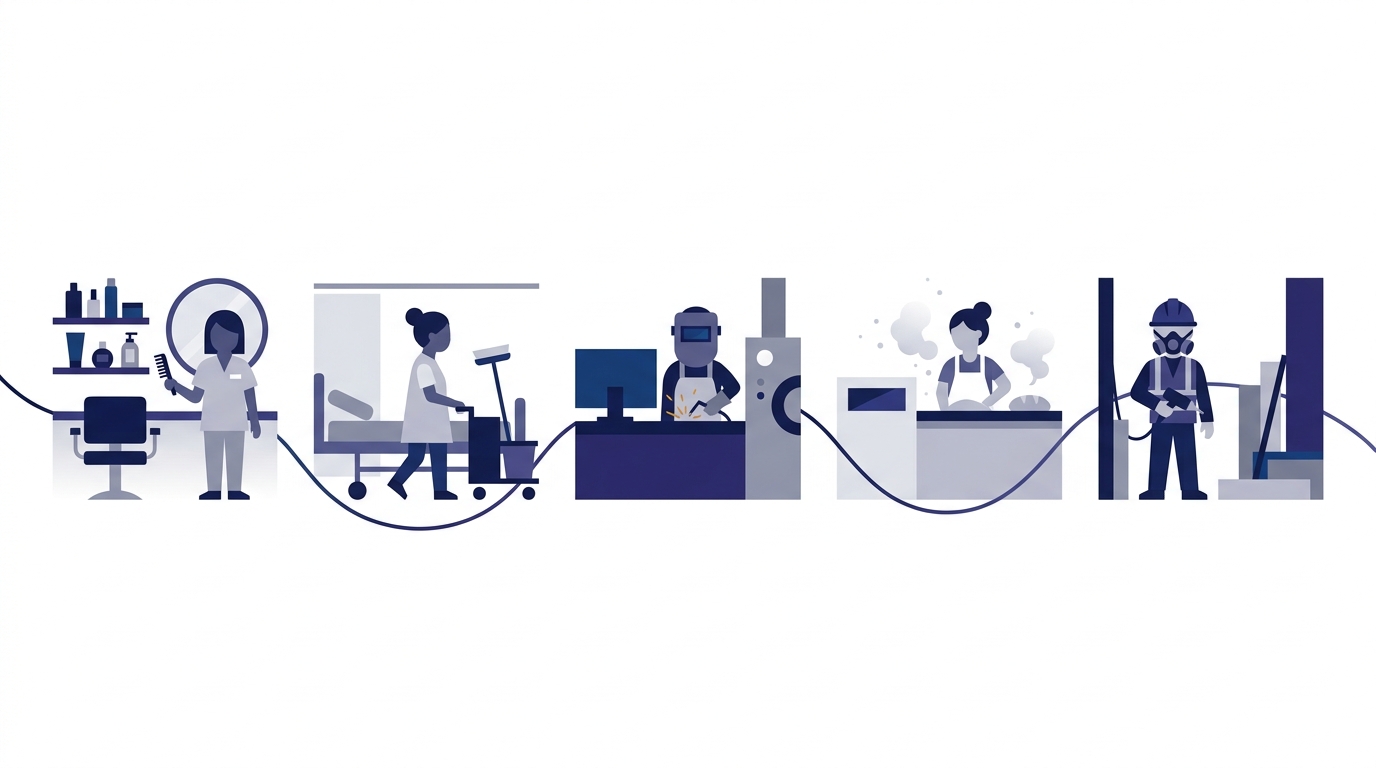
A baker in her forties develops a persistent cough. She has been kneading dough for two decades. The flour dust she once thought was harmless has, micron by micron, sensitised her airways. She now has occupational asthma. She will carry an inhaler for the rest of her life, and she can never return to the trade she loved.
A cleaner finds the skin on his hands cracking, weeping, refusing to heal. He has been using bleach and degreasers without gloves because nobody told him he needed them, and the gloves in the cupboard were the wrong size anyway. He has occupational contact dermatitis. Some mornings he cannot grip a mop.
A welder in his late fifties is told the shadow on his lung scan is mesothelioma. He spent the early years of his career grinding and welding without realising the metal fume he inhaled — and the asbestos lagging in the old factory — would, forty years later, end his life.
A care worker is splashed in the eye with an unlabelled liquid because a colleague decanted floor cleaner into an old lemonade bottle. The eye is saved. Her trust in the workplace is not.
These are not extreme or rare cases. They are the everyday casualties of an entirely preventable problem. And the law — backed by decades of scientific understanding — gives us the tools to stop them happening.
Almost every case of work-related ill health caused by hazardous substances is preventable. The hazards are known, the controls are known, and the law is clear. What is missing, when harm occurs, is almost always knowledge, attention or follow-through.
What This Course Is — and What It Will Do for You
Welcome to Level 2 COSHH: Mastering the Control of Substances Hazardous to Health. Over the next thirty lessons, you are going to move from a basic awareness of hazardous substances to a confident, working command of how to identify them, assess them, control them and respond when things go wrong.
This course is built on the Control of Substances Hazardous to Health Regulations 2002 — known universally as COSHH. These regulations are the cornerstone of British workplace chemical safety. They apply in every sector you can imagine: hospitals and hair salons, factories and farms, construction sites and care homes, laboratories and laundries, bakeries and breweries. If your work brings you within reach of a chemical, a dust, a fume, a vapour, a mist, a gas, a nanomaterial or a biological agent — COSHH applies to you.
What COSHH Covers
COSHH is broad on purpose. The regulations cover:
- Chemicals — solvents, acids, alkalis, cleaning products, paints, adhesives, pesticides and the thousands of formulated products in daily industrial use.
- Products containing chemicals — even seemingly innocuous items like printer inks, hair dyes, two-pack glues and resin systems.
- Fumes, dusts, vapours, mists and gases — the airborne by-products of cutting, grinding, welding, spraying, mixing and heating.
- Nanotechnology — ultra-fine engineered particles, a growing concern in modern manufacturing and research.
- Biological agents — bacteria, viruses, fungi and other micro-organisms encountered in healthcare, laboratories, farming, waste handling and sewage work.
What COSHH Does Not Cover
Three categories of hazard sit outside COSHH because they are governed by their own dedicated regulations:
- Asbestos — covered by the Control of Asbestos Regulations 2012.
- Lead — covered by the Control of Lead at Work Regulations 2002.
- Radioactive substances — covered by the Ionising Radiations Regulations 2017.
We will return to this important distinction in Lesson 3. For now, simply remember: if your workplace handles any of these three, additional law applies on top of everything you learn here.
How to use what you learn here
This course delivers the essential awareness and understanding required of every worker under COSHH. It is not a substitute for your workplace's own COSHH assessments, safe systems of work, or task-specific training. Your employer is legally required to provide site-specific instruction on the substances you actually handle, the controls in place for them, and the emergency procedures for your environment. Always treat workplace-specific guidance as the operational layer on top of the foundation you build here.
Why Knowledge Is the First Control
In the language of health and safety, we talk about a hierarchy of control — a structured order of preference for how we reduce risk. You will meet it formally in Section 6. At the top of that hierarchy is elimination: getting rid of the hazard entirely. Below that come substitution, engineering controls, administrative measures and finally personal protective equipment.
But there is something that sits behind every level of that hierarchy, something without which none of the controls work: knowledge. A worker who does not understand why a substance is dangerous will not use the extraction hood properly. A supervisor who cannot read a safety data sheet will not know what gloves to issue. A manager who cannot tell a hazard from a risk will not commission the right assessment. Knowledge is not a control measure on the official list — but every control measure depends on it.
That is what this course gives you.
The Journey Ahead — What You Will Be Able to Do
By the end of this course, you will be able to do all of the following with confidence:
- Recognise hazardous substances in any form — solid, liquid, gas, dust, fume, vapour, mist or biological agent — and understand how each form behaves in a workplace.
- Decode the labels on chemical containers — every pictogram, every signal word, every H-statement and P-statement under the CLP (Classification, Labelling and Packaging) regulation.
- Read and use a Safety Data Sheet — navigating all sixteen sections with confidence, knowing exactly where to find first-aid information, exposure limits, storage requirements and incompatibilities.
- Understand the four routes of entry — inhalation, skin absorption, ingestion and injection — and why each one demands a different control approach.
- Distinguish acute from chronic effects, and local from systemic harm — so you can spot the early warning signs of occupational disease in yourself and your colleagues.
- Conduct or contribute meaningfully to a five-step COSHH assessment, including the use of Workplace Exposure Limits (WELs).
- Apply the hierarchy of control appropriately — knowing why PPE is the last resort, not the first, and how to select engineering controls like Local Exhaust Ventilation.
- Select, wear, maintain and replace PPE and RPE, including understanding face-fit testing for respiratory protection.
- Understand exposure monitoring and health surveillance — what they are, when they are required, and what your rights are as a worker.
- Store hazardous substances safely and respond competently to spills, splashes and emergencies.
- Build a personal COSHH action plan for your own workplace — a practical tool you will take away in the final lesson.
That is a substantial body of capability. It is, in fact, the standard expected of any worker who handles hazardous substances under UK law — and it is the standard your employer is legally required to ensure you meet.
Why This Matters to Everyone, Not Just Safety Specialists
There is a temptation, in any organisation, to think of COSHH as somebody else's problem — the health and safety officer's, the line manager's, the compliance team's. This thinking is dangerous, and it is wrong.
The truth is that COSHH duties cascade. Employers must assess and control. But employees have legal duties too: to use the controls provided, to wear the PPE issued, to report defects and incidents, to follow safe systems of work, and to cooperate with health surveillance. A worker who unplugs an extraction hood because it is noisy, or who decants chemicals into drinks bottles for convenience, or who skips PPE because the job will only take a minute, is not just being careless — they are breaching their own legal obligations under the Health and Safety at Work etc. Act 1974 and the COSHH Regulations themselves.
And there is a second, more human reason this matters to everyone. The person most likely to be harmed by your inattention to COSHH is not the chief executive. It is you. It is the colleague next to you. It is the cleaner who comes in after you have left. It is the apprentice who watches what you do and learns whether shortcuts are acceptable.
COSHH knowledge is a duty of care to yourself, your colleagues and your future health.
The Business Case — Briefly
We have focused on the human cost, because that is where the moral weight lies. But it is worth noting that poor substance control is also catastrophic for businesses. HSE statistics suggest that work-related ill health costs the UK economy around £20 billion every year. Individual prosecutions for COSHH failures regularly result in fines of tens or hundreds of thousands of pounds, and in serious cases unlimited fines and custodial sentences for directors. Insurance premiums rise. Skilled workers are lost to ill-health retirement. Reputations, painstakingly built over decades, are destroyed in a single bad inspection or a single tragic case.
Good COSHH practice is not a cost. It is one of the highest-return investments any organisation can make.
The takeaway from Lesson 1
COSHH is not a niche concern for safety specialists. It is a shared responsibility that touches every worker, in every sector, every day. The substances on your shelf, the dust in your air, the fume from your process and the residue on your hands are all governed by it. By the end of this course, you will not just know the rules — you will understand why they exist, you will be able to apply them with judgement, and you will be equipped to protect yourself and the people around you from harm that is almost always preventable.
What's Next
In the next lesson, The COSHH Regulations 2002 Explained, we will open up the regulations themselves — what each part requires, what the key legal duties are, and how the framework hangs together. You will see exactly where the obligations sit, who owes them, and how enforcement works in practice. From there, we will build outwards: into what COSHH covers, who is at risk, the nature of hazardous substances, and the precise mechanisms by which they cause harm.
Take a moment, before you move on, to think about your own workplace. What substances do you handle, or sit near, in a typical week? What containers, what labels, what dusts or fumes or splashes? Hold those examples in your mind as we go. By the end of the course, every one of them will look different to you — and you will know exactly what to do about it.
Enjoyed this preview? Enrol to unlock all 40 lessons + your certificate.
Training a team? Buy seats for your team →