Welcome: You Are the Front Line
By the end of this module, you'll be able to:
- Explain why employees — not technology alone — are the primary line of defence against cyber attacks, citing the types of cost a UK organisation faces after a breach.
- Define the core cyber security terms (malware, ransomware, phishing, smishing, vishing, BEC) and use them accurately when reporting suspicious activity.
- Apply the Stop, Think, Check, Report habit to any unexpected or urgent digital request, identifying the emotional levers the message is pulling.
Welcome to the Human Firewall
Take a moment to picture the last time you checked your email at work. Maybe it was this morning. Perhaps there was a message from a supplier, a colleague asking for an urgent favour, a notification from a service you use, or a calendar invite from someone you didn't quite recognise. In that ordinary moment — coffee in hand, multiple browser tabs open, half-listening to a meeting — you were doing something extraordinary. You were standing on the front line of your organisation's cyber defences.
That isn't a dramatic flourish. It's how modern cyber security actually works. The firewalls, the antivirus software, the encrypted servers and the security operations centre dashboards are all doing their job behind the scenes. But the attackers know that breaking through those technical defences is hard, expensive and often noisy. So instead, they aim at something far easier to influence: the people who use the systems every day. People like you.
Welcome to Level 2 Cyber Security Awareness: The Human Firewall. Over the next 34 lessons, we're going to transform the way you see your inbox, your devices, your desk, your home office and even the car park outside your building. Not by turning you into a cyber security engineer — that isn't your job — but by giving you the situational awareness, vocabulary and reflexes of someone who genuinely understands how attacks work and how ordinary, alert behaviour stops them.
Who this course is for
This course is written for every person in a UK organisation who uses a computer, a phone or a network as part of their working day. That includes:
- Office staff, administrators and managers across any sector
- Frontline workers who use shared devices, kiosks or handhelds
- Hybrid and remote workers using home broadband and personal spaces
- Contractors, temps and volunteers with access to organisational data
- Senior leaders, who are increasingly the targets of the most sophisticated attacks
You don't need a technical background. You don't need to know what a packet is, or how DNS works, or what makes one encryption algorithm better than another. If you can use email, browse the web and log into your work systems, you have everything you need to succeed here.
What you'll be able to do by the end
By the time you finish the final capstone, you will be able to:
- Recognise the most common attack techniques used against UK workers today — from phishing emails and smishing texts to physical tailgating and rogue USB drives.
- Respond calmly and correctly when something looks wrong, using a simple four-step approach: Stop, Think, Check, Report.
- Protect your accounts with strong, unique credentials, password managers and multi-factor authentication that actually works.
- Handle personal and confidential data in a way that respects UK GDPR, including the 72-hour breach notification rule.
- Operate securely in any environment — the office, a café, a train, your kitchen table — without falling for the convenience traps that attackers exploit.
- Report incidents quickly and honestly, knowing that early disclosure is always better than a cover-up.
That's a meaningful list. Master it, and you genuinely will be the human firewall this course is named after.
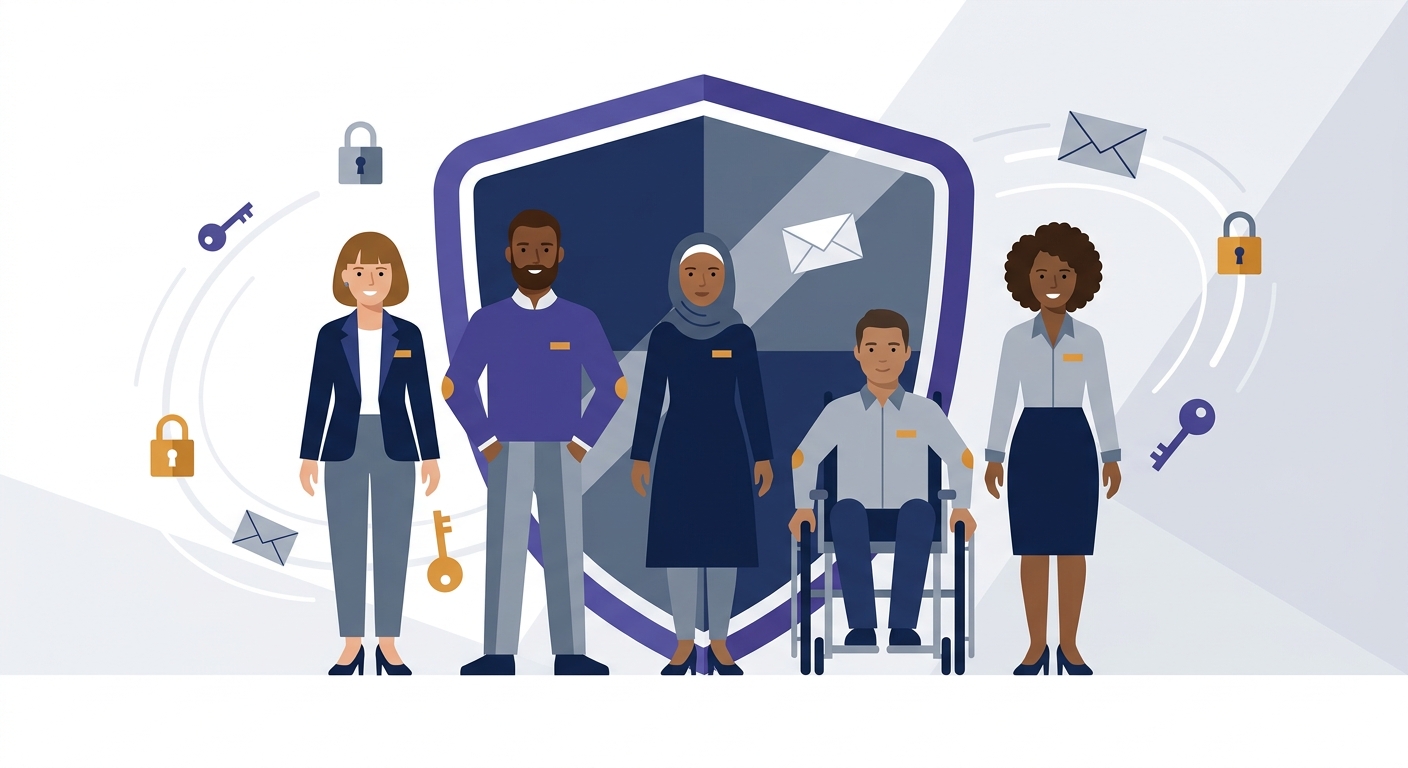
You can buy the best locks in the world, but if someone inside opens the door, the locks don't matter. In cyber security, every employee holds a key.
Why people, not just technology, are the front line
For decades, the cyber security industry sold a comforting story: buy the right products, and you'll be safe. Install the firewall. Run the antivirus. Patch the servers. Tick the boxes. That story was never completely true, and today it is dangerously incomplete.
Year after year, the UK government's Cyber Security Breaches Survey tells the same story. The overwhelming majority of successful attacks on UK organisations begin not with a technical exploit, but with a human being doing something entirely reasonable in the moment: clicking a link, opening an attachment, approving a payment, helping a stranger who seemed to belong, or reusing a password that had quietly been stolen years earlier.
This isn't because people are foolish. It's because attackers have become extraordinarily skilled at engineering situations where the wrong action feels like the right one. A finance assistant who pays a fraudulent invoice didn't fail an IQ test — they were targeted with a convincing message, at a busy moment, that mimicked a real supplier they recognised. A manager who approved a suspicious login wasn't careless — they were bombarded with multi-factor authentication prompts until clicking 'Approve' felt like the only way to make it stop.
This is why we call you the front line. Not because the technology has failed, but because the technology can only do so much. The decisive moment in almost every modern attack happens in a human mind — yours, a colleague's, a supplier's — in the seconds between noticing something and acting on it. That moment is where this course lives.
The shift in mindset
To be effective, you don't need to become paranoid. Paranoia is exhausting and, ironically, unhelpful — people who distrust everything quickly stop distrusting anything. What you need instead is a small, sustainable shift in how you process the everyday digital signals around you.
We'll build that mindset gradually across the course, but its core is simple:
- Stop before you act on anything that creates urgency, fear, curiosity or flattery.
- Think about whether the request makes sense in context — does this person normally ask me this, in this way, at this time?
- Check using a separate, trusted channel if you have any doubt. A two-minute phone call has saved organisations millions.
- Report anything suspicious, even if you've already clicked. Especially if you've already clicked.
You'll meet this four-step pattern again in Lesson 4 of this section, and you'll practise it in scenario workshops throughout the course. By the end, it should feel as automatic as looking both ways before crossing the road.
What this course is — and what it isn't
It's worth being honest about the boundaries of awareness training, because clarity here will save you frustration later.
Awareness training vs technical controls
Your organisation runs two parallel programmes of cyber defence, and they're designed to support each other.
The first is technical controls: the firewalls, email filters, endpoint protection, identity management systems, backup regimes, vulnerability scanning and incident response platforms run by your IT or security team (or an outsourced provider). These are the engineered defences. They block the vast majority of attacks before you ever see them. They are not your responsibility, and you don't need to understand how they work in detail.
The second is human awareness: the knowledge, habits and reflexes that allow people across the organisation to recognise and respond appropriately to the attacks that slip through, or that target humans directly. That is what this course addresses. It is not a substitute for the technical controls — it sits on top of them, closing the gap that no piece of software can fully close.
Think of it like road safety. Cars now have airbags, ABS, lane assist and automatic emergency braking. These technical controls save lives every day. But we still teach drivers to look in their mirrors, leave a safe gap and avoid using their phone at the wheel — because no amount of engineering removes the need for an alert human in the seat. Cyber security is exactly the same.
Your organisation's policies come first
This course teaches you the underlying principles and patterns that apply across UK workplaces. It draws on guidance from the National Cyber Security Centre (NCSC), the Information Commissioner's Office (ICO) and established international standards. But every organisation also has its own specific policies — about which tools to use, how to report incidents, what data classifications mean in your context, who to contact when something goes wrong, and what the consequences of a serious breach might be.
Where this course and your organisation's policies disagree, your organisation's policies always win. If your employer says 'never use personal email for work documents', that rule applies even if a lesson here discusses scenarios involving personal email. If your incident response procedure says 'phone the IT service desk on a specific number', that is the route to use — not a generic email address mentioned in a video.
So as you work through the course, keep two questions in mind:
- What does this lesson teach me about how attackers and defenders behave in general?
- How does this map onto my specific organisation's tools, policies and people?
If you don't know the answer to the second question for any topic — passwords, reporting, data handling, remote working — that gap is itself a useful finding. Note it down and check with your manager or IT team. Closing those gaps is part of becoming a genuinely capable human firewall.
How the course is structured
We've organised the 34 lessons into eight sections that build on each other:
- Section 1 sets the stage: why this matters, what it costs, the threat landscape and the core mindset.
- Sections 2 to 4 dive into the three big technical-but-human threats: phishing and social engineering, passwords and authentication, malware and ransomware.
- Sections 5 to 7 cover the practical environments in which you work: devices, networks, data, remote working and physical security.
- Section 8 brings it all together with incident response, scenario workshops and a capstone that confirms your readiness.
Each lesson is short, focused and designed to leave you with something you can apply the same day. The very next lesson — The Real Cost of a Cyber Incident — looks at what actually happens to UK organisations when defences fail, drawing on real cases. It's a sobering but motivating reminder of why your attention here matters.
Key takeaway: security is a habit, not a one-off lesson
Cyber security isn't a course you complete and tick off — it's a set of small habits you practise every working day. Reading a suspicious email twice before clicking. Pausing before approving an MFA prompt. Locking your screen when you stand up. Reporting the thing that felt 'a bit off' rather than hoping it was nothing.
None of these habits are difficult on their own. What makes them powerful is doing them consistently, especially when you're busy, tired or distracted — because those are exactly the moments attackers are counting on.
Treat this course as the beginning of a practice, not the completion of a task.
A final word before we begin
You may have arrived at this course feeling that cyber security is someone else's problem — IT's problem, the security team's problem, the problem of whoever wrote that long policy document you skimmed when you joined. That's an understandable position, and it's also the single most useful belief an attacker could hope you held.
The truth is that every successful attack on a UK organisation in the last year passed through, or aimed at, ordinary people doing ordinary jobs. And every unsuccessful attack — the ones you'll never read about in the news — was stopped somewhere along the way by someone who noticed, paused, checked or reported. Those people weren't security specialists. They were colleagues, just like you, who had learned to spot the patterns we're about to explore together.
By the end of this course, you'll be one of them. Let's begin.
Enjoyed this preview? Enrol to unlock all 44 lessons + your certificate.
Training a team? Buy seats for your team →