The Language of Food Safety: Essential Terminology
Why words matter in food safety
Every profession has its own vocabulary, and food safety is no exception. The difference between a kitchen that simply thinks it is safe and one that demonstrably is safe often comes down to whether the team shares a precise, common language. When an Environmental Health Officer asks you to identify the hazards in your kitchen, when your manager writes a HACCP plan, when a colleague warns you that a dish is 'high-risk' — these are not loose, interchangeable words. Each has a specific technical meaning, and each is woven into the legislation, the inspection regime and the international standards that govern how food is produced in the United Kingdom.
This lesson is short, but it is one of the most important in the entire course. Without these terms, the rest of what we cover — bacterial growth, temperature control, allergen management, HACCP — will feel like a fog of jargon. With them, every later lesson clicks into place. Think of this lesson as the operating manual for the language you will hear every day in a professional kitchen. Take the time to learn these words properly now, and you will think more clearly, communicate more accurately, and act more decisively for the rest of your career.
There is a deeper reason too. Food safety law in the UK is built on a small number of core concepts: hazard, risk, control, contamination, due diligence. Regulators, courts and auditors use these words in their strict technical sense. If you confuse 'hazard' with 'risk' in a tribunal, you will lose the argument. If you describe something as 'high-risk food' when you mean something else, your records may not stand up to scrutiny. Precise language is not pedantry — it is professional protection.
The essential vocabulary, defined
Let's work through each term in turn. Read the definition, then read the catering example that follows it. The example is where the definition comes to life.
Food safety (and food hygiene)
Food safety means all the practices and conditions necessary to make sure that the food we prepare and serve will not cause harm or illness. 'Food hygiene' is often used interchangeably, although strictly speaking hygiene refers to the cleanliness practices that contribute to safety. In practice, when the law, the FSA and your employer talk about food safety, they mean the entire chain of activity from the moment a delivery arrives at the back door to the moment a plate is set down in front of a customer — and beyond, to how leftovers are cooled, stored and reused.
Catering example: a chef checking the core temperature of a roast chicken with a probe, a kitchen porter sanitising a chopping board, and a waiter asking a customer about allergies are all doing food safety. None of these tasks is optional; each is part of the same system.
Contamination
Contamination is the presence in food of any unwanted or harmful substance. There are four recognised types, and you must learn all four:
- Microbiological (biological) — harmful bacteria, viruses, moulds or parasites.
- Physical — foreign objects such as glass, metal, plastic, hair, jewellery, blue plasters or fragments of packaging.
- Chemical — cleaning chemicals, pesticides, machine oil, descaler residue or toxic metals leaching from damaged equipment.
- Allergenic — proteins from one of the 14 named allergens entering a dish that was supposed to be free of them.
Catering example: if a chef uses the same unwashed knife to cut raw chicken and then to slice cooked ham, the cooked ham is now microbiologically contaminated — even though it looks identical to the slice next to it.
Hazard
A hazard is anything that could cause harm to the consumer. Notice the word could. A hazard is a source of potential harm; it exists whether or not it is currently doing damage. The four food safety hazards correspond directly to the four types of contamination: microbiological, physical, chemical and allergenic.
Catering example: a glass jug stored above a worktop is a physical hazard. Salmonella in a tray of raw chicken is a microbiological hazard. A bottle of degreaser stored on a shelf above an open container of flour is a chemical hazard. A bowl of peanuts in a kitchen that also produces 'nut-free' desserts is an allergenic hazard.
Risk
Risk is the likelihood that a hazard will actually cause harm, often combined with how serious that harm would be. This is the term most often confused with hazard, and the confusion is professionally costly. Hazard is the what; risk is the how likely and how bad.
Consider two kitchens. Both contain raw chicken — the hazard is identical. In Kitchen A, the chicken is stored at 3 °C on the bottom shelf of a dedicated raw-meat fridge, handled with colour-coded boards, and cooked to a verified 75 °C. In Kitchen B, the chicken sits in a warm prep area for two hours, is cut on the same board as the salad, and is served pink in the centre. Same hazard. Wildly different risk.
This distinction is the engine of HACCP. We cannot eliminate every hazard from a working kitchen — raw meat, hot oil, knives, allergens and chemicals all have to be there. What we can do is reduce the risk that those hazards reach the customer as harm.
Control measure
A control measure is any action or activity used to prevent, eliminate or reduce a hazard to a safe level. Cooking to 75 °C is a control measure. Washing your hands is a control measure. Storing raw meat below ready-to-eat food is a control measure. So is checking deliveries, calibrating probes, labelling allergen-containing dishes, and excluding sick staff from work.
Catering example: the hazard of Salmonella on raw chicken is controlled by (a) refrigeration below 5 °C to prevent multiplication, (b) separation from ready-to-eat foods to prevent cross-contamination, and (c) thorough cooking to destroy the bacteria. Three layered control measures, each addressing the same hazard in a different way. This is how robust food safety is built — in layers, not in single defences.
Food poisoning
Food poisoning is illness caused by eating food contaminated with harmful bacteria, their toxins, viruses, or chemical or physical contaminants. It is a broad, everyday term that covers everything from a mild upset stomach to fatal kidney failure.
Foodborne illness (foodborne disease)
Foodborne illness is the more precise medical term for illness caused by pathogenic micro-organisms carried by food. Campylobacter infection is technically a foodborne illness rather than classical food poisoning, because the bacterium itself colonises the gut rather than producing a toxin in the food. In practice, the two terms are often used together. What matters is that you understand both are caused by something the customer ate — and both are preventable.
Food allergy
A food allergy is an adverse immune-system reaction to a specific food protein. It is not the same as food intolerance (which is uncomfortable but not immune-mediated) and it is not the same as food poisoning. A severe allergic reaction — anaphylaxis — can kill within minutes, and unlike most food poisoning cases, the dose required can be vanishingly small. A trace of peanut protein on a poorly washed utensil has been enough to kill people.
High-risk food
High-risk foods are ready-to-eat foods that support the growth of bacteria and require refrigerated storage because they will receive no further cooking before being eaten. The category includes cooked meat and poultry, dairy products, cooked rice and pasta, prepared salads, sandwiches, cream cakes, cooked shellfish, pâté, quiches and gravies.
The phrase trips many learners up. 'High-risk' here does not mean 'dangerous'; it means 'capable of supporting bacterial growth and intended to be eaten without further cooking'. A raw chicken breast is hazardous but it is not high-risk in the technical sense, because we know it must be cooked. A bowl of cooked rice in a buffet, by contrast, is unambiguously high-risk: it is moist, neutral in pH, protein-rich, sitting in the danger zone, and about to go straight onto a plate.
HACCP
HACCP stands for Hazard Analysis and Critical Control Points. It is the internationally recognised system for managing food safety by systematically identifying hazards at every step of a process and controlling them at the points where control is most critical. UK law requires every food business to operate a food safety management system based on HACCP principles. For most small caterers, this takes the form of the Food Standards Agency's Safer Food, Better Business pack, which translates HACCP into plain-English daily procedures and diary records.
HACCP is examined in depth in Section 9 of this course. For now, lock in this idea: HACCP is the framework that ties every other word in this lesson together. It identifies hazards, evaluates the risk, specifies control measures, and produces the records that prove due diligence.
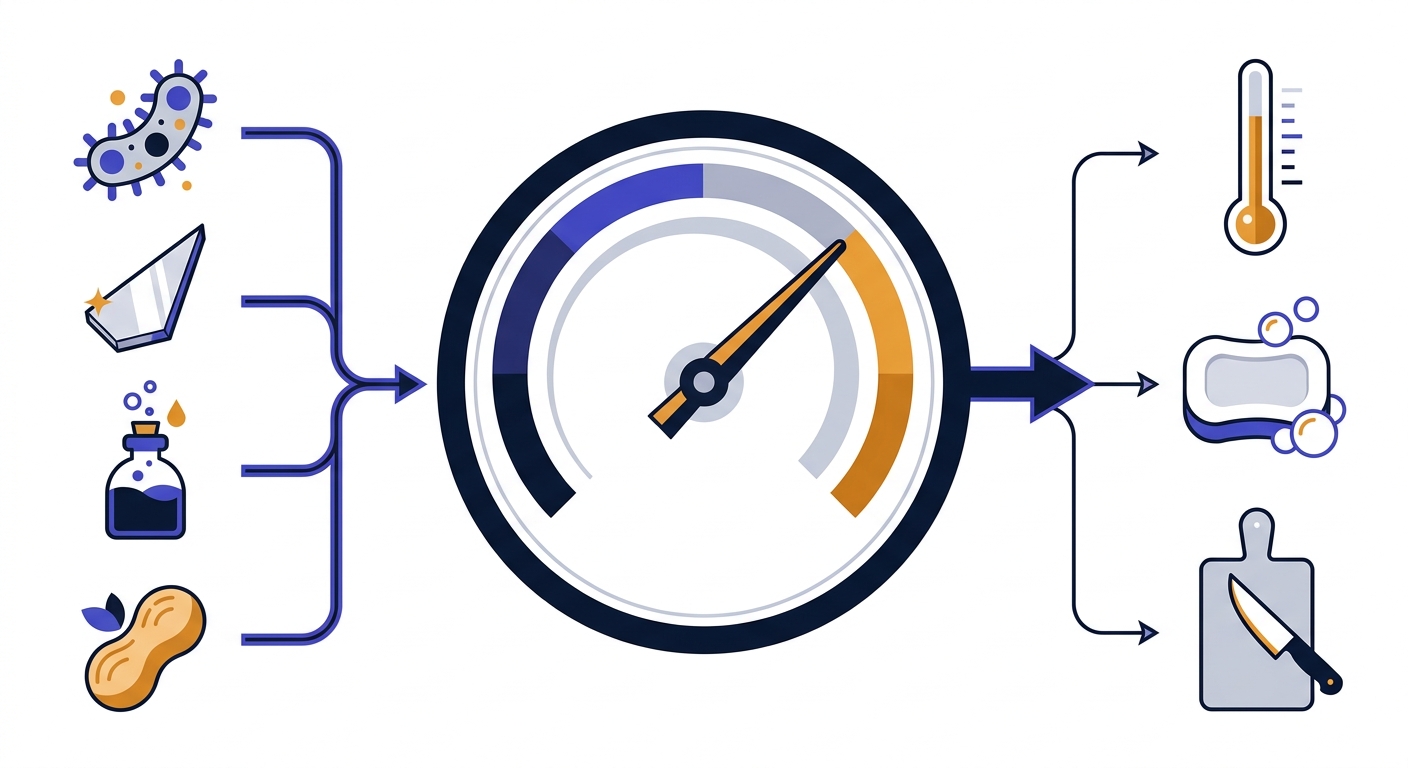
Understanding the difference between hazard and risk lets you prioritise your actions and put the most effort where the danger is greatest.
Putting the language to work
Notice how the terms are not isolated definitions — they fit together as a single thinking process. Walk through any kitchen task in your head and you can narrate it in this vocabulary:
- Identify the hazard. What could cause harm here? (Raw chicken — microbiological hazard, Salmonella and Campylobacter.)
- Assess the risk. How likely is this hazard to harm the customer, and how severe would it be? (High likelihood without controls; severe, potentially fatal in vulnerable groups.)
- Apply control measures. What will I do to prevent, eliminate or reduce this risk? (Separation, refrigeration, thorough cooking to 75 °C, hand-washing afterwards.)
- Record what I did. Did I check the temperature? Did I write it down at the time? (Due diligence in action.)
This four-step pattern — hazard, risk, control, record — is the silent grammar of every food safety conversation in the industry. Auditors will use it. EHOs will use it. Your HACCP plan is structured around it. The more naturally you can think in this pattern, the more confident and competent you will become.
A note on related terms you will meet
Two further terms deserve a brief mention here, even though they belong properly to later lessons:
- Cross-contamination — the transfer of bacteria, allergens or other contaminants from one food, surface, or person to another. It is the single most common route by which raw-food hazards reach ready-to-eat food.
- Due diligence — the legal defence available to a business that can prove it took all reasonable precautions to avoid an offence. In practice, due diligence means documented procedures and honest, real-time records. The phrase 'we always do it' is worthless in court; a signed temperature log is gold.
Exercise: hazard, risk and control
Read each scenario below and, in your own words, identify (a) the hazard, (b) why the risk is high or low in this situation, and (c) one suitable control measure. Write your answers down before checking your reasoning with a colleague or trainer.
- A tray of raw diced chicken is left uncovered on a prep bench at 22 °C for ninety minutes while the chef takes a break.
- A 5-litre container of catering-strength sanitiser is stored on a shelf directly above an open sack of self-raising flour.
- A salad bar contains a bowl of cooked rice salad that was prepared at 9 a.m. and is still on display, unrefrigerated, at 2 p.m.
- A pastry chef uses the same piping bag for a buttercream containing hazelnut praline and, after a quick rinse, for a 'nut-free' birthday cake for a child with a known nut allergy.
- A glass measuring jug with a small chip on the rim is being used to portion soup into takeaway containers.
Hint: in each case, name the type of hazard (microbiological, physical, chemical or allergenic), then explain what makes the risk high — and finally describe the single most effective control measure you would put in place.
Why this vocabulary will repay your effort
You are not learning these words to pass a test and then forget them. You are learning them because they are the tools you will use, every shift, for the rest of your catering career. When a new colleague asks you why raw chicken has to go on the bottom shelf, you will not say 'because the rules say so' — you will explain the hazard, the cross-contamination risk and the control measure, and they will understand. When an inspector asks how your business manages allergens, your manager will not stumble — they will point to the hazard analysis, the control measures and the records. When something goes wrong, as it occasionally will, you will be able to describe what happened in language that protects you, your colleagues and your business.
In the next lesson we move from language to law: the legal framework that turns these definitions into binding obligations on every food business in the United Kingdom. You will see the same vocabulary reappear — hazard, control, due diligence, HACCP — written into statutes and regulations. Master it now, and the law will read like a familiar map rather than a foreign code.
Key takeaway
Precise language enables precise action. The four pillars to lock in from this lesson are:
- Hazard = anything that could cause harm (the four types: microbiological, physical, chemical, allergenic).
- Risk = how likely that hazard is to cause harm, and how serious it would be.
- Control measure = the action that prevents, eliminates or reduces the risk.
- High-risk food = ready-to-eat food that supports bacterial growth and will not be cooked again.
If you can apply these four ideas to any situation in your kitchen, you are already thinking like a food safety professional.
Enjoyed this preview? Enrol to unlock all 51 lessons + your certificate.
Training a team? Buy seats for your team →