The Language of Infection: Key Terms Defined
Words Are Tools — Use Them Precisely
In infection prevention and control, language is not decoration. It is a working tool, as functional as a pair of gloves or a sharps bin. When you tell a colleague that a resident is colonised with MRSA rather than infected, you are not splitting hairs — you are triggering a different clinical response, a different conversation with the family, and a different entry in the care plan. When you write that a surface is contaminated, you are telling the next person who reads your note exactly what action to take, and what action not to take.
This precision matters because IPC operates on the edges of risk. A vague word — "dirty", "unwell", "a bit of a bug" — invites a vague response. A precise word draws a clear line: this is the hazard, this is the route it travels, this is what we do about it. Every regulator, inspector, coroner and court that reviews care documentation reads it through the lens of these terms. So do the GPs, infection control nurses and public health teams you may need to call.
This lesson builds your fluency in the foundational vocabulary of IPC. By the end, you will be able to distinguish a micro-organism from a pathogen, contamination from colonisation, colonisation from infection, and a community infection from a healthcare-associated one. You will be able to use these words in a handover, a body map, an incident form or a phone call with confidence — and to challenge their misuse when you hear it.
The Microbial World: Micro-organisms and Pathogens
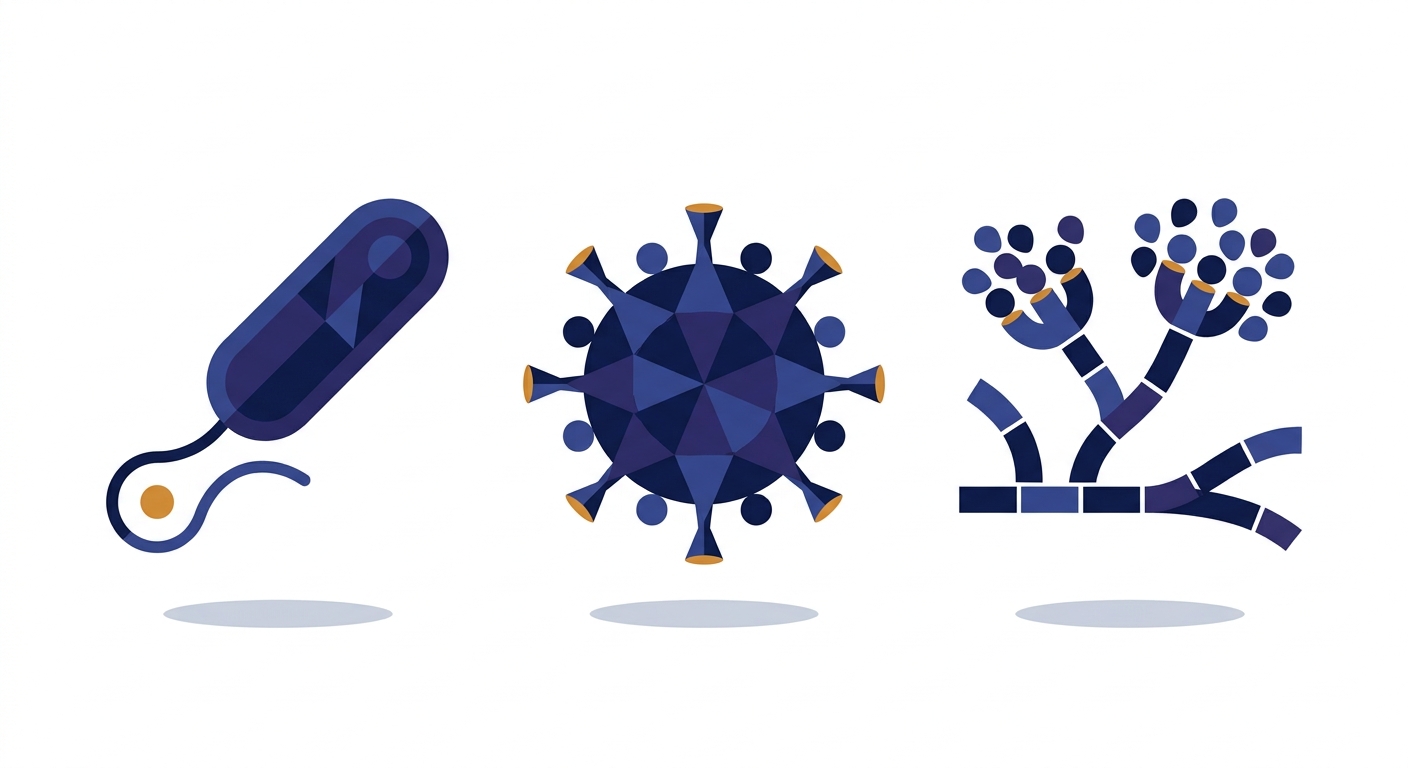
A micro-organism (sometimes shortened to microbe) is any living thing too small to see with the naked eye. The category is enormous and includes bacteria, viruses, fungi, protozoa and prions. Most micro-organisms are not only harmless — they are essential. The human gut contains trillions of bacteria that help us digest food, produce vitamins and train our immune system. The skin, mouth, nose and bowel each host their own microbial communities, collectively called the microbiome. Without these organisms, we would not survive.
A pathogen is a micro-organism capable of causing disease. The distinction is critical: all pathogens are micro-organisms, but only a minority of micro-organisms are pathogens. When we talk about IPC, we are almost always talking about pathogens — the small subset of microbes that can make people ill. Some organisms are pathogens in every circumstance (the measles virus, for instance). Others are opportunistic pathogens — harmless in their usual home but dangerous if they move somewhere else, or if the person they live on becomes vulnerable. Staphylococcus aureus, for example, lives quite happily in the nose of around a third of the population. It only becomes a pathogen when it reaches a wound, a catheter or the bloodstream.
Bacteria
Bacteria are single-celled organisms that can live almost anywhere — soil, water, skin, the inside of the gut. They reproduce by dividing, often very quickly. Some bacteria cause disease through the damage they do to tissue (such as Streptococcus in a throat infection), while others release toxins (such as Clostridioides difficile, which produces toxins that inflame the bowel). Crucially, bacteria can be treated with antibiotics — but only bacteria. Antibiotics have no effect on viruses, and over-using them drives antimicrobial resistance, the subject of our next lesson.
Examples you will meet in your work include MRSA (meticillin-resistant Staphylococcus aureus), E. coli, C. difficile, and the various organisms responsible for urinary tract infections and pneumonia.
Viruses
Viruses are far smaller than bacteria and are not, strictly speaking, alive in the way bacteria are. They cannot reproduce on their own — they must invade a living cell and hijack its machinery to make copies of themselves. This is why viral illnesses spread quickly through closed environments such as care homes, nurseries and dental waiting rooms: a single infected cell can produce thousands of viral particles, each capable of infecting another host.
Antibiotics do not work on viruses. A small number of antiviral medicines exist for specific viruses (influenza, HIV, hepatitis, COVID-19), but for most viral infections the body must fight them off on its own, with rest, hydration and time. Examples relevant to your practice include norovirus, influenza, COVID-19, respiratory syncytial virus (RSV) and the bloodborne viruses hepatitis B, hepatitis C and HIV.
Fungi
Fungi include yeasts and moulds. Most fungal infections encountered in care settings are superficial — affecting skin, nails or mucous membranes. Candida (thrush) is the most common example, often appearing in the mouth, skin folds or genital area, especially in people taking antibiotics, those with diabetes or those whose immune system is weakened. Fungal infections of the feet (athlete's foot) and nails (onychomycosis) are common in older adults. Serious systemic fungal infections do occur, but usually only in severely immunocompromised people.
And a quick word on protozoa and prions
You will encounter these less often, but for completeness: protozoa are single-celled parasites (causing illnesses such as malaria and giardiasis), and prions are misfolded proteins — not strictly micro-organisms at all — responsible for rare but devastating conditions like Creutzfeldt-Jakob disease. Prions are particularly important in dental and surgical instrument decontamination because they survive normal sterilisation.
Three Words That Sound Similar and Mean Very Different Things
If there is one set of distinctions worth committing to memory, it is this one. Contamination, colonisation and infection sit on a progression — each describes a different relationship between micro-organisms and a host or surface, and each demands a different response.
Think of it as a guest analogy. Imagine your home as the body or environment, and a micro-organism as a visitor.
Contamination — the visitor on the doorstep
Contamination means that micro-organisms are present on a surface, object or person, but they are not growing or causing harm. The doorbell has rung; the visitor is on the step. They have not come in, they have not unpacked, they have not made themselves at home. A door handle touched by someone with a cold is contaminated. A pair of gloves that has touched a wound is contaminated. A clean uniform that brushes against a soiled bedrail is contaminated.
Contamination is the everyday reality of any care or workplace environment. It is not a failure — it is a constant condition that we manage through cleaning, hand hygiene and the safe disposal of waste. The danger of contamination is what it can lead to: if a contaminated hand touches a mouth, a wound or another person, the organisms have moved one step further along the chain.
Colonisation — the visitor moves in
Colonisation means that micro-organisms have settled on or in the body and are multiplying, but they are not causing illness or any signs of disease. The visitor has come in, put their bags down and started living in the spare room. They are not damaging the furniture. They are just there.
Many of us are colonised with potentially dangerous organisms right now. As mentioned earlier, around a third of healthy adults carry Staphylococcus aureus in their nose without any problem. Some people carry MRSA on their skin or in their nostrils for months or years with no symptoms. Their bodies are not under attack — they are simply hosting an organism that could, in different circumstances, cause harm. People who are colonised are usually well, do not feel ill, and do not need antibiotics. But they can pass the organism to others, who may be more vulnerable.
Infection — the visitor causes harm
Infection means the organism is multiplying and causing damage — provoking an immune response, producing signs and symptoms of illness. The visitor has stopped being a guest and started breaking things. There is fever, redness, swelling, pain, discharge, cough, diarrhoea, confusion in older adults — the body is responding.
Infection is what IPC exists to prevent. It is also what triggers a different chain of action: clinical assessment, possibly antibiotics or antivirals, isolation precautions, notification, contact tracing and review of what went wrong.
The progression — contamination, colonisation, infection — is not always linear or inevitable. Many contamination events are interrupted by cleaning or hand hygiene before they go any further. Many colonisations never become infections. But understanding where on the spectrum a situation sits tells you precisely what you need to do next.
Worked example: Mrs Patel and the difference a word makes
Mrs Patel, an 84-year-old resident in your care home, has a positive MRSA swab from her left nostril. She has no symptoms — she eats well, has no fever, no redness anywhere, no wounds. This is colonisation. Your response: standard precautions, meticulous hand hygiene, careful with shared equipment, possibly decolonisation treatment as prescribed by the GP. She continues to enjoy communal activities. The care plan documents her status clearly.
Six weeks later, Mrs Patel develops a pressure ulcer on her sacrum. The wound becomes red, hot, swollen, and produces pus. A swab confirms MRSA. This is now infection. Your response changes: the wound needs clinical review and likely antibiotics, dressings are managed with additional precautions, the room and equipment receive enhanced cleaning, you document the change in status, you notify the appropriate clinicians, and you review whether anything in her care contributed. Same organism, same resident — completely different clinical picture, completely different actions.
This is why the words matter. Calling colonisation an "infection" leads to unnecessary antibiotic prescriptions (driving resistance). Calling an infection "just colonisation" delays treatment and risks deterioration.
Healthcare-Associated Infections (HCAIs)
A healthcare-associated infection — abbreviated to HCAI, and sometimes called a nosocomial infection in older textbooks — is an infection that a person acquires as a result of receiving care. The standard definition used in the UK is an infection that develops during, or as a direct result of, healthcare that was not present or incubating when the care began. Generally, infections appearing more than 48 hours after admission to a care setting, or within a defined period after discharge or after a procedure, are classified as HCAIs.
The phrase "healthcare-associated" is broader than many people assume. It does not mean "hospital-acquired". An HCAI can be acquired in:
- A hospital ward, intensive care unit, or theatre
- A care home or nursing home
- A dental practice
- A GP surgery or community clinic
- A patient's own home, during a visit by a community nurse or carer
- An outpatient department, dialysis unit or day surgery
- An ambulance or patient transport vehicle
The common factor is that the infection arose in connection with the delivery of care, not from the person's ordinary life in the community. If a resident in your care home develops a UTI after catheterisation, that is an HCAI. If a dental patient develops an infection at the site of an extraction performed in a poorly decontaminated chair, that is an HCAI. If a district nurse transmits norovirus between two housebound clients on the same morning round, the second person's illness is an HCAI.
Why HCAIs matter so much
HCAIs cause a staggering amount of preventable harm. UK estimates suggest that around 300,000 patients a year acquire an HCAI in NHS hospitals alone, contributing to thousands of deaths and costing the health service over £1 billion annually. The figures for care homes and community settings are less comprehensively tracked but are believed to be substantial — and rising, as more complex care is delivered outside hospitals.
The human cost is harder to quantify but more important. An HCAI can mean a longer stay, a slower recovery, the loss of independence, the loss of confidence in services, and sometimes the loss of life. For an older person, a urinary tract infection acquired through poor catheter care can be the start of a cascade — delirium, falls, immobility, decline — that ends in a way no one foresaw when the catheter was inserted.
The common HCAIs you will hear about repeatedly are:
- Urinary tract infections (UTIs), often associated with catheter use
- Respiratory tract infections, including hospital-acquired pneumonia and ventilator-associated pneumonia
- Surgical site infections
- Bloodstream infections, particularly those associated with intravenous lines
- Gastrointestinal infections — most notably C. difficile and norovirus outbreaks
- Skin and soft tissue infections, including those affecting pressure ulcers and surgical wounds
The encouraging truth is that a large proportion of HCAIs are avoidable. They are caused by lapses in the very practices this course exists to teach: hand hygiene, PPE use, environmental cleaning, aseptic technique, sharps and waste management. Every HCAI prevented is a person spared, a family relieved, a bed freed and a course of antibiotics not needed.
Healthcare-associated infections are not an inevitable consequence of care. They are, in the great majority of cases, a measurable consequence of practice — and practice is something we can change.
A Few More Terms Worth Knowing
While the six terms above form the core vocabulary, you will encounter several others repeatedly in documentation, training and team meetings. A working familiarity will save you time and prevent misunderstanding.
- Communicable / infectious — descriptions of a disease that can be passed from one person (or animal, or environment) to another. Not all infections are communicable; a UTI, for example, is an infection but is not directly passed person-to-person.
- Reservoir — the place where an organism normally lives and multiplies. The reservoir for C. difficile is the human gut and the contaminated environment around an infected person; the reservoir for Legionella is warm water systems.
- Carrier — a person who harbours an organism (often without symptoms) and can pass it on. Closely related to colonisation.
- Outbreak — two or more linked cases of the same infection occurring in a defined setting and time period, suggesting transmission within that setting. We will cover outbreaks in detail in Section 8.
- Incubation period — the time between acquiring an organism and developing symptoms. This is why an infection appearing soon after admission may have been incubating beforehand and is not classified as healthcare-associated.
- Asymptomatic — carrying or being infected with an organism without showing symptoms. Asymptomatic people can still transmit organisms, which is why we treat everyone with the same baseline precautions.
- Susceptible host — a person whose defences are reduced, making them more likely to develop infection if exposed. Older adults, very young children, people with chronic illness, people on chemotherapy and people with wounds or invasive devices are all relatively more susceptible.
- Antimicrobial — an umbrella term for any agent that kills or inhibits microbes, including antibiotics (against bacteria), antivirals, antifungals and antiseptics.
You do not need to memorise these as if for an exam. You will absorb them by encountering them in context throughout the rest of the course.
Quick-fire matching exercise
Match each term to the scenario that best fits it. Cover the answers below with your hand and read each scenario first.
Scenarios:
- A care assistant's apron has touched a soiled bed sheet during a pad change.
- A care home resident has C. difficile in her stool and is experiencing watery diarrhoea, abdominal pain and a raised temperature.
- A dental nurse's nostrils carry MRSA on routine screening; she has no symptoms and feels completely well.
- A patient develops pneumonia four days after being admitted to hospital for a hip replacement.
- The hepatitis B virus, which can cause liver disease in humans.
Answers: 1 = Contamination | 2 = Infection | 3 = Colonisation | 4 = HCAI (Healthcare-Associated Infection) | 5 = Pathogen
If you got all five, you have already built the foundation. If any tripped you up, go back and re-read the relevant section before moving on — these terms will reappear in every lesson that follows.
Why This Vocabulary Is a Safety Tool
You may have noticed that the terms in this lesson do more than describe — they prescribe. Each word carries with it an expected action.
- If something is contaminated, the action is to clean, decontaminate or dispose of it, and to perform hand hygiene.
- If a person is colonised, the action is to apply standard precautions meticulously, document the status, and avoid unnecessary antibiotics.
- If a person is infected, the action is to assess clinically, consider treatment, apply transmission-based precautions where indicated, and document the change.
- If an infection is healthcare-associated, the action also includes review, reporting and learning — what happened, what can change, who else needs to know.
This is why precision in language is not a pedantic concern. The wrong word triggers the wrong action, or no action at all. In a court, a coroner's inquest or a CQC inspection, the language used in your documentation will be read carefully. "Resident had a bit of a sore patch" tells the reader nothing. "Resident's sacral pressure ulcer showed clinical signs of infection — erythema, warmth, purulent discharge — and was reviewed by the GP" tells the reader everything they need to know.
Use these words deliberately. When you hear colleagues use them loosely — "she's got an infection in her nose" when they mean colonisation, or "the room is infected" when they mean contaminated — gently correct, or model the right term in your own next sentence. This is how culture changes: one accurate word at a time.
Key takeaway: vocabulary in service of action
You now have the foundational vocabulary of IPC. You can distinguish between:
- Micro-organism (any tiny living thing) and pathogen (the subset that causes disease)
- Bacteria (treatable with antibiotics), viruses (mostly not), and fungi (often superficial)
- Contamination (present on a surface), colonisation (multiplying without harm) and infection (multiplying and causing harm)
- HCAI — an infection acquired as a result of care, in any setting from hospital to home
Every subsequent lesson will assume this fluency. When we cover the chain of infection, standard precautions, hand hygiene, PPE, cleaning and outbreaks, these are the words we will be using — and now you will use them too, with the precision that safe practice demands.
In the next lesson, we turn to one of the most urgent consequences of getting infection prevention wrong: antimicrobial resistance, the silent pandemic that is reshaping medicine across the world.
Enjoyed this preview? Enrol to unlock all 41 lessons + your certificate.
Training a team? Buy seats for your team →