Hallucination: Why Confident AI Gets Things Wrong
The Confident Liar in the Machine
In the last lesson, we established the single most important mental model in this course: a large language model is a next-token predictor. It doesn't know things. It doesn't believe things. It produces the statistically most plausible continuation of whatever text it's been given. Hold that sentence in mind, because it's the key that unlocks today's topic.
The phenomenon we call hallucination — when an AI confidently states something that is simply not true — is not a glitch. It is not a bug that engineers at OpenAI, Anthropic or Google are about to patch away in next quarter's release. It is the same mechanism that produces the model's good output, operating exactly as designed, but landing on a plausible-sounding falsehood instead of a plausible-sounding truth.
This is the single most uncomfortable fact in modern AI, and most professionals never fully internalise it. They think of hallucination the way they think of a printer paper jam: an occasional malfunction, annoying but exceptional. The reality is closer to this: every output an LLM produces is a hallucination. It's just that most of them happen to be correct, because the training data contained enough accurate patterns about the world that plausible continuations are usually true ones. When the model wanders into a region where the training data was thin, contradictory, or absent, the same machinery produces the same kind of fluent, confident text — only now it's wrong.
Why the model can't tell the difference
Here is the part that most surprises people: the model has no internal flag for "I'm making this up." From its perspective, there is no difference between generating "The capital of France is Paris" and generating "The 2019 Harvard Business Review study by Chen and Whitfield found that 73% of mid-market firms…" Both are sequences of tokens assembled by the same probability calculations. The first happens to map to reality. The second is a coherent grammatical structure assembled from fragments of how academic citations tend to look in the training data — confident, specific, plausibly named, and entirely fictional.
This is why hallucinations are so dangerous. A human liar betrays themselves through hesitation, vague language, or shifty body language. An LLM hallucinates with the exact same fluent confidence it brings to verified facts. The prose is smooth. The structure is professional. The names sound right. The numbers have the right number of digits. There is no tell.
The Hard Rule
Never publish, send, file, quote, or act upon an AI-generated factual claim that you have not independently verified against a primary source. Not a statistic. Not a citation. Not a quote attributed to a real person. Not a legal precedent. Not a date, a percentage, a study, a regulation, or a brand name. If it claims to be a fact about the world, it is unverified until you have personally checked it. This rule is non-negotiable, and breaking it has already cost lawyers their licences, journalists their jobs, and companies their reputations.
The Anatomy of a Hallucination: Common Failure Modes
Hallucinations are not random noise. They follow recognisable patterns, and learning to spot them is the first defence. Here are the failure modes you will encounter most often in business and marketing work.
1. Fabricated citations and sources
This is the classic. Ask a model for sources, papers, or articles supporting a claim, and it will often invent them — complete with authors, journal names, publication years, page numbers, and DOIs. The citations look immaculate. They are also entirely fictional. In 2023, a New York lawyer was sanctioned after submitting a court brief stuffed with ChatGPT-generated case law that did not exist. The opposing counsel could not find the cases because the cases were never written. The judge was not amused. Variations of this story have now repeated in courts on three continents.
2. Invented statistics
"73% of consumers prefer brands that…" "Companies that adopt AI see a 4.2x increase in…" "According to a 2024 McKinsey report…" Numbers are catnip to LLMs because the training data is awash with statistics-shaped prose. The model knows what a credible-sounding statistic looks like — round-ish but not too round, attributed to a known consultancy, paired with a specific year — and it will generate one on demand whether or not such a study exists.
3. Plausible but wrong names and attributions
The model may attribute a quote to the wrong person, invent the CEO of a real company, mix up two executives with similar names, or assign a book to the wrong author. The substitutions are often "nearby" in conceptual space — the wrong person is usually someone who plausibly could have said it.
4. Non-existent case law, regulations, and standards
Particularly dangerous in legal, compliance, medical, and financial contexts. The model will confidently cite a section of a regulation that does not exist, summarise a court ruling that was never handed down, or describe an ISO standard with the wrong number. Because the structure of legal and regulatory citations is so formulaic, the model is exceptionally good at producing convincing fakes.
5. Confident summaries of documents the model hasn't actually read
When you paste a long PDF or link, the model may summarise parts it didn't fully process — filling in gaps with what such a document typically contains rather than what yours actually says. The summary reads fluently. Half the details are extrapolation.
6. Phantom features and APIs
Ask a model how to do something in a software product, and it may describe menu options, command-line flags, or API endpoints that do not exist. They look exactly like the real ones. They just aren't there. Developers lose hours every day chasing functions that the LLM invented on the spot.
7. The confident wrong answer to a maths problem
Without a code-execution tool turned on, LLMs are notoriously unreliable at arithmetic beyond simple cases. They will produce a clean, structured, totally wrong calculation — and present it with the same authority as a correct one. We'll return to this in Section 6.
Why this happens more on the edges
Hallucinations cluster around a predictable set of conditions: recent events (after the training cut-off), obscure topics (thin training data), highly specific factual claims (names, numbers, dates), your own organisation (the model has never heard of you), and anything you've asked it to be precise about when it would rather be vague. The more pressure you put on the model to produce a specific, citable, numerical answer in an unfamiliar domain, the more likely it is to fabricate one. It would rather make something up than disappoint you.

Treat every factual claim as unverified until you check it. The fluency of the prose is not evidence of the truth of the content.
Why You Can't Just "Tell It Not To"
A reasonable question at this point: can't we just instruct the model not to hallucinate? Prompts like "Only state facts you are sure of" or "Say 'I don't know' if you're not certain" feel like they should work. They don't — not reliably.
The reason is that the model has no genuine access to its own certainty. When it produces a statistic, it doesn't have a meter reading saying "73% confidence in this number." It has a probability distribution over next tokens, and the most probable continuation often happens to be a specific-sounding number because specific numbers are what such sentences contain in the training data. Instructions to "only state what you're sure of" can reduce the frequency of confident fabrication — particularly in newer models trained with this kind of behaviour in mind — but they do not eliminate it. The same machinery that produced the hallucination is now also evaluating whether the hallucination is trustworthy. The fox is guarding the henhouse.
Two things do meaningfully help:
- Retrieval-augmented generation (RAG) and live web search: when the model is given actual source documents or live search results to ground its answer, hallucination rates drop substantially — though not to zero, because the model can still misread, misquote, or misattribute what it has retrieved.
- Reasoning modes: the newer "thinking" models that work through problems step-by-step before answering tend to catch some of their own errors mid-flow. Useful, but not a substitute for verification.
Neither of these eliminates the need for the human verification step. They just shift the failure rate from "frequently wrong" to "occasionally wrong in ways you might not notice." Arguably, that is more dangerous, not less, because complacency creeps in.
Workshop Exercise: The Industry Report
The scenario: A colleague drops a slick two-page "industry report" into your shared channel. It's been put together with ChatGPT and contains three impressive statistics: a market growth figure attributed to Gartner, a consumer behaviour stat citing a 2024 Deloitte study, and a quote from a named industry analyst. Your colleague wants to put it in front of a client tomorrow.
Before you read on, pause and write down your verification plan. What is your first move? Your second? What do you require to see before this leaves the building? What do you do if even one of the three claims cannot be independently traced to a primary source? Don't continue until you've sketched an answer — this is exactly the situation you will face, repeatedly, for the rest of your career.
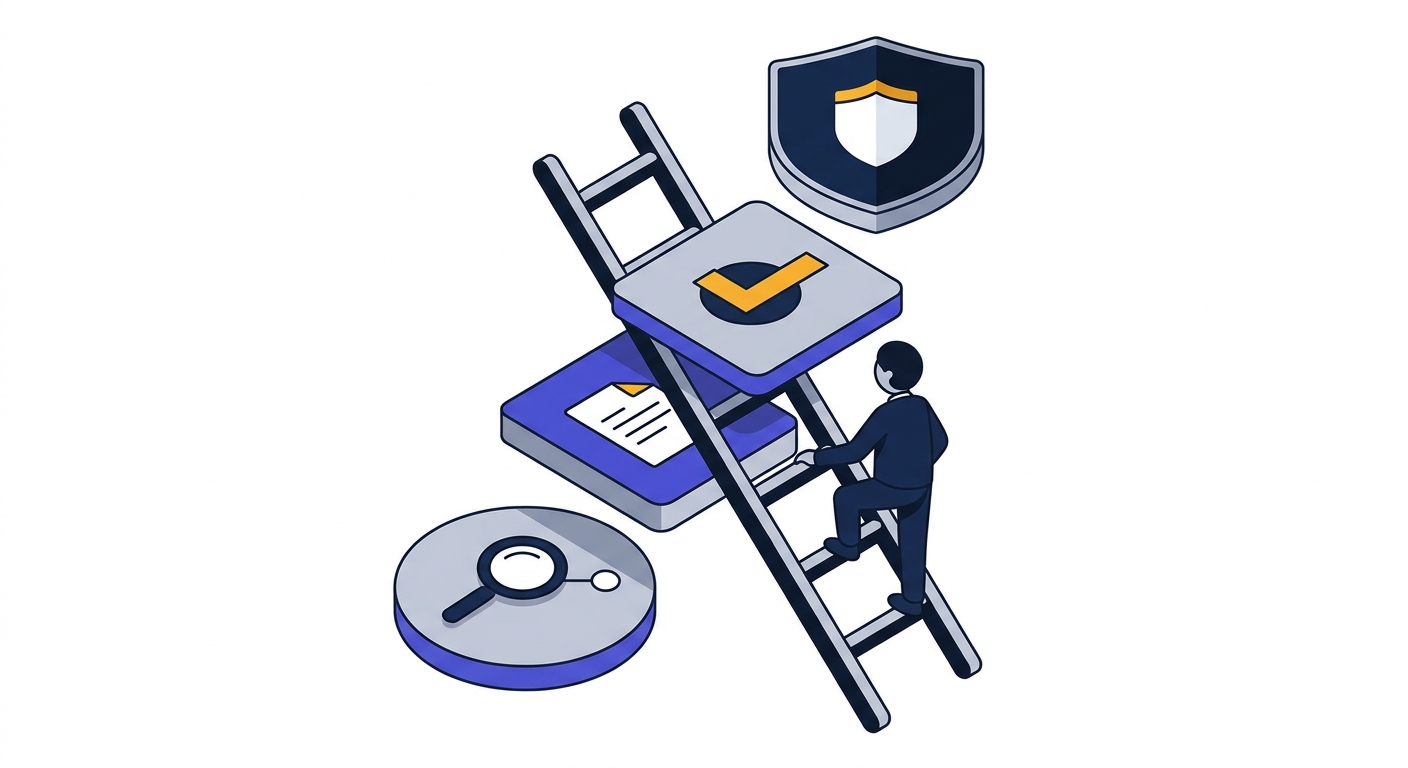
The Verification Ladder
Once you accept that hallucination is intrinsic and that prompt-level instructions don't fix it, the workflow implication is clear: verification must become a non-negotiable, scheduled step in every process that uses AI for factual content. Not an afterthought. Not "if I have time." A discrete stage, with its own time allocation, before anything goes out the door.
Here is the verification ladder I teach. Climb it for every factual claim, in order:
Rung 1: Identify every checkable claim
Read the AI output with a highlighter (literal or mental) and mark every assertion that could be true or false in the world. Numbers. Names. Dates. Quotes. Attributions. Citations. Legal claims. Product features. Historical events. Anything that isn't pure opinion or generic prose. If you find yourself with more highlights than not, that's normal — and it tells you how much verification work the document actually represents.
Rung 2: Trace each claim to a primary source
Not "a Google result that mentions it." Not "another AI confirmed it." The primary source: the original report, the actual study, the regulator's own website, the company's own filing, the named person's own published words. If the AI says "according to a 2024 Deloitte report," you need to find that Deloitte report on Deloitte's website, open it, and locate the specific figure. If you cannot find it, the claim does not exist until proven otherwise.
Rung 3: Check the claim against the source, not just that the source exists
A subtler failure mode: the cited source is real, but it doesn't actually say what the AI claimed it said. The study exists, but the 73% figure is from a different table, or refers to a different population, or has been misinterpreted. You have to open the source and verify the specific claim — not just confirm that something with that title was once published.
Rung 4: Sanity-check against domain knowledge
Does the claim pass the smell test? If the AI tells you that 95% of UK SMEs use a particular software product, your gut should object — that's an implausibly high number for almost any tool. If a stat seems too neat, too convenient, or too perfectly suited to the argument the document is making, treat that as a red flag, not a confirmation.
Rung 5: Escalate for high-stakes claims
For anything legal, medical, financial, regulatory, or reputational, primary-source verification is the floor, not the ceiling. You also need the qualified human in the loop: the lawyer, the compliance officer, the accountant, the named expert. "The AI said so" — and even "I verified it against a source" — is not enough when the downside is a regulatory fine or a defamation claim.
Rung 6: Document what you verified
For anything that will live beyond the moment — a published article, a client deliverable, a strategy document — keep a verification trail. Which claims came from AI? Which sources confirmed them? Who signed off? This is partly governance and partly insurance. When something does eventually slip through (and over a long enough career, it will), you want to be able to show that you had a reasonable process.
The time cost is the point
Yes, this is slower than just trusting the output. That is not a bug in the workflow; it is the workflow. The productivity gain from AI is real, but it lives in the generation stage — the blank-page-to-first-draft transition, the ideation, the structural scaffolding. It does not live in eliminating the verification stage. Anyone selling you AI as a way to skip fact-checking is selling you a liability disguised as a time-saver.
Building the Verification Mindset Into Your Team
Individual discipline isn't enough. If you're rolling AI out across a team or organisation — which is exactly what later sections of this course will help you do — you need verification habits baked into the culture before the tools are baked into the workflow. A few principles that work:
- Separate the "draft" stage from the "defend" stage. Make it normal — even expected — for someone to say "this is an AI draft, I haven't verified the claims yet." That label should be socially acceptable and structurally embedded in your documents and channels. The danger is when AI drafts get treated as finished work because nobody flagged what stage they were at.
- Require source links, not source mentions. If a document says "according to Gartner," the document should also contain a working link to the specific Gartner page. No link, no claim. This single rule catches an enormous proportion of hallucinations before they propagate.
- Reward catches, not just speed. If the only thing your team is praised for is volume of output, verification will be the first corner cut. Create explicit recognition for the colleague who caught the fabricated stat, the wrong attribution, the phantom case citation.
- Run hallucination fire drills. Periodically, deliberately seed an AI-generated document with a plausible but false claim and circulate it through your normal review process. See whether anyone catches it. Treat the result as diagnostic, not punitive — it tells you where your verification culture has thin spots.
- Match scrutiny to stakes. A brainstorm of social-post ideas does not need the same verification rigour as a regulatory submission. Build a simple internal tiering: ideation outputs vs. internal documents vs. external/client work vs. legal/regulatory/financial — with escalating verification requirements at each tier.
The Honest Bargain
Let me close with the honest bargain that this course asks you to accept. Large language models are extraordinary tools. They can compress days of work into hours, generate options you would never have thought of, and lift the floor on writing quality across an entire organisation. The productivity gain is real and the competitive cost of ignoring it is rising every quarter.
But the same mechanism that produces those gains also produces hallucinations, and that side of the trade cannot be wished away with better prompting, premium subscriptions, or vendor reassurances. The price of admission to the AI productivity bonus is a permanent, disciplined verification layer on top of every factual output. Skip the verification, and you don't get to keep the productivity — you've just postponed the cost to whenever the wrong claim catches up with you. And it will.
The professionals who win with AI over the next decade will not be the ones who trust the model most. They will be the ones who built the most disciplined verification habits earliest — who treated fluent confidence with the suspicion it deserves, and who made "trace it to a primary source" as automatic a reflex as "spell-check before sending."
Key Takeaway
The mental model to carry forward: LLMs generate plausibility, not truth. Their job is to produce text that looks like the kind of text a knowledgeable human would write. Whether that text is actually correct is a separate question that the model is neither asked nor equipped to answer. That question is yours — every time, for every claim, without exception. Verification is not a phase you graduate from as you get better at AI. It is the workflow itself.
Coming up next
Now that you understand why AI gets things wrong, the next lesson zooms in on the mechanics of what the model can and cannot "see" in a single conversation: tokens, context windows, and the strange, lossy memory of a large language model. Understanding these mechanics will sharpen your prompting, explain why long conversations sometimes drift, and reveal why "just paste everything in" is usually the wrong instinct.
Enjoyed this preview? Enrol to unlock all 67 lessons + your certificate.
Training a team? Buy seats for your team →