The Next-Token Predictor: A Plain-English Model of LLMs
The Single Most Important Idea in This Course
If you take away only one concept from the rest of this course, make it this: a large language model is a next-token predictor. It is not a thinking entity. It does not believe things. It does not know what it is saying in the way you know what you are saying. It is a staggeringly sophisticated pattern-completion engine — one that has read more text than any human ever could — and it generates language by repeatedly guessing the statistically most plausible next chunk of text given everything that came before.
That sentence is going to sound like a deflation. Good. It should. Because nearly every mistake professionals make with AI — from over-trusting a fabricated statistic to writing baroque, polite prompts as if soothing a temperamental colleague — flows from a wrong mental model. People treat ChatGPT like an oracle, or a search engine, or a junior employee, or a sentient assistant. It is none of those things. It is something genuinely new, and getting the mental model right is the difference between using AI like an amateur and using it like a practitioner.
What "Next-Token Prediction" Actually Means
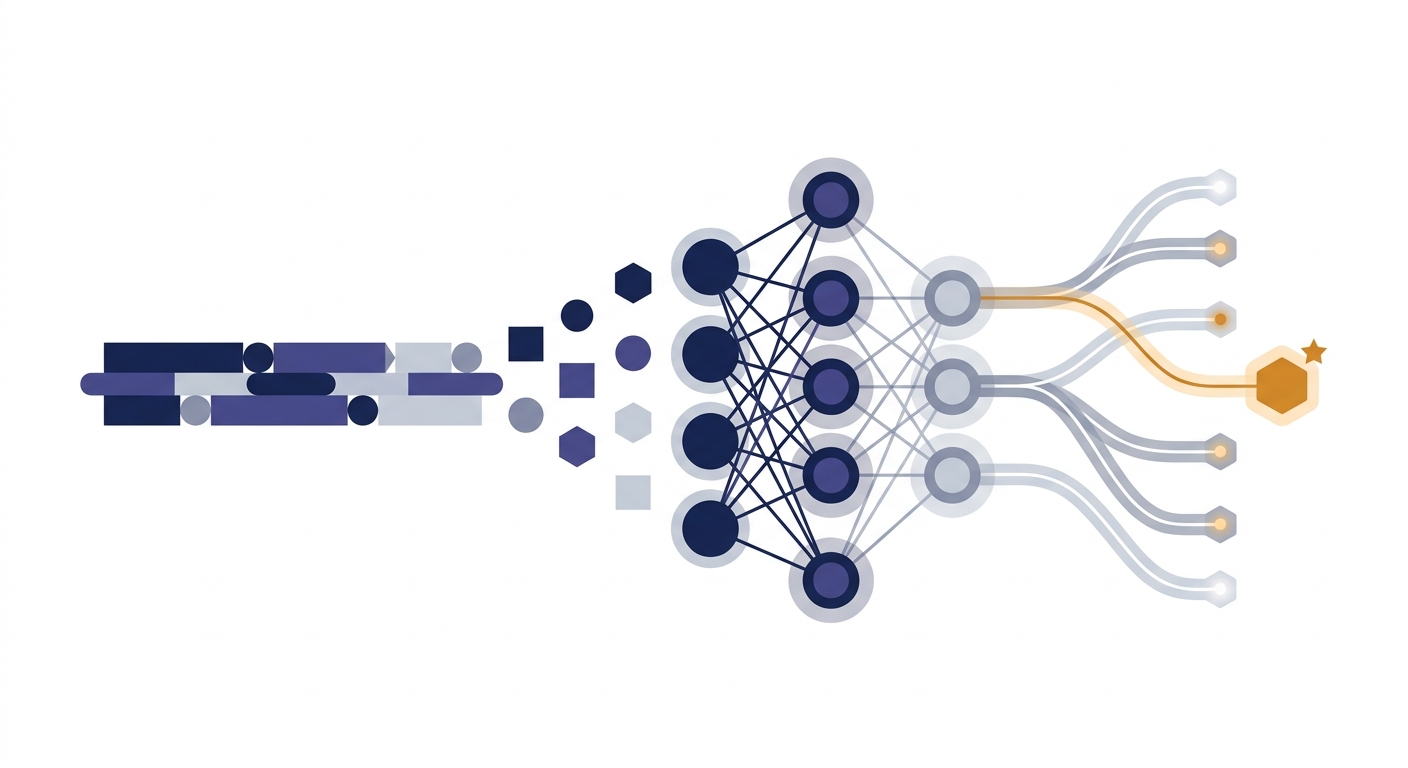
Let's slow down and look at the mechanism. When you type a prompt into Claude, ChatGPT, Gemini or Copilot, the model does not read your sentence, understand your intent, consult a knowledge base, and compose a reply. That is the human metaphor we project onto it. What actually happens, in plain English, is this:
- Your input is chopped into tokens — small chunks of text, roughly three-quarters of a word in English. "Marketing strategy for SaaS" might become five or six tokens.
- The model processes those tokens through an enormous mathematical structure (a transformer neural network) containing hundreds of billions of learned numerical weights.
- It produces a probability distribution across its entire vocabulary for what the very next token should be. Not a single answer — a ranked list of likelihoods.
- It picks a token (usually with a little controlled randomness, called "temperature"), appends it to the running text, and then does the whole thing again. And again. And again. One token at a time, until it decides to stop.
That is the entire trick. A trillion-parameter model writing a beautiful sonnet about your Q4 pipeline is doing exactly the same thing, mechanically, as the autocomplete on your phone. The difference is scale, training data, and architecture — not category.
What This Means About What's Really Inside
Once you internalise the next-token framing, a series of strange, counterintuitive truths about AI become obvious rather than surprising.
It has no beliefs
When an LLM tells you "I think the best approach is X," there is no "I" doing any thinking. The model has generated the tokens "I think the best approach is X" because that sequence had high probability given the preceding context. Ask it the same question phrased differently and it may produce the opposite recommendation with equal confidence. This is not lying. It is not even inconsistency in the human sense. There is simply no underlying belief state to be consistent with.
It has no memory of you — unless you give it one
By default, every conversation starts from zero. The model does not remember that you are a marketing director at a fintech, that you prefer British English, that your last campaign flopped because of a tone-of-voice misstep. Each new chat is, in effect, meeting a brilliant stranger who has read the entire internet but knows nothing about your life. Modern tools have started bolting on memory features — ChatGPT's persistent memory, Claude's Projects, custom GPTs and Gems — but these are additions to the underlying mechanism, not native properties of it. We'll cover them deeply in Section 7. For now, assume amnesia is the default state.
It has no understanding in the human sense
This is the hardest claim to accept, because the output feels so understanding. The model can summarise a legal contract, explain quantum mechanics to a child, and write a wedding speech that makes people cry. Surely that requires understanding? Here is the uncomfortable answer: it requires the statistical fingerprint of understanding. Having processed billions of examples of humans explaining, summarising, and consoling, the model has learned the shape of those activities so well that its output is indistinguishable from the real thing — most of the time. But it can be confidently, fluently wrong in ways a genuinely understanding mind would not be. It will invent a court case that sounds exactly like a real court case. It will cite a paper that does not exist. It will assure you that a particular tax rule applies when it does not. Because the goal was never accuracy. The goal was plausibility.
And yet — it is remarkably useful
None of this is a reason to abandon the tools. It is a reason to use them correctly. A next-token predictor trained on most of human writing turns out to be astonishingly good at a long list of business-critical tasks: drafting, summarising, brainstorming, restructuring, translating, explaining, role-playing, extracting structure from mess, generating variants, pressure-testing ideas. For these tasks — most of which involve language transformation rather than truth assertion — the technology is genuinely transformative. The trick is knowing which tasks belong in which category.
It has no beliefs, no memory of you unless given one, and no understanding in the human sense — yet, in the right hands, it is one of the most useful tools ever built. The whole skill is knowing which sentence in that paragraph applies to the task in front of you.
Try this now: ask the model how it knows
Open whichever AI tool you use most. Find a recent answer it gave you that contained a specific factual claim — a statistic, a date, a name, a quote, a recommendation. Now ask it, in a new message: "How do you know that? What's your source, and how confident are you?"
Watch carefully what happens. Sometimes the model will produce a plausible-sounding source. Sometimes it will hedge and admit uncertainty. Sometimes it will quietly revise its earlier claim. Sometimes it will invent a citation outright. All four responses tell you something important — not about the truth of the original claim, but about the mechanism generating both the claim and the justification. They are the same mechanism. The model is not consulting a fact when it answers "how do you know that?" It is predicting what a plausible answer to that question would look like.
Do this exercise once a week for a month. It will permanently change your relationship with AI output.
Why the Mental Model Changes Everything Downstream
Once you accept that you are working with a statistical fluency engine rather than a knowledgeable assistant, a cascade of practical implications follows. Almost every later lesson in this course is, at heart, a working-out of one of these implications.
1. Verification is not optional — it's the workflow
If the model's job is to produce plausible text, and your job is to produce true text, then verification is not an extra step you do when you have time. It is structurally built into the work. We will return to this in the lesson on hallucination, but the principle starts here: any factual claim — a statistic, a citation, a date, a regulation, a name, a quote — must be traceable to a real source before it leaves your hands. A colleague who pastes an AI-written "industry report" containing three impressive statistics into a board pack has not produced research. They have produced fiction with a high probability of being partly true. The practitioner's first move is always: trace each claim back.
2. Prompts are not requests — they're context-setting
If the model is predicting the next token given the preceding context, then your prompt is not really a question or an instruction. It is the preceding context that conditions what comes next. This is why a one-line prompt produces generic output and a richly specified prompt produces sharp output. You are not being more polite or more thorough — you are giving the statistical engine more signal about which region of its enormous possibility space to draw from. The RCTFC framework you'll meet in the next section (Role, Context, Task, Format, Constraints) is just an organised way to load that signal efficiently.
3. Confidence is not calibrated
Humans, broadly, sound less certain when they are less certain. LLMs do not — at least not reliably. The model produces fluent, confident prose by default because most of its training data is fluent, confident prose. "I'm not sure" is a learnable pattern, but it is not the model's natural register. This means you cannot use the tone of an answer as a signal of its reliability. A confidently delivered wrong answer and a confidently delivered right answer are linguistically indistinguishable. Stop reading confidence as evidence.
4. The same mechanism produces the magic and the mistakes
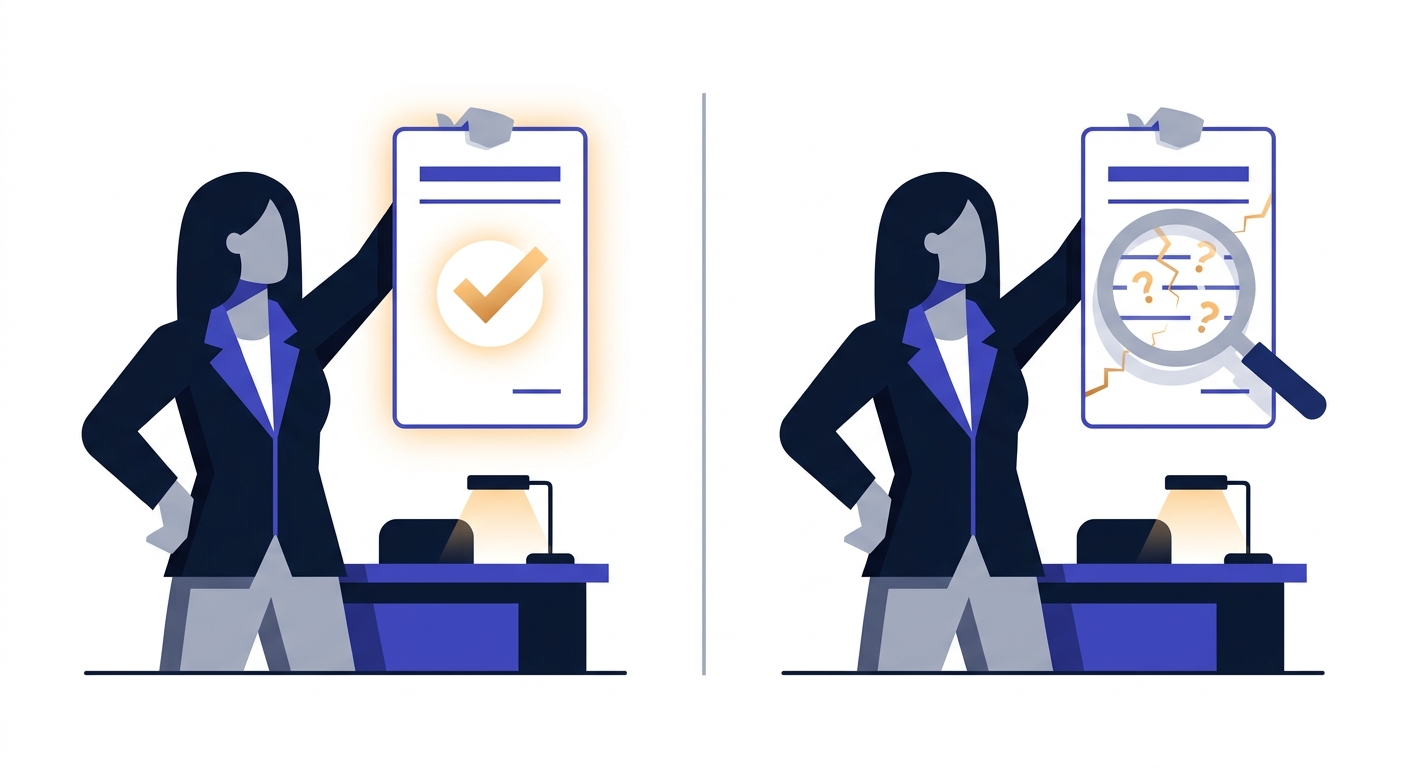
This is perhaps the most important consequence. People sometimes imagine hallucination as a separate failure mode — a glitch in an otherwise reliable system. It is not. The same next-token prediction that produces a brilliant summary of a 40-page document also produces a fake court case. Fluency and fabrication are the same process. You cannot keep the first and switch off the second. You can only design your workflow knowing both come from the same source.
5. "Memory" and "knowledge" are bolted-on, not native
When you connect an LLM to your company's documents (via retrieval-augmented generation, or RAG), or give it web browsing, or attach files, or persist memory across chats — you are not making the model smarter. You are giving it better context at the moment of prediction. The mechanism is unchanged. Knowing this helps you understand why these features sometimes work brilliantly and sometimes fail in surprising ways: the model still predicts plausibly from what's in its context window, and if the retrieved context is wrong or irrelevant, the output will be wrong or irrelevant — but it will still sound great.
6. Different tools, same underlying physics
ChatGPT, Claude, Gemini and Copilot have different strengths, training data, fine-tuning choices, and ecosystem integrations. We'll compare them in detail in lesson 5. But all of them are next-token predictors. The mental model you build in this lesson applies to every major LLM you will use this year, and almost certainly to every one you will use in the next five years. The interfaces will keep changing. The underlying physics will not.
A Working Analogy: The Improv Actor With a Library Card
If the technical framing feels abstract, here is an analogy that holds up under pressure. Imagine an extraordinarily talented improv actor who has spent twenty years reading in a vast library. They have read law textbooks, medical journals, marketing blogs, Shakespeare, every novel ever published, technical manuals, Reddit threads, scientific papers and corporate annual reports. Their recall is extraordinary — not verbatim, but pattern-level. They have absorbed the shape of how every kind of document sounds.
Now you put them on stage. You give them a scene: "You are a tax adviser. A client asks about deducting home-office expenses." Without hesitation, they begin speaking in fluent tax-adviser register, producing sentences that sound exactly like a tax adviser would say. Most of what they say will be roughly correct, because they have read so much tax advice that the patterns are deeply learned. But somewhere in the monologue, they will invent a section number of the tax code. They will state a threshold with confidence. They will reference a case that does not exist. And they will do all of this in exactly the same tone as the parts that are correct, because — and this is the key — they are not distinguishing between recall and invention. They are just performing the role of someone who knows.
That is your AI tool. It is the world's most well-read improv actor. The right way to work with it is the same way a producer works with a brilliant but unreliable collaborator: give them rich direction, let them produce extraordinary first drafts at superhuman speed, and never, ever put their output on stage without checking the facts.
What this analogy gets right — and where it breaks down
The analogy is useful but imperfect. The improv actor has a single coherent identity; the LLM does not. The actor can be embarrassed by being caught out; the LLM cannot. The actor learns from a single correction; the LLM, in a given conversation, can be corrected and may still repeat the same error two prompts later because nothing about its underlying weights has changed. So treat the analogy as a starting point for intuition, not a complete map. When in doubt, return to the technical truth: statistical next-token prediction, conditioned on whatever is in the context window right now.
The Practitioner's Posture
Here is the stance this course will return to again and again. Hold these four ideas together:
- Respect the fluency. The output is genuinely impressive. Underusing AI because you don't trust it is just as costly as overusing it because you trust it too much.
- Distrust the confidence. Fluent does not mean correct. The tone of an answer tells you nothing about its truth.
- Own the verification. You are the editor, fact-checker and final signatory. The model is the drafter. That division of labour is non-negotiable for anything that matters.
- Engineer the context. The quality of the output is largely determined by the quality of what you put in front of the model. Vague in, vague out. Specific in, specific out. This is the central craft of prompt engineering, which we'll spend all of Section 2 on.
Adopt that posture and you will get a 10x return on AI in your work. Skip it — treat the tool as either an oracle to obey or a toy to dismiss — and you will get either embarrassing failures or stagnation.
The core takeaway
A large language model is a fluent statistical engine for predicting the next chunk of text, not an oracle, search engine, or thinking entity. This single mental shift — from "AI knows things" to "AI generates plausible continuations" — is the foundation every other skill in this course is built on.
If you find yourself in the rest of this course frustrated by an AI output, or seduced by one, return here. Ask: am I treating this like an oracle? Am I reading confidence as evidence? Am I engineering the context, or just asking a question? The answers will usually point straight at the fix.
Where We Go Next
In the next lesson, we'll zoom in on the most consequential implication of the next-token model: hallucination. Why does AI confidently invent things? Why can't the vendors just "fix" it? What are the predictable patterns in which things it invents — so you know where to look? And what does a professional verification workflow actually look like when you're producing AI-assisted work at volume?
You'll leave that lesson with a sharper eye for the specific kinds of errors LLMs make, and a practical checklist for catching them before they cost you. The mental model you've just built is the foundation. Hallucination is what happens when you ignore it.
Enjoyed this preview? Enrol to unlock all 67 lessons + your certificate.
Training a team? Buy seats for your team →