Features, Benefits, and Emotional Payoffs
Nobody Buys a Drill Bit
There's a line every copywriter eventually hears, usually attributed to Harvard marketing professor Theodore Levitt: "People don't want a quarter-inch drill. They want a quarter-inch hole." It's been quoted so often it's become a cliché — which is a shame, because most people who repeat it stop one rung too early.
Nobody buys a drill bit. True. But nobody really buys a hole in the wall either. They buy the shelf that goes on the wall. And they don't really buy the shelf — they buy the tidy living room. And they don't really buy the tidy living room — they buy the feeling of being on top of their life, the partner who stops sighing every time they walk past the pile of unhomed books, the quiet pride of a room that finally looks like a grown-up lives there.
That is what the customer is actually paying for. Everything else — the drill, the bit, the hole, the bracket, the screws — is just plumbing. It's the means by which they get to the feeling.
If you don't understand this in your bones, your copy will read like a spec sheet for the rest of your career. You'll write about pocket springs and processor speeds and proprietary algorithms, and your reader's eyes will glaze, and you'll wonder why a product you know is genuinely brilliant isn't selling. The answer is almost always the same: you described the drill. You forgot to sell the tidy room.
This lesson is about fixing that — permanently. By the end of it you'll have a four-rung ladder you can apply to any product on Earth, a drill-down technique that finds the emotional payoff hiding inside even the most boring industrial spec, and a working understanding of why emotion is what closes the sale and logic is just the alibi.
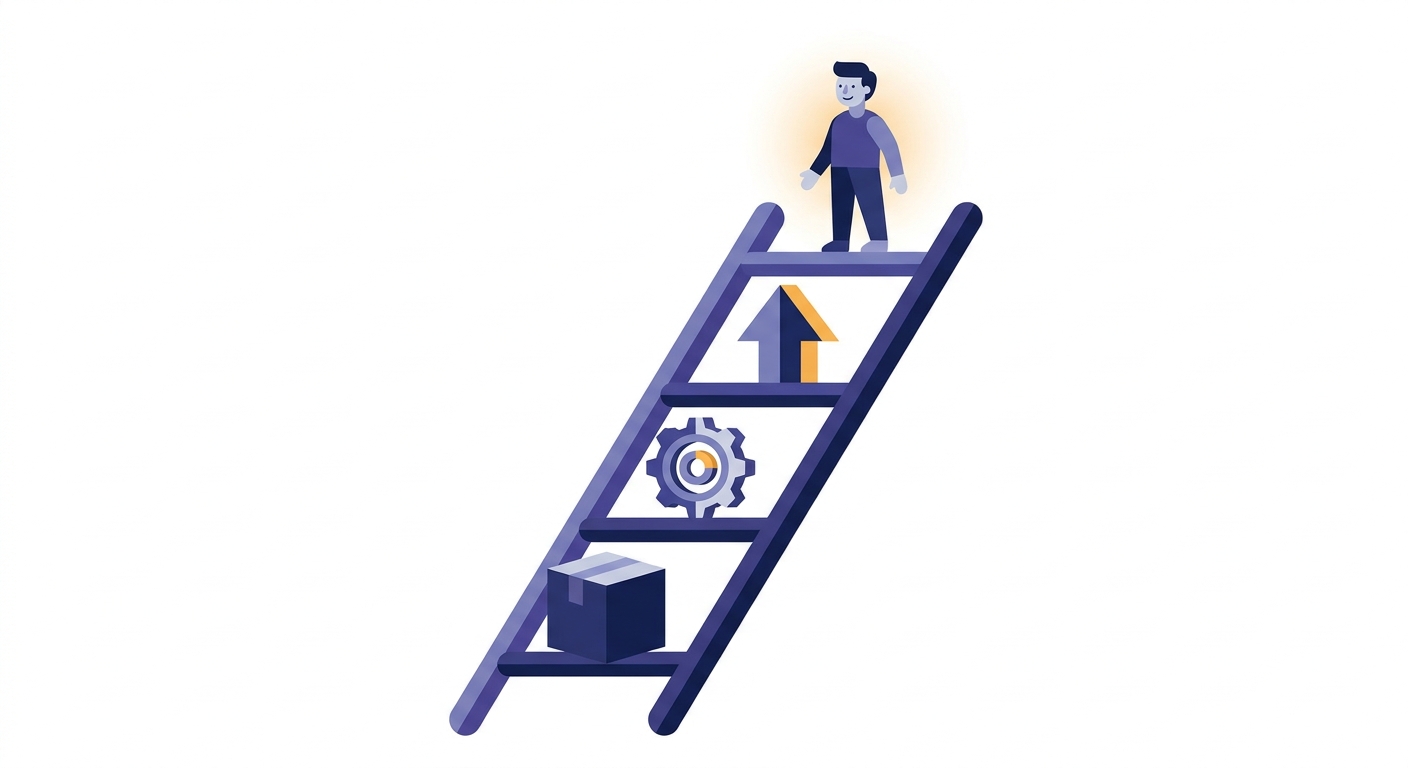
The Four-Rung Ladder
Every product, service, app, course, candle, consultancy and SaaS tool on Earth can be described at four levels. Most copy lives, and dies, on the bottom rung. Great copy climbs all the way to the top.
Rung 1: The Feature
A feature is what the product is. It's the factual, objective, measurable thing. The 2,000 pocket springs. The 13-hour battery. The 256GB of storage. The cold-pressed Italian olive oil. The 1-on-1 weekly call.
Features are easy to write because they're sitting on the manufacturer's spec sheet or the founder's pitch deck. This is why so much copy never gets past them — they're the path of least resistance. They're also, on their own, almost completely useless as persuasion. A feature answers a question nobody asked: "What is this thing made of?"
Rung 2: The Advantage
An advantage is what the feature does. It's the mechanical consequence of the feature existing. 2,000 pocket springs distribute weight independently. A 13-hour battery lasts an entire working day. 256GB holds roughly 60,000 photos. Cold-pressed olive oil retains more polyphenols. The weekly call means you're never stuck for seven days.
Advantages are better than features because they begin to translate the spec into action. But they're still product-centric. They describe what the thing does in a vacuum, not what it does for the reader.
Rung 3: The Benefit
A benefit is what the advantage means for the reader's life. It is the answer to the most important three letters in copywriting: WIIFM — What's In It For Me?
Independent springs mean your partner can shift in the night and you won't feel it. A 13-hour battery means you can leave the charger at home. 256GB means you'll never have to delete a photo to make room for another. Polyphenols mean the oil actually tastes like olives, not vegetable lubricant. A weekly call means you'll never lose a week to indecision again.
Notice the shift. We're no longer describing the product. We're describing the reader's day, their kitchen, their work, their relationship. The product has receded into the background and the customer has stepped into the spotlight — which is exactly where they want to be.
Rung 4: The Emotional Payoff
The benefit is what the reader gets. The emotional payoff is how they feel about it. And feeling — not knowing — is what triggers the buy.
If your partner can fidget all night and you won't feel it, then you both wake up rested, which means you stop snapping at each other over breakfast, which means your relationship gets a little easier. If you can leave the charger at home, you feel lighter, freer, less tethered. If you never delete a photo, your kids' first steps and your grandmother's last birthday are safe forever. If you never lose a week to indecision, you start to feel like the kind of person who finishes things.
This is the top of the ladder. This is where the actual decision gets made. Everything below it is scaffolding.
Our mattress has 2,000 individual pocket springs becomes: 2,000 pocket springs mean your partner can fidget all night and you'll never feel a thing — so you both wake up actually rested.
A Worked Example: The Same Product, Four Ways
Let's walk a single feature up the ladder, one rung at a time, so you can see the gear changes clearly. We'll use a project-management app — the kind of product that's notoriously hard to write about because it's all menus and dashboards.
- Feature: "Drag-and-drop task boards with custom columns."
- Advantage: "Rearrange your week in seconds without retyping anything."
- Benefit: "When a client pushes a deadline at 4pm on Friday, you fix your whole plan in under a minute and still leave on time."
- Emotional payoff: "You stop dreading your inbox. You stop bringing work-anxiety home. For the first time in months, Sunday evenings feel like Sunday evenings again."
Same product. Same feature. But by the time you reach the bottom of that list, the software has stopped being software. It's become a reclaimed Sunday evening. That is what the reader will hand over their credit card for. Nobody has ever, in the history of human commerce, handed over a credit card for "custom columns."
Try it with anything. Try it with a £4 bar of soap. Feature: triple-milled French soap with shea butter. Advantage: lathers richly and lasts three times longer than a supermarket bar. Benefit: your morning shower stops feeling like a chore and starts feeling like the one bit of the day that's actually for you. Emotional payoff: a small, repeatable ritual of self-respect — the feeling that your life contains nice things, on purpose, because you decided.
Soap. We're selling soap. And we've sold dignity.
The Drill-Down Technique — Keep Asking "So What?"
How to do it: Write down any feature of your product. Then ask "So what?" Write the answer. Then ask "So what?" again. Keep asking until the answer is no longer about the product — it's about how the reader feels, who they get to be, or what their life looks like on the other side. That final answer is your emotional payoff.
Example: "Our running shoes have a carbon-fibre plate." So what? "It returns more energy with every stride." So what? "You run faster with the same effort." So what? "You'll finally beat your half-marathon PB." So what? "You'll prove to yourself that the version of you who started running three years ago wasn't wasting their time."
That last line is the sale. Everything above it is just engineering.
Why Emotion Decides, and Logic Defends
There is a stubborn myth, especially among technical founders and B2B marketers, that their buyers are different. Their buyers, they insist, are rational. Logical. Spreadsheet-driven. Their buyers compare specs, read whitepapers, and make decisions in committees.
This is partly true and mostly wrong. The decision-makers in those committees are still human beings with mortgages, ambitions, insecurities, and bosses to impress. The CTO choosing between two cloud providers isn't just buying compute — she's buying the certainty that she won't be the one explaining a six-hour outage to the board. The procurement manager isn't just buying office chairs — he's buying "nobody emails me about back pain for the next five years." The emotion is quieter in B2B. It's about status, safety, reputation, and risk avoidance rather than romance or beauty. But it is absolutely still there, doing the steering.
Decades of behavioural science — from Kahneman's two-system model to Damasio's work on patients with damaged emotional centres who literally cannot make decisions — point to the same conclusion: emotion is not the opposite of rational decision-making; it's the engine of it. Without an emotional preference, the rational mind has no way to choose between options. It just runs comparisons forever.
What does this mean practically?
Lead with the feeling. Follow with the proof.
The structure of a persuasive paragraph almost always looks like this: an emotional benefit at the top to make the reader want the outcome, followed immediately by logical reasons that let them justify wanting it.
Notice how this works in the wild:
- "Wake up actually rested for the first time in years" (emotional payoff) — "…thanks to 2,000 independently-responsive pocket springs and a temperature-regulating bamboo cover" (logical justification).
- "Take back your Sunday evenings" (emotional payoff) — "…with automated task rollovers, client-facing dashboards, and one-click Friday reports" (logical justification).
- "Feel in control of your money for the first time" (emotional payoff) — "…£9/month, cancel anytime, FCA regulated" (logical justification).
The emotion is the bait. The logic is the hook that sets once they've bitten. Get the order wrong — lead with the logic, hoping the emotion will follow — and the reader never bites in the first place. They're not against your reasons. They just haven't decided they care yet.
The reader is arguing with someone in their head
Here's the thing most beginners miss: by the time your reader gets to the bottom of your page, they're not just deciding whether to buy. They're rehearsing the conversation they'll have when they tell their spouse, their boss, their accountant, or themselves why they bought.
Your job is to write both halves of that conversation. The emotional payoff is what they actually want. The logical reasons are the script you hand them for the defence. Good copy doesn't just sell — it arms the buyer. It gives them the bullet points they'll repeat at the dinner table.
Common Mistakes on the Ladder
Three failure modes show up again and again, even in copy from people who know better. Watching for them will save you years.
1. Stopping at the advantage and calling it a benefit
"Lasts three times longer." "Twice as fast." "Holds 60,000 photos." These feel like benefits because they're written in friendly, comparative language. They're not. They're still product-centric. The benefit is what those numbers mean in the reader's actual life. Three times longer than what? In whose hand? Doing what? On what kind of morning?
2. Jumping straight to the emotional payoff and skipping the proof
The opposite mistake. Copy that opens with "Imagine waking up every day feeling free, alive, and unstoppable" and never tells you what the bloody product actually is. The reader needs to climb the ladder with you. Without the lower rungs visible, the top one feels like marketing hot air — because it is.
3. Writing the same benefit for every feature
If every bullet on your sales page ends with "save time and reduce stress", you're not climbing the ladder — you're just stapling a generic feel-good phrase to a list of specs. Each feature has its own unique payoff. Find it.
Exercise: Walk Three Features Up the Ladder
Pick a product you know well — something you've bought recently, or your own offer if you have one. Choose three specific features (not generic claims — actual features).
For each one, fill in the four rungs:
- Feature: What is it? (Factual, spec-level.)
- Advantage: What does that feature do, mechanically?
- Benefit: What does that mean for the reader's day, work, body, or relationships?
- Emotional payoff: How will the reader feel, or who will they get to be, because of it?
Then write one sentence per feature that leads with the emotional payoff and supports it with the feature as proof. Read those three sentences aloud. If you flinch slightly because they feel "too emotional," you're probably finally in the right zone. Most copy underplays emotion, not the other way round.
Keep this worksheet. We'll come back to it when we write headlines, bullets, and sales pages — because the feature-to-payoff translation is the underlying move in all of them.
Where This Shows Up Next
The feature-to-payoff ladder isn't a one-off trick for product descriptions. It's the substructure of almost every copywriting move you'll learn in this course.
- Headlines work because they promise a payoff (top rung) and hint at a mechanism (lower rungs). "Lose 10 pounds without giving up bread" is payoff + mechanism in nine words.
- Bullet points on sales pages — "fascinations", as the old direct-response writers called them — are tiny ladders. Each one packages a feature into a benefit-shaped tease.
- Email subject lines live or die on whether they whisper a payoff worth opening for.
- Objection handling is, almost always, the moment a logical reason is needed to defend an emotional decision the reader has already half-made.
In the next lesson, we'll add the second great lever of persuasion: buyer awareness. Because here's the catch — even a perfectly written emotional payoff will fall flat if you aim it at someone who doesn't yet believe they have the problem. The ladder tells you what to say. Awareness tells you when the reader is ready to hear it. Together, they're 80% of why copy works.
The Takeaway
Lead with the emotional payoff. Support with the logical reason.
Every feature on Earth can be walked up a four-rung ladder: feature → advantage → benefit → emotional payoff. Most copy never leaves the bottom rung. Great copy climbs to the top, then hands the reader the lower rungs as proof.
People buy on emotion and justify with logic — in B2C, in B2B, in luxury, in software, in everything. Your job isn't to choose between feeling and reason. It's to deliver the feeling and hand the buyer the reasons they'll use to defend it.
When in doubt, keep asking "So what?" until the answer stops being about the product and starts being about the person.
Enjoyed this preview? Enrol to unlock all 56 lessons + your certificate.
Training a team? Buy seats for your team →