Mapping the Customer Journey & The AARRR Funnel
The Journey Your Customer Actually Takes
Before a single pound of ad budget gets spent, before a campaign brief gets written, before you debate whether to be on TikTok or LinkedIn, there is one question that determines whether your marketing will compound or evaporate: do you actually understand the journey your customer takes from stranger to advocate?
Most marketers think they do. Push them, and what emerges is a fuzzy mental model: "people see our ad, click it, and buy." That is not a customer journey. That is a wish. Real customers move through psychological stages, often non-linearly, sometimes over months, frequently across devices and channels you cannot directly attribute. They encounter your brand seven, twelve, sometimes twenty times before they part with money. They forget you, remember you, ignore you, recommend you. The job of strategy — as we established in the previous lesson — is to design deliberate experiences across each of those stages, rather than dumping all your energy into the first moment of contact and hoping the rest takes care of itself.
This lesson does two things. First, it gives you the classical customer journey model — awareness, consideration, conversion, retention, advocacy — so you have shared vocabulary with every marketer and CMO you'll ever work with. Second, it overlays the more operationally useful framework called AARRR, or "Pirate Metrics," which converts that journey into measurable, diagnosable stages you can actually run a business on. By the end, you'll be able to look at any business — yours or a client's — and identify exactly which stage is leaking money.
Why stages matter
Think about how you yourself bought the last meaningful product in your life. Maybe a pair of running shoes, a piece of software, a course (perhaps even this one). Trace it backwards. You did not see an ad and buy. You felt a vague need. You started noticing the category. You researched. You compared. You hesitated. You read reviews. You returned to the site three times. You finally bought. Then you either became a repeat customer who told friends — or you forgot the brand within a week.
That is the journey. And every stage of it requires different content, different messages, different channels, and different metrics. Treating a stranger like a customer is creepy. Treating a customer like a stranger is wasteful. The entire art of modern marketing is matching message to stage.
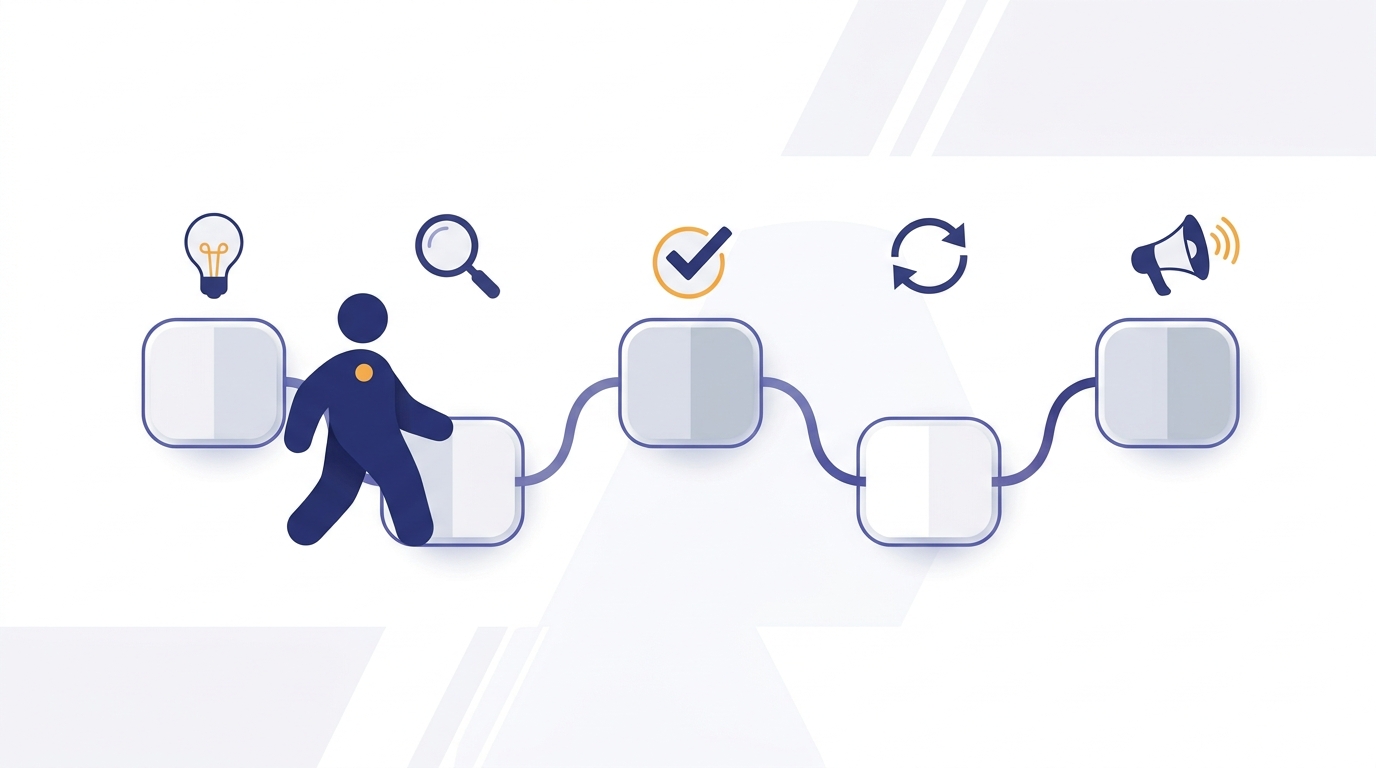
The Classical Funnel: Awareness to Advocacy
Let's walk the five stages of the customer journey in their classical form. This vocabulary is universal. Use it with confidence in any boardroom.
1. Awareness
The prospect does not know you exist. They may not even know they have the problem you solve, or they have it but haven't named it. The job here is attention and naming. Awareness content makes the audience say, "Huh — that's a thing? That's me?" It is broad, often educational, sometimes entertaining. Channels typically include organic social, paid social (especially video), SEO for top-of-funnel queries, PR, podcasts, and partnerships. Metrics are reach, impressions, video views, branded search lift.
2. Consideration
Now they know the problem exists and they're evaluating options — including the option of doing nothing. The job here is credibility and education. You need to teach them how to think about the category, position yourself as the smart, trustworthy choice, and remove the doubts that keep them from acting. Comparison content, case studies, webinars, in-depth blog posts, email nurture sequences, retargeting ads. Metrics are time on site, pages per session, email subscriptions, content downloads, demo requests.
3. Conversion
They've decided to act. Your job is to remove friction and make saying yes obvious. Landing pages, checkout flows, sales calls, free trials, pricing pages. The mistake most businesses make here is investing in awareness and consideration while their checkout has six form fields, their pricing page is buried, or their sales follow-up takes 48 hours. Metrics are conversion rate, cost per acquisition, cart abandonment, sales cycle length.
4. Retention
They bought. Now what? In subscription businesses, this is everything — your business is retention. In one-off purchase businesses, retention shows up as repeat purchase rate, frequency, and average order value over time. The job is delight and habit: onboarding, customer success, lifecycle email, loyalty programmes, surprise-and-delight moments. Metrics are churn, repeat purchase rate, NPS, expansion revenue.
5. Advocacy
The retained customer doesn't just stay — they tell others. They leave reviews, refer friends, post about you, defend you in comments threads. This is the holy grail because referred customers convert at higher rates, churn less, and cost almost nothing to acquire. The job is to make sharing easy and rewarding: referral programmes, community, user-generated content campaigns, ambassador schemes. Metrics are referral rate, review volume, NPS promoters, organic mentions.
That's the classical funnel. It's useful for shared vocabulary, but it has a problem: it's vague. "Awareness" is not a number. "Retention" is not a metric. You can't put it on a dashboard. So let's upgrade.
Enter AARRR: The Pirate Metrics Framework
In 2007, Silicon Valley investor Dave McClure introduced what he called Pirate Metrics — five stages whose initials spelt AARRR (which, yes, sounds like a pirate, hence the name). The framework was originally designed for startups, but it has become the de facto operating model for any business that takes growth seriously. The reason it stuck is simple: each stage is measurable, diagnosable, and improvable as an isolated unit.
Here are the five stages and how they map onto the classical funnel:
A — Acquisition
How do strangers become visitors? This is the awareness stage made operational. Anyone who lands on your website, follows your social account, downloads your app, or opens your email for the first time has been "acquired" in this sense. The metric is volume by channel: how many visits from organic search, how many from paid, how many from social, how many from referral. The cost is CAC (customer acquisition cost) — though properly speaking, that's the cost per customer, not per visit. Cost per visit is its precursor.
A — Activation
This is the stage most marketers ignore and where most funnels silently bleed money. Activation asks: did the visitor have a good first experience? Did they read the page, scroll past the fold, click through, sign up, start a trial, complete the onboarding step? Activation is the moment a stranger becomes engaged — when they cross the line from "I'm here" to "I see why this is for me." In Dropbox's famous early metrics, activation was "uploaded at least one file to one folder on two devices." Specific. Measurable. Predictive of retention.
If your acquisition is strong but activation is weak, you have a leaky bucket. You're pouring more water in while it gushes out the bottom. Most SMBs cannot tell you what their activation event is, let alone its rate.
R — Retention
Do they come back? This is straightforward in SaaS (do they log in week 2, week 4, week 12?) and more nuanced in ecommerce or services (do they reorder within 90 days?). Retention is the single greatest predictor of business health. As venture capitalist Brian Balfour has written, retention drives everything else — without it, acquisition is a treadmill and your CAC keeps creeping up because you're constantly replacing churned customers.
R — Referral
Do they bring others? This is your viral coefficient — the number of new users each existing user generates. For most SMBs, this is informal: word of mouth, casual recommendations, reviews. For mature companies, it's instrumented: referral codes, share buttons, ambassador programmes. The point is that referred users typically have higher LTV, lower CAC, and shorter sales cycles. A 10% referral rate compounds. A 30% referral rate transforms a business.
R — Revenue
Do they pay, and how much, and how often? In the original AARRR ordering, McClure put revenue last because for many startups, monetisation came after engagement. For most businesses you'll work on, revenue is more interleaved — it happens at the conversion moment and through retention and through expansion. The key metrics are LTV (lifetime value), average order value, expansion revenue, and the LTV:CAC ratio — which we'll dig into properly in lesson four.
Lay these five stages out in a diagnostic table and you have a kind of MRI scanner for any business. Strong A, weak A2? Onboarding problem. Strong R1, weak R2? Product loved but not shareable. Strong everything except final R? Pricing or monetisation issue. The framework forces you to stop saying "sales are down" and start saying "our week-2 retention dropped from 34% to 27% after the April redesign."
Most SMBs spend ninety percent of their effort on the top of the funnel and ignore the bottom — which is exactly where the real money lives.
The 90/10 Trap
Walk into ten small businesses and ask "what's your marketing strategy?" Nine will describe acquisition activities: ads, social posts, SEO, maybe some content. Ask about retention and you'll get a blank look or "we send a newsletter sometimes." Ask about referral and you'll hear "oh, we get a lot of word of mouth" — said with no idea what the actual rate is or how to influence it.
This is the single biggest pattern in SMB marketing: massive over-investment in the top of the funnel, near-zero investment in the bottom. The result is a treadmill — you keep paying more to acquire customers who don't stick, don't repeat, and don't refer. CAC creeps up, LTV stays flat, and margins compress. Eventually the business plateaus or dies.
The fix is not to acquire less. It's to balance the system. A pound spent improving activation, retention, or referral typically returns more than the same pound spent on acquisition — because it compounds.
Diagnosing Where Your Funnel Leaks
Here is the practical superpower of the AARRR framework: it turns vague problems into specific ones. "We need more sales" is not a problem you can solve. "Our visit-to-trial conversion is 2.1% versus a benchmark of 4%, costing us roughly £14,000 a month in lost activations" is a problem you can absolutely solve.
The way to diagnose a funnel is to lay out the stages as a sequence of conversion rates, multiply them together, and look for the weakest link relative to benchmark.
A worked example
Imagine a small SaaS business selling project management software for £30 per month. Their funnel looks like this:
- Acquisition: 10,000 visitors per month
- Activation: 4% start a free trial → 400 trials
- Conversion: 20% of trials convert to paid → 80 paying customers
- Retention: 85% retain month-over-month → average customer lifetime 6.7 months
- Referral: 8% of paid customers refer one new customer
- LTV: £30 × 6.7 = £201
Now they want to double revenue. The instinctive answer is "double traffic" — go buy more ads, write more content, hire an SEO agency. That doubles acquisition cost too, and if CAC is already £80, the LTV:CAC ratio is already only 2.5:1 — below the healthy 3:1 threshold. Doubling acquisition with the same conversion rates makes the unit economics worse.
But look at the funnel. What if instead they pushed trial conversion from 4% to 6%? That's a 50% lift in activations with no extra acquisition spend — meaning the CAC effectively drops by a third. What if they pushed retention from 85% to 90%? Average lifetime jumps from 6.7 months to 10 months, and LTV jumps from £201 to £300 — a 49% increase. What if referral went from 8% to 20%? Every paying customer effectively brings in a fifth of another for free.
Combine modest improvements across activation, retention, and referral and you can double revenue without spending a penny more on acquisition. This is the multiplicative magic of the bottom of the funnel. Acquisition is additive — every new customer costs the same as the last. Retention and referral are multiplicative — improvements stack and compound.
How to spot the weakest stage
You do not need expensive tools to do this. You need:
- Honest numbers for each stage. Visitors (from GA4 or your analytics). Activation event (define one — first action that suggests engagement). Conversion to paid. Retention by cohort. Referral rate (even an estimate, even if you ask customers "how did you hear about us?").
- Benchmarks. Industry-specific where possible. Ecommerce conversion benchmarks (typically 1.5–3%). SaaS trial-to-paid (typically 15–25%). Email open rates (20–40% depending on sector). If your number is dramatically below benchmark, that's your leak.
- A diagnostic table. One row per stage, three columns: your number, the benchmark, the gap. The biggest gap is almost always your first project.
This single exercise is worth more than ninety percent of the marketing books you'll read. It moves you from "random acts of marketing" — the tactical thrashing we identified in lesson one — to deliberate, evidence-based investment.
The Three Stages SMBs Systematically Under-Invest In
1. Activation
Almost no SMB has defined an explicit activation event. Yet activation is the moment that determines whether all that acquisition spend was wasted. Define yours. For an ecommerce business, it might be "added to cart" or "created an account." For a service business, it might be "booked a discovery call." For a content business, "read three articles in first session" or "subscribed to email." Whatever it is, measure it weekly and treat it as a top-three KPI.
2. Retention
If you sell anything that can be bought again — and almost every business does — you should have a retention strategy. This is not the same as "having a newsletter." It's a deliberate set of touchpoints designed to bring customers back: lifecycle emails timed to usage patterns, replenishment reminders, loyalty programmes, anniversary offers, win-back campaigns for lapsed customers. We'll cover the mechanics in detail in the email and automation modules — but the strategic point belongs here. Retention is a marketing job, not just an operations job.
3. Referral
"Word of mouth" said with a shrug is not a strategy. Word of mouth can be designed. Ask happy customers for reviews at the moment they're happiest — typically 7–14 days post-purchase or post-positive-interaction. Make sharing easy with one-click referral links. Reward both sides of a referral. Build a remarkable product experience that customers want to talk about. Track referral rate as a metric. The businesses that grow fastest treat referral as engineered, not accidental.
Exercise: Sketch Your Own AARRR Funnel
Pause the lesson and do this now. It will take fifteen minutes and will change how you see your business.
- Draw five boxes on a sheet of paper, left to right: Acquisition, Activation, Retention, Referral, Revenue.
- For each box, write down (a) the single best metric you have for that stage and (b) the actual current number. If you don't know the number, write "unknown" — that itself is a finding.
- Next to each number, write the rough benchmark for your industry (Google it; even rough benchmarks are useful).
- Circle the stage with the biggest gap between your number and benchmark.
- Write one sentence: "My weakest stage is ____, and over the next 30 days I will improve it by ____."
That one sentence is more useful than most marketing plans. Keep it visible. Revisit it in 30 days.
Why the Journey Is Never Actually Linear
Before we close, an honest caveat. The funnel — whether classical or AARRR — is a useful simplification, not a literal description. Real customers do not march obediently from awareness to advocacy in a straight line. They:
- Skip stages. A friend's strong recommendation can collapse awareness, consideration, and conversion into a single conversation.
- Loop backwards. A retained customer might re-enter consideration when a competitor launches something new.
- Exist in multiple stages at once. A long-time customer of your core product can be a complete stranger to your new product line.
- Take non-obvious paths. A podcast listener becomes an email subscriber three years later, then a customer six months after that.
Researchers like Google's own marketing science team have described the modern journey as a "messy middle" — a chaotic loop of exploration and evaluation between trigger and purchase, where consumers cycle through information sources, biases, and emotional reactions before deciding. This is real and worth respecting. But it does not invalidate the funnel. It refines how you use it. The stages are still real psychological states. The metrics are still measurable. The diagnostic still works. You just stop expecting any individual customer's path to look like the diagram, while still using the diagram to plan your aggregate investment.
The implication for channel and message
Because customers exist across all stages simultaneously, your marketing must too. You cannot run only awareness campaigns and wait for sales. You cannot run only conversion campaigns and wonder why your CAC is rising. A mature marketing operation has — at minimum — something running for each major stage:
- Acquisition: SEO, paid social, content, partnerships
- Activation: landing page optimisation, onboarding, lead magnets
- Retention: lifecycle email, community, customer success content
- Referral: review prompts, referral programme, ambassador outreach
- Revenue: pricing tests, upsell flows, expansion campaigns
This does not mean you need a huge team or budget. A solo marketer can run all five with the right systems and AI augmentation — which is exactly what later modules of this course will build. But you must consciously decide what's running for each stage, even if some stages are running on autopilot.
Key Takeaway: The Compounding Bottom of the Funnel
Acquisition is additive. Retention and referral are multiplicative.
A pound spent on acquisition buys you a finite, often diminishing return — more spend usually means higher CAC, because you exhaust the cheapest channels first. A pound spent improving activation, retention, or referral changes the multiplier on every pound of acquisition that follows, forever.
This is why the businesses that compound — the ones that look effortless from the outside ten years in — are not the ones that won at acquisition. They are the ones that won at the bottom of the funnel and let the top take care of itself.
In the next lesson, we'll go deeper on the foundation that makes all of this work: positioning, value proposition, and knowing exactly who your ideal customer is. Because no funnel — however well-designed — can save you from speaking to the wrong person, in the wrong way, about the wrong problem.
Enjoyed this preview? Enrol to unlock all 68 lessons + your certificate.
Training a team? Buy seats for your team →