Strategy Before Tactics: The Hierarchy That Stops Random Marketing
The Most Expensive Sentence in Marketing
There is a sentence that has cost small and medium businesses more money than almost any other in the last decade. It usually arrives in a Monday meeting, delivered with the confident energy of someone who has just had a shower-thought epiphany:
"We need to be on TikTok."
Or LinkedIn. Or Threads. Or whatever platform a competitor was spotted on last week. The sentence feels strategic. It mentions a channel. It implies action. It signals modernity. But it is not a strategy — it is a tactic in costume, masquerading as thought. And until you can tell the difference, you will keep paying the cost: wasted retainers, abandoned content calendars, agency invoices for campaigns that never connected to a single revenue number, and the slow demoralising sense that marketing is a black box that occasionally swallows money.
This lesson is the most important one in the entire course. Not because the others are weak — they are not — but because every other lesson, every channel chapter, every clever AI workflow, becomes ten times more valuable when it sits on top of a strategic hierarchy. And ten times more wasteful when it doesn't.
By the end of this lesson you will be able to do something that, in my experience, fewer than one in twenty business owners can do cleanly: take any marketing activity in your business — a podcast appearance, a Google Ads campaign, a new landing page, a Reels series — and trace it upward through five connected layers to the business objective it serves. If the trace breaks, the activity is suspect. If the trace holds, you have something worth investing in.
Why Tactic-Led Marketing Feels Productive (And Why That's the Trap)
Tactic-led marketing is seductive because it is visible. You can see a TikTok video. You can see a posted blog. You can see a campaign go live. Visibility creates the feeling of progress, which is psychologically rewarding regardless of whether the activity actually moves the business forward.
Strategy, by contrast, is invisible. It is a set of choices written down somewhere, a sequence of decisions that constrain activity rather than generate it. Strategy says "no" far more often than it says "yes". That is uncomfortable. It feels less like work. And so businesses default to the dopamine of doing — launching channels, chasing trends, copying competitors — and call it marketing.
The result is what I call random acts of marketing: a Frankenstein collection of channels, posts, ads, and half-finished funnels stitched together with no underlying logic. Each piece may be individually well-executed. The blog post is fine. The Instagram grid is on-brand. The Google Ads account is technically competent. But none of it adds up, because none of it was designed to add up. The pieces were never asked to serve the same goal.
The Strategic Hierarchy: Five Layers, One Direction
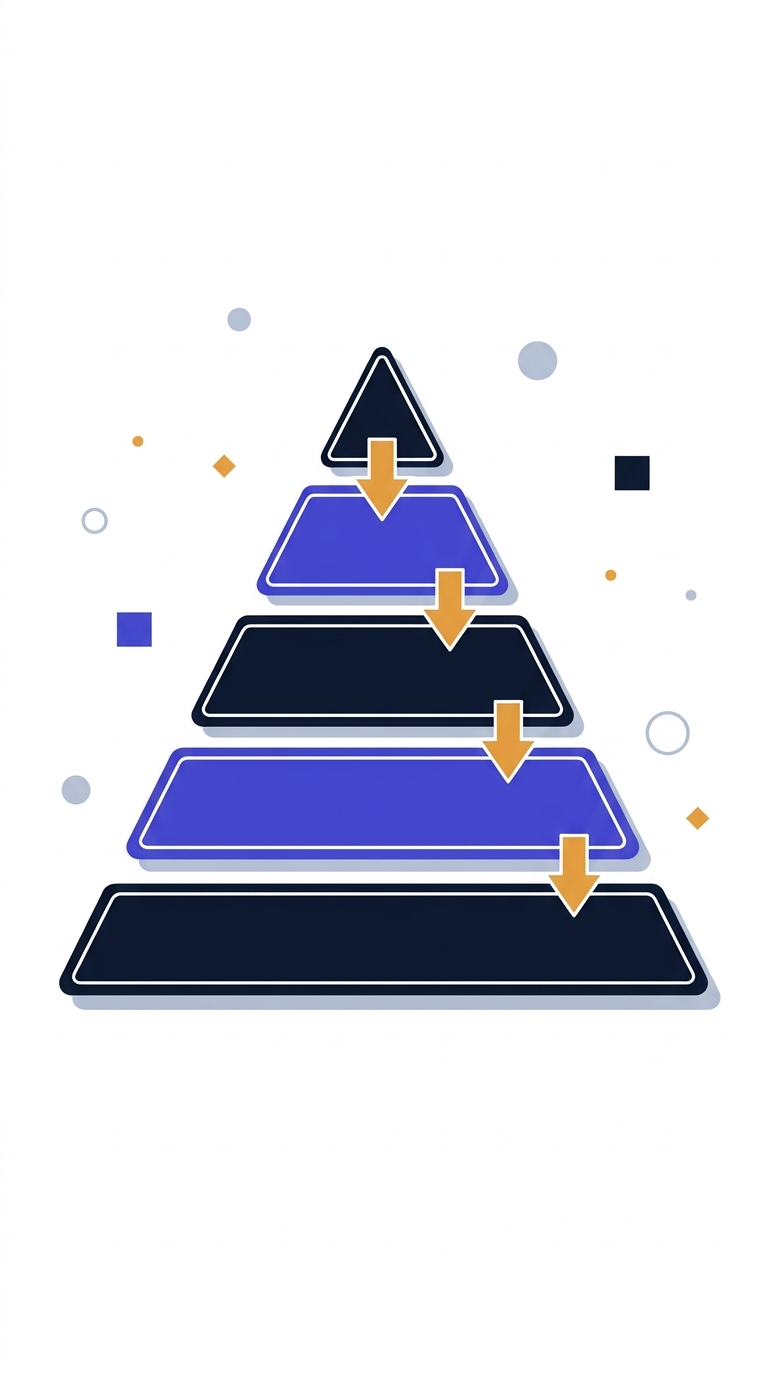
The antidote to random acts of marketing is a hierarchy. Five layers, top to bottom, where each layer is justified by the layer above it and expressed through the layer below it. The discipline is simple to state and brutally hard to practise: you always start at the top and work down. Never the other way around.
- Business Objective — what the business needs to achieve, in commercial terms.
- Marketing Goal — the specific contribution marketing will make to that objective.
- Channel — where you will operate to achieve the marketing goal.
- Tactic — what specifically you will do within that channel.
- Metric — how you will know it is working.
Let's walk through each layer with a real, unglamorous example: Sarah, who runs a six-person accountancy practice in Leeds serving local trades businesses — plumbers, electricians, builders. Revenue around £480,000. She wants to grow.
Layer 1: Business Objective
This is not a marketing statement. It is a commercial one. It belongs in the board minutes, not the marketing meeting. Sarah's business objective for the year:
"Grow annual recurring revenue from £480k to £600k within twelve months, maintaining current 38% net margin."
Notice what's there: a number, a timeframe, and a constraint. Notice what's not there: any mention of marketing, channels, or tactics. The objective is agnostic about how the growth happens. It could come from price increases. From upselling existing clients. From acquiring new ones. From a combination. The objective sets the destination; the strategy decides the route.
Layer 2: Marketing Goal
Now we ask: what role will marketing play in hitting the £120k revenue gap? After analysis, Sarah and her team conclude that price increases will deliver £30k, upsells from existing clients another £30k, and the remaining £60k must come from new client acquisition. With an average client worth £4,800 per year, that means roughly 13 new clients of the right profile.
The marketing goal becomes:
"Generate 13 new clients matching our ideal profile (UK trades businesses, £150k–£1m turnover, owner-operated) over the next twelve months, at a customer acquisition cost no greater than £1,600."
This is where most businesses start their marketing planning, which is already too far down. Without Layer 1, you cannot know whether thirteen clients is enough, too few, or too many. Without the CAC ceiling, you cannot evaluate whether any channel is viable. (We will go deep on CAC and LTV in Lesson 4 — for now, just notice how the constraint flows logically from the objective.)
Layer 3: Channel
Only now do we talk about where. And the channel decision is not driven by what's trendy or what a competitor is doing — it is driven by a sober question: where do UK trades business owners, aged roughly 35–55, actually spend their attention when they are open to considering a new accountant?
The honest answer for Sarah's audience is not TikTok. It's a combination of: Google search (when something has gone wrong with HMRC or their current accountant), trade-specific Facebook groups, word-of-mouth referrals from existing trades clients, and local visibility (van wraps, supplier partnerships, trade association events). Sarah selects three channels: local SEO, Google Ads on high-intent keywords, and a structured referral programme. Three is the right number. Two would be fragile; five would be too thin.
Layer 4: Tactic
Tactics are the specific actions inside each channel. For local SEO, the tactics include a fully optimised Google Business Profile, location-and-trade landing pages ("accountant for plumbers Leeds", "electrician accountant West Yorkshire"), and a monthly content piece answering questions trades businesses actually ask ("Can I claim my van as a business expense?"). For Google Ads, it's a tightly structured campaign targeting bottom-of-funnel keywords like "accountant for self-employed plumber" with negative keywords excluding consumer queries. For the referral programme, it's a clear incentive structure, a quarterly outreach to existing clients, and a dedicated landing page.
Notice that the tactics are specific. "Do SEO" is not a tactic. "Publish a location-and-trade landing page each month targeting a niche keyword cluster" is.
Layer 5: Metric
Finally, we decide how we will know whether each tactic is working. Crucially, the metric must tie back through every layer to the business objective. Sarah's metrics include: qualified consultation bookings per month (the leading indicator), cost per qualified lead by channel, new client signups, blended CAC, and revenue from new clients. She is explicit about what she is not measuring as a primary KPI: follower counts, post impressions, website sessions in aggregate. These are vanity metrics — they describe activity, not outcome.
Reading the Hierarchy Both Ways
The hierarchy was designed top-down, but its real power is that you can read it in either direction once it exists. If Sarah's monthly Google Ads spend rises by 40%, she can read up the hierarchy: that spend is for a tactic, which lives in a channel, which serves the goal of 13 new clients at ≤£1,600 CAC, which serves the objective of growing to £600k. If the spend would push her past the CAC ceiling, the decision is automatic — even if the ads "feel" like they're working.
This is the quiet superpower of strategy: it makes hard decisions easy, because the hard thinking has already been done. You are no longer arguing about whether to try Threads. You are asking whether Threads serves a goal that serves an objective, and if so, what specific tactic on Threads is best, and what metric will tell you within ninety days whether to double down or kill it.
A strategy is a sequence of choices, not a list of tactics. If you cannot trace an activity from the metric at the bottom to the business objective at the top, you are not doing marketing — you are committing random acts of marketing and hoping for a commercial outcome.
Exercise: Trace Your Current Activity
Take ten minutes and do this now. Pick one marketing activity your business is currently running — a campaign, a content series, a channel investment, a freelancer's retainer. Then complete this trace, in writing:
- Metric: What number is this activity supposed to move?
- Tactic: What specifically is being done?
- Channel: Where is it happening?
- Marketing Goal: What is the marketing contribution it serves?
- Business Objective: What commercial outcome does that goal support?
If you can complete all five layers with specific, defensible answers, the activity is strategic. If you stall — most commonly at Layer 2 or Layer 1 — you have just found a candidate for either ruthless redesign or quiet retirement. Do this for every active marketing line item. The exercise will surface, on average, two to four activities per business that exist for no reason other than historical momentum.
Three Pitfalls That Collapse the Hierarchy
Even businesses that nod along to the hierarchy in theory tend to violate it in three predictable ways. Recognising the pattern is half the cure.
1. Shiny Object Syndrome
A new platform launches. A new AI tool goes viral. A new ad format rolls out. The instinct is to investigate, experiment, perhaps commit. Sometimes this instinct is correct — early movers on TikTok in 2019 and on short-form video in 2020 captured real arbitrage. But for every successful early mover there are fifty businesses that spent a quarter chasing a shiny object that never served their objective.
The discipline is not to ignore new things. It is to filter them through the hierarchy. When a new channel appears, the right question is not "should we be on it?" It is: "does this channel plausibly reach our ICP, can it serve our existing marketing goal, and if so, what minimum viable tactic could we run to test it within ninety days at a known cost?" Most shiny objects fail that filter in under five minutes. The ones that pass deserve serious attention.
2. Competitor Mimicry
Your closest competitor launches a podcast. Should you? The instinctive answer is "probably, before they get ahead." The strategic answer is: you have no idea whether their podcast is working. You can see the activity, not the outcome. You don't know their downloads, their conversion rate, their CAC, or — most importantly — whether the podcast even serves the same business objective as yours would.
Competitor mimicry is the most dangerous form of tactic-led marketing because it feels safest. "Everyone in our space is doing it" is not a strategy; it is a confession that you have outsourced your thinking. Watch competitors closely for signals about market dynamics and customer expectations — but never copy them as a substitute for your own hierarchy.
3. Channel Chasing ("We Need to Be On X")
This is the original sin we started with. It treats channels as the unit of strategic decision-making, when channels are actually Layer 3 — three full steps below where strategic thinking should begin. "We need to be on LinkedIn" presupposes that LinkedIn serves a marketing goal that serves a business objective, without ever having articulated either.
The cure is to ban the phrase "we need to be on [platform]" from internal meetings for ninety days. Replace it with: "Our objective is X. Our marketing goal is Y. The channels that could plausibly serve Y are A, B, and C. Let's evaluate each." The conversation transforms.
The Hierarchy in Practice: A Counter-Example
To see the hierarchy's power, consider a business that doesn't use it. Imagine a direct-to-consumer skincare brand whose founder reads that UGC (user-generated content) is the dominant ad format on Meta. She commissions twenty UGC videos, briefs an agency to run them, allocates £15,000 to test. Three months later, the videos have generated 1.2 million impressions, 28,000 clicks, and 340 purchases at an average order value of £42. Is this good?
Without the hierarchy, the answer is a shrug and a vibe. The impressions feel impressive. The agency reports look professional. The founder is not sure whether to scale, kill, or modify.
With the hierarchy, the answer is instant. Business objective: hit £1.2m revenue this year, up from £800k. Marketing goal: acquire 6,000 new customers at a CAC of ≤£25, knowing the brand's twelve-month LTV is £78 (a 3.1:1 LTV:CAC ratio, which is the threshold of viability). The UGC test produced 340 customers at a CAC of £44 — almost double the ceiling. Decision: not to scale as-is. Either find a creative angle that converts at half the cost, or reallocate to a channel that can. The decision takes ninety seconds because the thinking was done up front.
This is what strategy buys you. Not certainty — no one gets certainty in marketing — but decisive clarity. The ability to look at a number and know what it means, what to do about it, and what to do next.
Strategy Is a Document, Not a Vibe
One final, practical note before we close. Strategy is not something you hold in your head, or that lives implicitly in your team's culture. Strategy is a document. It is written down. It has a date. It is revisited quarterly. It is shared with every person — internal or external — who makes a marketing decision on behalf of your business.
The document does not need to be long. For most SMBs, the entire strategic hierarchy fits on one page: a single business objective, two or three marketing goals, three to five channels with their rationale, the primary tactics in each, and the metrics that will be reported monthly. One page. One source of truth. Every campaign, every brief, every freelancer engagement, every agency conversation refers back to it.
When this document exists, marketing becomes a calmer, more confident discipline. Decisions get faster. Disagreements get clearer (because they happen at the level of the hierarchy, not at the level of personal preference). Reporting gets sharper. And the next time someone says "we need to be on TikTok", you will smile, ask them which marketing goal it serves, and watch the conversation transform into something genuinely useful.
Key Takeaway & What's Next
Strategy is a sequence of choices, not a list of tactics. The five-layer hierarchy — business objective, marketing goal, channel, tactic, metric — exists not to make planning more bureaucratic, but to make every subsequent decision faster and more confident. When the hierarchy is written down, every marketing activity in your business should be traceable upward in under sixty seconds. If it isn't, you have found either an opportunity to redesign or a candidate for retirement. In the next lesson, we will go one layer deeper into the customer side of this picture by mapping the journey customers actually take through your funnel — the AARRR framework — and identifying where most SMBs are leaking value without realising it.
Enjoyed this preview? Enrol to unlock all 68 lessons + your certificate.
Training a team? Buy seats for your team →