The Owned Audience Advantage
The Foundation Lesson: What You Actually Own
Before we touch a single subject line, segmentation rule, or automation flow, we need to settle the most important strategic question in modern marketing: which of your audiences do you actually own?
Most business owners have never asked this question seriously. They count followers, watch engagement rates, and feel a warm sense of progress as numbers climb on Instagram, LinkedIn, TikTok, or YouTube. But ask them what would happen tomorrow if that platform suspended their account, throttled their reach, or shut down entirely — and the colour drains from their face. Because deep down, they know the answer: their business would be in serious trouble.
This lesson exists to draw a hard, clear line between two categories of audience that look similar on the surface but behave like completely different financial assets:
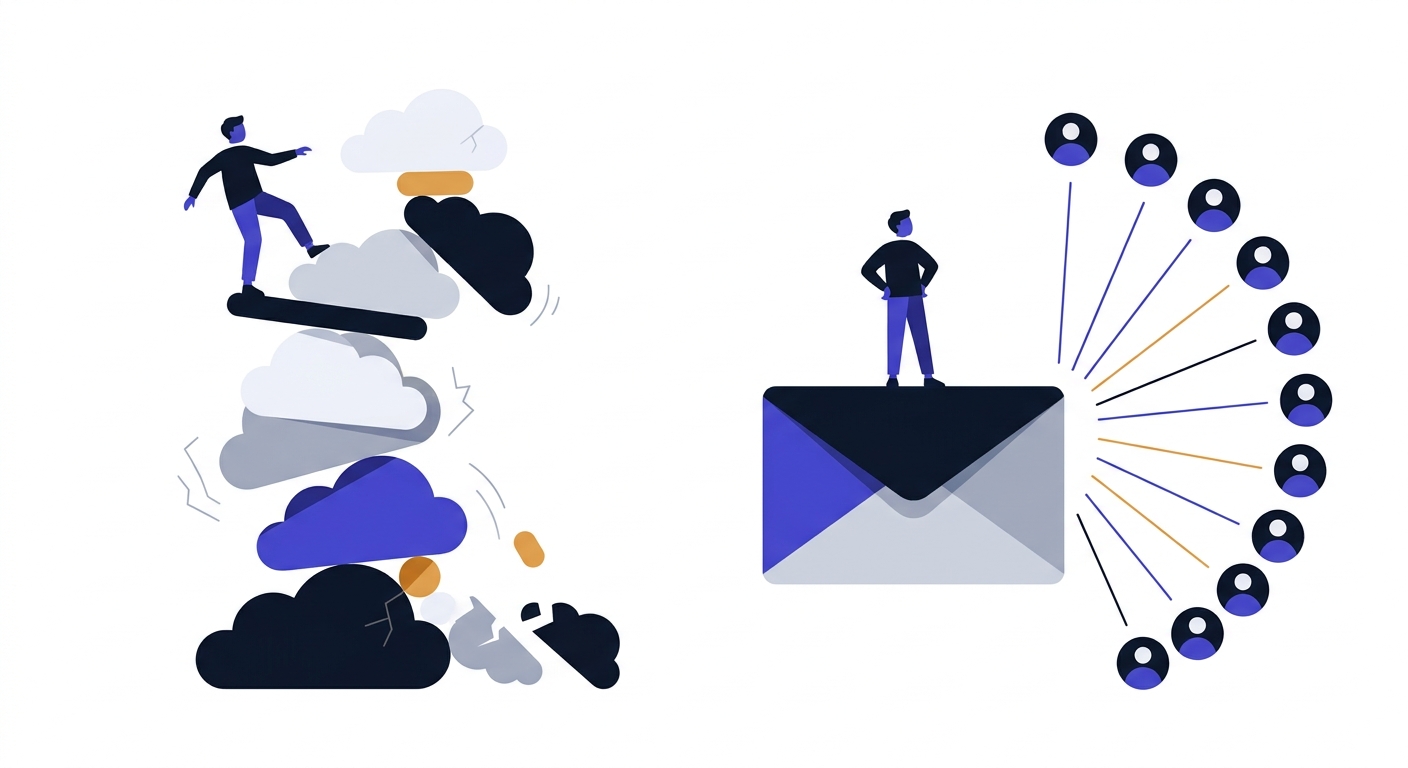
- Rented audiences — followers, fans, ad audiences, marketplace listings, search rankings. You can reach them, but only with the permission of an intermediary who controls the terms, the price, and the relationship.
- Owned audiences — your email list (and to a lesser extent, your SMS list and your customer database). You can export them, move them, contact them, segment them, and build a direct commercial relationship without anyone's permission.
Once you internalise this distinction, every subsequent decision in your marketing stack becomes clearer. You stop chasing vanity metrics on platforms that don't owe you anything, and you start building an asset that compounds — quietly, predictably, and in your favour.
The Landlord Problem
Here's the simplest analogy I know. Imagine you've spent five years building a thriving café in a beautiful building on the high street. You don't own the building. You rent it. The landlord can:
- Raise your rent at any time (rising CPMs, ad cost inflation)
- Change the rules about what you can sell or how you can display it (algorithm changes, content policy shifts)
- Decide that other tenants get more prominent signage than you (declining organic reach)
- Terminate your lease for a violation you didn't know you committed (account bans, shadow-bans, de-platforming)
- Sell the building to someone with completely different priorities (acquisitions, leadership changes, strategic pivots)
You can be the best café in the city. The food can be extraordinary. The reviews can be glowing. None of that protects you from the landlord. You are operating on borrowed ground.
That is precisely the position you are in with every social platform on which you've built a following. Your audience does not belong to you. It belongs to Meta, ByteDance, Google, Microsoft, or whoever else is running the building this quarter. You are paying rent — in content, in attention, in increasingly in actual cash to reach the people who once chose to follow you — and the landlord can change the deal at any time.
Email is different. Email is the equivalent of owning the building outright, with the customer's home address in your records and an explicit invitation to knock on their door.
Your email list is the one marketing asset nobody can switch off, throttle, or take away. Everything else is a lease.
A Tale of Two Bakers
Let me make this concrete with a scenario that has played out, in some form, thousands of times over the past few years.
Meet Sarah. She runs an artisan bakery in Bristol. Over four years of consistent posting — beautiful flat-lay photography of sourdough loaves, behind-the-scenes videos of early-morning bakes, the occasional reel that went viral — she built an Instagram following of just over 40,000 people. It became the engine of her business. Weekend pre-orders, pop-up announcements, new product launches, collaborations with local cafés — all of it flowed from Instagram. She estimated that 80% of her weekly revenue traced back to that single channel.
Then, sometime in the spring, something changed. Whether it was a tweak to the recommendation algorithm, a shift in how the platform prioritised video over photography, or simply the slow grind of declining organic reach that every creator eventually faces — Sarah's posts stopped landing. A post that would have reached 12,000 accounts six months earlier now reached 1,800. Engagement halved. Pre-orders dropped. Within eight weeks, her Saturday morning queue, once around the block, was barely filling the shop.
Sarah hadn't done anything wrong. She hadn't violated a policy. She hadn't changed her content. The landlord had simply changed the terms of her lease, and there was no appeals process.
Now meet Eleanor. Same town, similar bakery, similar quality. Eleanor has a smaller Instagram following — around 11,000 — but she'd done something Sarah hadn't. From day one, every Instagram post, every market stall, every customer interaction had included a soft invitation: "Join the bread list — Wednesday morning email, what's baking this weekend, first pick of the limited loaves." Slowly, deliberately, she'd built an email list of 6,000 subscribers.
When the same algorithm shift hit Eleanor, her Instagram reach collapsed too. But her Wednesday morning email — sent to 6,000 people who had explicitly asked for it — opened at 52%. Pre-orders that week were identical to the week before. The week after that. The month after that.
Eleanor's business didn't even notice the algorithm change. Sarah's nearly didn't survive it.
The difference wasn't talent, product quality, or work ethic. The difference was that Eleanor had spent four years quietly building an owned asset while Sarah had spent four years building on rented ground.
Why Email Specifically — And Not Just Any Direct Channel
You might reasonably ask: isn't SMS owned? Isn't a phone number owned? What about a Discord server, a Slack community, a private Telegram group?
Each of those has merits, and we'll touch on the channel mix in later lessons. But email occupies a unique position in the marketing stack for four reasons that no other channel matches simultaneously:
- Universality. An email address is the de facto identifier of adult digital life. Almost every working adult has one, uses it daily, and treats it as a permanent address. Phone numbers churn. Social handles get abandoned. Email persists.
- Portability. You can export your email list as a CSV file today, sign up with a different email service provider tomorrow, and import it without losing a single subscriber. No social platform offers anything remotely like this. Try exporting your Instagram followers and emailing them — you can't.
- Direct delivery. Subject to deliverability (which this course will teach you to master), your email lands in the recipient's inbox. There is no algorithm deciding which 4% of your followers see it. If 10,000 people are on your list and your sender reputation is healthy, 10,000 inboxes receive your message.
- Commercial intent is welcome. Social platforms quietly penalise outbound selling — too many product posts, too many links, and reach collapses. Email is one of the few channels where subscribers expect commercial messages, because they opted in knowing that's part of the deal.
Combined, these four properties make email the most reliable, scalable, and resilient direct-marketing channel ever invented for the small and medium business. It has been declared dead approximately every eighteen months since 2003, and each time the obituary has been spectacularly wrong.
Email as a Compounding Asset
Here's the subtler argument — the one that most marketers miss because they think in campaigns rather than in assets.
A paid ad is an expense. You spend £500, you get a result, the result ends when the ad stops. There is no residual asset. Tomorrow you start from zero again.
A social post is similar. It lives for a few hours, maybe a few days if it catches fire, and then it sinks into the feed never to be seen again. The follower count it generated is real but, as we've established, rented.
An email list behaves like a financial portfolio that you keep contributing to. Every new subscriber adds expected lifetime value. Every automation you build once — a welcome sequence, a cart-abandonment flow, a post-purchase upsell — keeps working in the background, generating revenue from new subscribers months and years after you wrote it. The list grows. The automations compound. The revenue per subscriber refines as you learn what works.
This is why mature direct-to-consumer brands often attribute 20–40% of total revenue to email and SMS combined, despite those channels representing a much smaller share of marketing spend. The arithmetic of an owned, automated asset is fundamentally different from the arithmetic of paid acquisition.
The Smart Stack: How Channels Work Together
I'm not arguing that you should abandon social media, stop running ads, or ignore SEO. That would be foolish. Each channel has a job to do, and the smartest marketing operations use them in concert.
Here is the framework I want you to hold in your head from this point forward:
- Social media and content marketing create awareness, build trust, and demonstrate expertise. Their job is discovery.
- Paid advertising buys reach at scale and accelerates the speed at which strangers find you. Its job is acquisition velocity.
- Search (SEO and PPC) intercepts existing demand from people already looking for what you sell. Its job is capture.
- Email (and SMS) nurtures the audience you've earned across all the above, converts them into customers, and retains them as repeat buyers. Its job is monetisation and retention.
Notice the flow. The first three are all funnels into email. Social posts include a link to a lead magnet. Ads drive traffic to a landing page with an opt-in form. SEO content offers a free guide in exchange for an email address. The entire purpose of your top-of-funnel work, from this point on, is to convert rented attention into owned subscribers.
A concrete example: a course creator spends £200 running ads to a free downloadable workbook. 400 people download it; the cost per lead is £0.50. Over the next six months, an automated email nurture sequence introduces those 400 subscribers to the creator's paid course, building trust through useful content and well-timed offers. Twelve of them buy a £197 course. That £200 ad spend has generated £2,364 in revenue — a return of nearly 12× — and the email sequence keeps running, paid for, ready to convert the next 400 leads.
That is the smart stack in action. Ads bought reach. The list captured it. Email monetised it. And the automation will keep monetising it for as long as the creator chooses to leave it running.
Exercise: The Owned vs Rented Revenue Audit
Take 10 minutes now and do this audit before moving on:
- List every marketing channel currently driving revenue or leads into your business — social platforms, paid ads, SEO, referrals, partnerships, email, anything else.
- Next to each, estimate the percentage of your monthly revenue that depends on it. (Be honest. If Instagram disappeared tomorrow, what % of revenue goes with it?)
- Mark each channel as OWNED or RENTED.
- Add up your OWNED percentage.
If less than 30% of your revenue depends on owned channels, you have a strategic fragility problem — and this course is about to fix it. Keep this number. We'll revisit it at the end of the programme to measure how far you've shifted the balance.
The Permission Principle
One last point before we close this opening lesson, because it underpins everything we'll do for the next 38 lessons.
The reason email works is not the technology. SMTP is forty years old. The reason email works is permission. Every person on your list, if you've built it properly, has explicitly raised their hand and asked you to email them. They've given you something more valuable than an address — they've given you an invitation.
This is the single greatest source of leverage you will ever have as a marketer, and it's also the easiest thing to destroy. Buy a list, scrape one from LinkedIn, import unconsented contacts from your CRM, or simply email people who didn't really sign up for what you're now sending — and you don't just face legal consequences (GDPR, PECR, CAN-SPAM, which we'll cover in Module 3). You destroy the very thing that makes email an asset in the first place: engagement, deliverability, and trust.
This is why I keep saying that a small, engaged, consented list of 500 people will outperform a bought list of 50,000 every single time. The 500 want to hear from you. The 50,000 will mark you as spam, tank your sender reputation, and ensure that even the people who do want your emails stop receiving them. Permission isn't a legal box to tick — it's the asset itself.
We'll spend Modules 2 and 3 of this course making sure your list is built on permission so solid that it could withstand a regulatory audit, a platform crisis, and a decade of compounding growth. That's the foundation. Everything else is built on top of it.
Key Takeaway
Your email list is the only audience asset that survives platform changes, algorithm shifts, account bans, acquisitions, and shifts in the broader marketing landscape. It is portable, exportable, directly addressable, and built on explicit permission. Every other channel — social, paid, organic search, marketplaces — is a lease. The strategic objective of this course is to systematically shift the centre of gravity of your marketing from rented ground to owned ground, so that your business is resilient by design, not by luck.
In the next lesson, we'll examine the honest economic case for email — including which ROI figures you should believe, which you should treat with scepticism, and how to model the actual return your specific business can expect.
Enjoyed this preview? Enrol to unlock all 51 lessons + your certificate.
Training a team? Buy seats for your team →