The ROI Case, Told Honestly
Where the famous numbers come from
If you've spent more than five minutes researching email marketing, you've encountered the headline figure: email returns around £35–£42 for every £1 spent. It appears in pitch decks, agency proposals, LinkedIn posts, and the opening slide of nearly every email marketing course on the internet. It's repeated so often that it has acquired the status of folklore — a number everyone knows but few can source.
So let's source it properly. The most-cited origin is the Data & Marketing Association (DMA), whose annual Marketer Email Tracker reports have historically placed email ROI in that £35–£42 band for UK marketers. Litmus, an email testing and analytics platform, has run parallel research showing a global figure that hovers in the same neighbourhood — roughly $36–$42 returned per $1 spent in recent years. Other research houses (Statista, McKinsey, HubSpot's State of Marketing) all produce numbers in the same magnitude. The figures move year to year, but the order of magnitude is remarkably stable: roughly 30x to 45x return, depending on the year and the sector surveyed.
By any reasonable comparison, this is extraordinary. Paid search typically returns somewhere between £2 and £5 per £1 in mature accounts. Display advertising rarely clears £2. Even strong organic social, when you can measure it honestly, struggles to compete once you factor in the cost of content production and the platform's relentless suppression of organic reach. Email isn't just better — on the published numbers, it's better by an order of magnitude.
This is the case that gets email a meeting with the CFO. It's also the case that, taken at face value, sets new marketers up for disappointment within ninety days of launching their first campaign.
Read the small print on the big number
Industry averages are directional, not contractual. The £42-per-£1 figure is an average across thousands of senders — many of whom are mature ecommerce brands with eight-figure lists, optimised automations, and years of sender reputation built up. If you launch a list next month and earn £8 per £1 in your first quarter, you are not failing — you are starting. Treating the headline number as a promise rather than a ceiling-to-aim-at is the single fastest route to burning out on email before you give the channel a chance to compound.
Why the average hides more than it reveals
Averages are deceptive in any channel, but they are especially deceptive in email because the distribution of returns is wildly skewed. A handful of senders earn returns far above the headline figure — £100, £200, even £500 per £1 in extreme cases — while a long tail of senders earn near zero, or actively destroy value by damaging their domain reputation and brand trust.
If you imagine email ROI as a bell curve, you imagine it wrong. It looks more like a hockey stick. A small number of well-run programs pull the average up dramatically; the median sender's return is materially lower than the mean. When you read "£42 per £1," you are reading a number inflated by the top performers. The question this course is built to answer is: how do you join them?
The honest answer is that three things — and really only three things — explain almost all of the variance between a list that returns £3 per £1 and a list that returns £80 per £1. Everything else is detail. Get these three right and the headline numbers stop being aspirational; they become a floor.
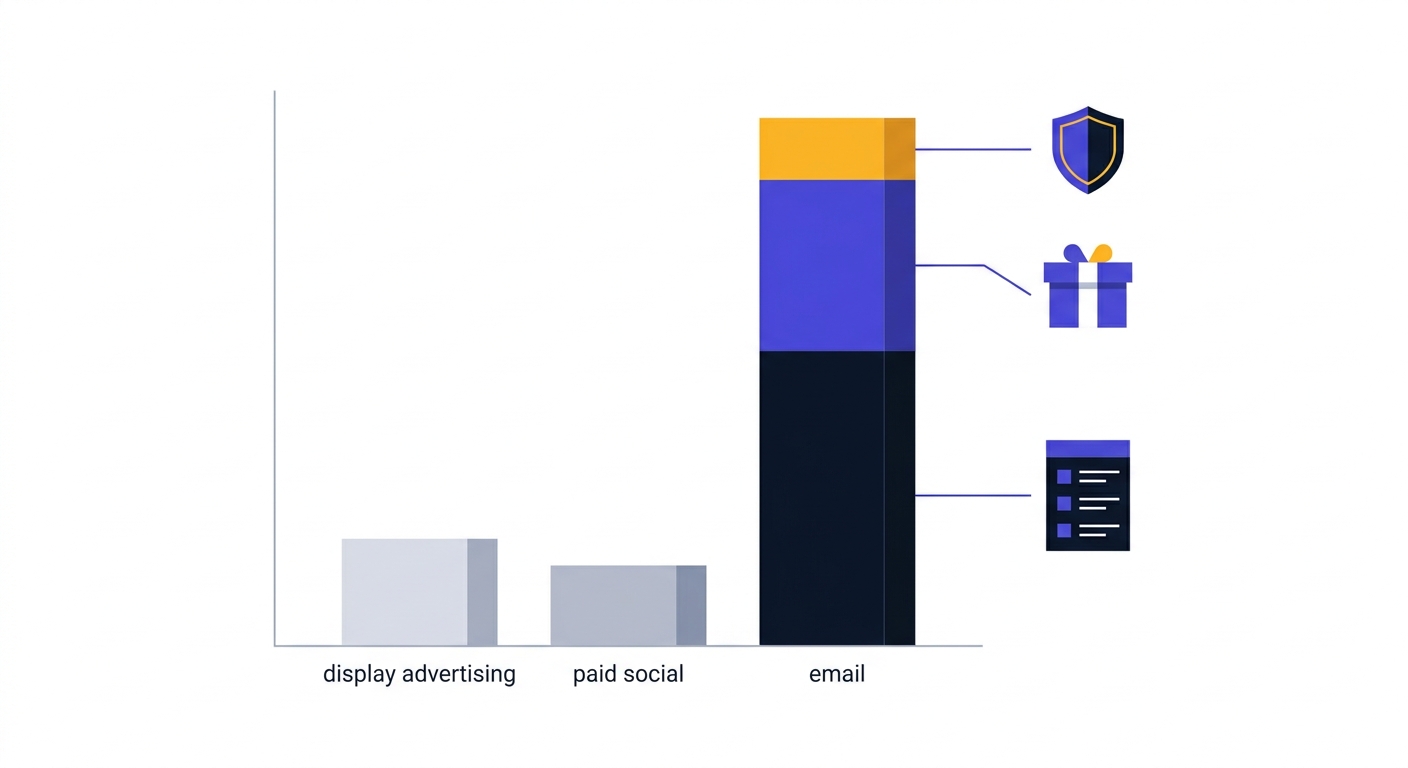
The three real levers of email ROI
Once you strip away the noise — the subject-line tricks, the design trends, the new AI tool launching this week — email economics come down to three compounding levers. Each one multiplies the others. Neglect any one and the whole equation collapses.
1. List quality
List quality is the most important variable in email and the most consistently underestimated. A list of 2,000 people who actively asked to hear from you, who opened your last three sends, and who bought something in the last year will out-earn a list of 50,000 cold or scraped contacts by an embarrassing margin.
Quality is a function of three things: how the contacts arrived (genuine opt-in vs. bought, scraped, or coerced), how engaged they are (recent opens, clicks, purchases), and how well-matched they are to what you sell (a fitness lead magnet attracts fitness buyers; a generic "win an iPad" competition attracts iPad hunters). The first determines whether you have legal and deliverability problems from day one. The second determines whether the inbox providers — Gmail, Outlook, Apple Mail — keep letting you reach the primary inbox. The third determines whether anyone actually buys.
This is why a small, engaged, consented list beats a big bought one every single time. It's not a slogan; it's arithmetic. A 2,000-person list with a 45% open rate and a 3% conversion rate on a £40 product generates £1,080 per send. A 50,000-person bought list with a 4% open rate, a 0.1% conversion rate, and an unsubscribe-and-spam-complaint storm generates £80 per send and a damaged domain reputation that costs you future revenue for months. Bigger is not better. Better is better.
2. Offer strength
The second lever is the offer — what you are actually asking the reader to do, and what they get in return. This is the variable most marketers want to skip past because it's not about email at all. It's about your product, your pricing, your positioning, and the value you create. Email is a delivery mechanism. If the thing being delivered is weak, no amount of beautiful design or clever subject lines will rescue it.
A strong offer has three properties: it is relevant to the specific segment receiving it, it is timely (it arrives when the reader has reason to act), and it is differentiated (it does something a generic ad cannot). "20% off everything, this weekend only" is a fine offer for a returning customer. It is a wasted send to someone who joined your list yesterday and doesn't yet know what you sell.
The reason offer strength is a lever rather than a constant is that email lets you match offers to segments in a way no other channel cheaply allows. We'll cover this in detail in Module 6, but the principle is simple: the same list, sent the same number of emails, will produce dramatically different revenue depending on whether each email lands in front of the right person at the right moment.
3. Sender reputation
The third lever is invisible to most marketers until it breaks. Sender reputation is the score the inbox providers — Gmail in particular — assign to your domain and IP, based on how recipients have behaved with your past emails. High reputation means your emails land in the primary inbox. Low reputation means Promotions tab, Spam folder, or quiet suppression at the gateway, where they aren't delivered at all and you never even see the bounce.
Reputation is built (and destroyed) by signals you can measure: open rates, click rates, spam complaints, unsubscribe rates, bounce rates, and authentication compliance (SPF, DKIM, DMARC — covered in Module 7). A sender who emails an engaged list with good content has a virtuous cycle: high engagement → high reputation → better inbox placement → higher engagement. A sender who blasts a stale list has the opposite: low engagement → falling reputation → more spam-folder placement → even lower engagement → eventual delivery collapse.
The cruel part of reputation is that it's asymmetric. It takes months of good behaviour to build and one bad campaign to damage. A single send to a purchased list, or a single emotional broadcast to people who haven't heard from you in two years, can undo a year of careful work. This is why list hygiene, sending cadence, and the discipline to not email certain segments are as important as the campaigns you do send.
How this course works the three levers
Almost every module in this course maps onto one of these three levers. It's worth seeing the map now, because it explains why we cover what we cover in the order we cover it.
- List quality is built in Modules 2, 3, 5, and 6 — list building and lead magnets, the legal and ethical frameworks that keep your list clean, the welcome sequence that qualifies new subscribers, and the segmentation that keeps it sharp.
- Offer strength is built in Modules 4, 5, 6, and 8 — understanding the lifecycle, designing automations that match offers to moments, segmenting so the right offer reaches the right person, and writing copy that makes the offer land.
- Sender reputation is built in Modules 7 and 10 — authentication, the 2024 bulk-sender rules, list hygiene, deliverability monitoring, and the analytics discipline that catches problems before they compound.
None of this is theoretical. Every module gives you a system you can implement against your own list this week. By the time you reach the Module 10 capstone, you'll have a programme designed to earn — not merely hope for — returns at the top end of the published benchmarks.
A small, engaged, consented list beats a big bought one every single time. It's not a slogan; it's arithmetic.
A realistic ROI trajectory
So what should you actually expect? Here is an honest sketch of what a well-built programme looks like over its first year, assuming you are starting from a small or non-existent list and following the system this course teaches.
- Months 1–3: Foundation. ROI is hard to measure because volume is low. You're building opt-in forms, lead magnets, the welcome sequence, and authentication. Returns might be £5–£15 per £1, but the absolute numbers are small. This is the investment phase. Resist the urge to abandon the channel here.
- Months 4–6: Compounding. Automations start firing reliably. The welcome sequence is converting at a measurable rate. Abandoned-cart and post-purchase flows kick in if you're ecommerce. Returns climb to £15–£30 per £1. The list is large enough that broadcasts move meaningful revenue.
- Months 7–12: Maturity. Segmentation is doing real work. You're running win-back flows on lapsed segments and lifecycle campaigns on engaged ones. Sender reputation is strong. Returns settle into the £25–£50+ per £1 range for most well-run programmes, with peaks well above that during seasonal campaigns.
These are not guarantees. They are the pattern we see in programmes that follow the disciplines this course teaches. Programmes that skip the foundations — that buy lists, neglect deliverability, or batch-and-blast — typically plateau at £3–£8 per £1 and stay there, blaming "email fatigue" for what is really a problem of execution.
What this honesty buys you
Other courses will tell you that email returns £42 per £1 and leave it at that. They will not tell you that the number is an average, that the distribution is skewed, that the median sender earns less, and that the gap between the top and the bottom of the distribution is almost entirely explained by three levers you can control.
This honesty matters for two reasons. First, it sets expectations that survive contact with reality — you will not give up in month two because your numbers don't match a deck. Second, it tells you exactly where to focus. You don't need to chase every new tactic, tool, or trend. You need to relentlessly improve list quality, offer strength, and sender reputation, in that order, for as long as you run the channel.
Everything else in this course is detail in service of those three things.
The takeaway: earn the high end, don't just quote it
The £35–£42 figure is real, but it's an average earned by senders who built systems. Your job over the next 38 lessons is not to hope for those returns — it's to earn the top end of them by building list quality, offer strength, and sender reputation into a compounding asset. Treat every lesson as a deposit into one of those three accounts.
Enjoyed this preview? Enrol to unlock all 51 lessons + your certificate.
Training a team? Buy seats for your team →