What First Aid Is: The Three Ps
By the end of this module, you'll be able to:
- State the three Ps of first aid and apply them to prioritise actions at an incident
- Identify an employer's legal duties under the Health and Safety (First-Aid) Regulations 1981, including the distinction between an appointed person and a qualified first aider
- Explain when implied consent applies and describe your obligations around accident records and casualty confidentiality
Welcome to the First Minutes That Matter Most
Somewhere in the United Kingdom right now, an ambulance is being dispatched. The average response time for a Category 1 call — the most life-threatening — currently sits at around 8 to 9 minutes, and for less critical emergencies it can stretch to 30, 60, even 90 minutes or more. That gap between the moment something goes wrong and the moment a paramedic kneels beside the casualty is the territory of the first aider. It is a territory measured not in hours but in heartbeats.
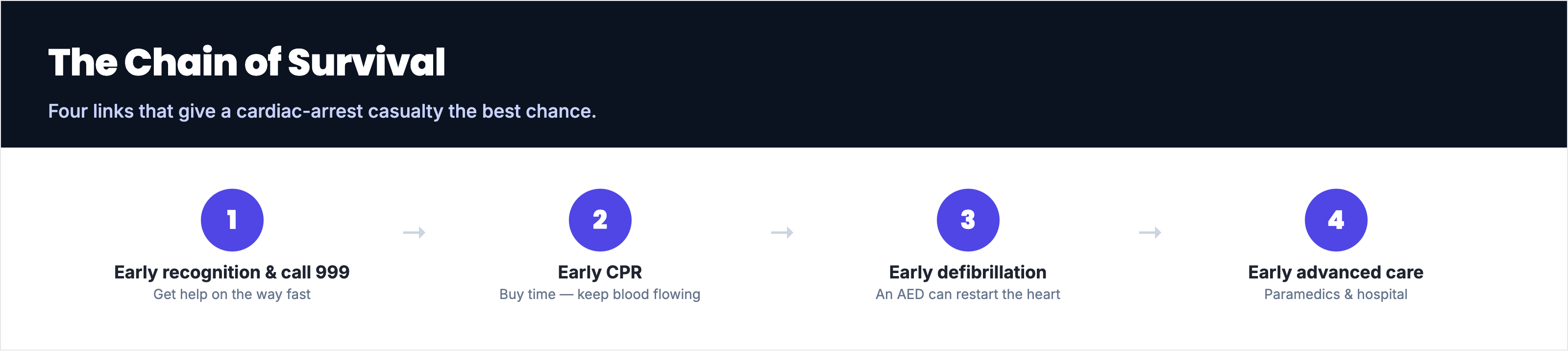
In those minutes, brains starve of oxygen, arteries empty, airways close, and shock deepens. But in those same minutes, a calm pair of hands can do extraordinary things. A bystander who starts chest compressions within the first minute of a cardiac arrest can more than double the casualty's chance of survival. A workplace colleague who cools a scald under running water for twenty minutes can prevent a lifetime of scarring. A friend who recognises the slurred speech of a stroke and dials 999 can save the brain tissue that holds a person's memories, language and personality.
This is the work of first aid: not heroic medicine, not advanced diagnosis, but skilled, decisive, deeply human help in the moments before the professionals arrive. And it begins with understanding precisely what first aid is — and, just as importantly, what it is not.
Defining First Aid
First aid is the immediate help given to a person who is injured or suddenly taken ill, before professional medical care arrives. Every word in that sentence does work.
- Immediate means you act now, with what you have, where you are. First aid is not a plan for tomorrow; it is a response to this moment.
- Help means assistance, not cure. A first aider supports the body's own efforts to survive while better-equipped help is summoned.
- Injured or suddenly taken ill covers the full spectrum — from a paper cut to a cardiac arrest, from a bee sting to a stroke.
- Before professional medical care arrives defines the boundary. First aid is pre-hospital, pre-paramedic, pre-doctor. It is the bridge, not the destination.
This bridge metaphor matters. A first aider is not trying to replace the hospital; they are trying to get the casualty to one — alive, stable, and in the best possible condition to receive definitive treatment.
The Three Ps: The Compass of Every First Aider
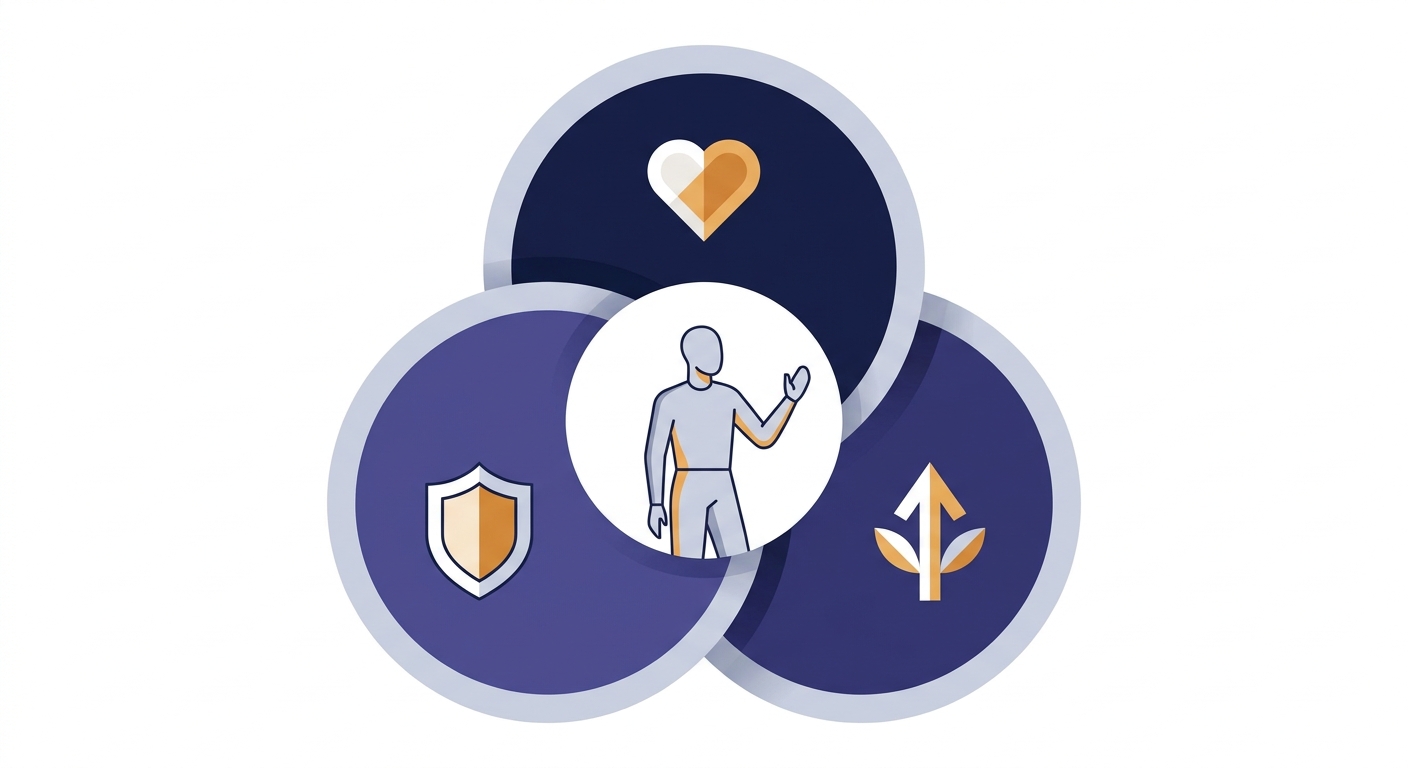
Throughout this course, you will learn dozens of techniques — how to deliver chest compressions, how to control catastrophic bleeding, how to recognise anaphylaxis, how to manage a seizure. The procedures will multiply. But beneath every single one of them lies a single, unchanging set of priorities. We call them the three Ps:
- Preserve life
- Prevent the condition worsening
- Promote recovery
These are not slogans. They are a hierarchy. They tell you, in any emergency, what to do first, what to do next, and what to do once the immediate danger has passed. When you do not know what to do — and even seasoned first aiders have moments of doubt — return to the three Ps. They are the compass.
1. Preserve Life
This is the first and most absolute priority. Nothing else matters if the casualty does not survive the next few minutes. To preserve life, a first aider focuses on the three things that kill people fastest: a blocked airway, the absence of breathing, and catastrophic bleeding. Everything in the famous DR ABC primary survey, which you will meet in Section 2, exists to serve this single P.
Consider a real workplace example. An office worker collapses in a meeting room. A colleague — you — arrive. Preserving life means, in this order: making sure the room is safe to enter (no exposed wires, no spilled chemicals); checking whether the person responds; opening their airway with a head-tilt and chin-lift; checking for normal breathing; and, if breathing is absent or abnormal, starting CPR and calling for an AED. You are not yet thinking about why they collapsed. You are not yet thinking about their medical history. You are preserving life — keeping oxygenated blood moving through the body until the ambulance arrives.
Crucially, preserve life also includes your own. A first aider who becomes a second casualty does not help anyone. If a colleague has been electrocuted, your first life-preserving act is not to rush forward but to ensure the power is off. If someone has collapsed on a busy warehouse floor, you may need to stop the forklift traffic before you kneel down. The casualty's life and your life are both protected by the same P.
2. Prevent the Condition Worsening
Once life is no longer in immediate danger, the next aim is to stop things getting worse. The body, once injured, often continues to deteriorate without intervention. Bleeding that was manageable becomes shock. A simple fracture becomes a complicated one if the casualty is moved carelessly. A small burn becomes a deep one with every additional second of exposed heat.
Picture a kitchen worker in a busy restaurant who tips a pan of boiling stock over their forearm. They are conscious, breathing, and not bleeding catastrophically. Life is not in immediate danger. But the burn is still burning — heat continues to drive deeper into the tissues for several minutes after contact ends. Preventing worsening means getting that arm under cool running water for at least 20 minutes, removing rings and watches before the swelling sets in, and covering loosely with cling film to keep contaminants out. You haven't healed the burn. You have stopped it from becoming a life-changing injury.
Or consider a warehouse operative who has fallen from a ladder and is complaining of back pain. They are conscious and alert. Preventing worsening means keeping them still, supporting the head and neck, and resisting every well-intentioned instinct to "help them up". An unstable spinal injury that is moved can become a permanent one. Sometimes, preventing worsening means doing less, not more.
3. Promote Recovery
The third P is the most often overlooked, and in some ways the most distinctively human. Promoting recovery means everything you do to make the casualty's experience better — physically, emotionally, and psychologically — both in the moment and in the hours that follow.
This is reassurance. This is keeping someone warm with a foil blanket when they are pale and shocked. This is holding the hand of an elderly woman who has fallen in the car park while you wait for the ambulance. This is staying calm yourself, because your calm is contagious. This is using the casualty's name. This is explaining what you are doing before you do it. This is gathering their belongings, calling their next of kin, and giving the paramedics a clear handover so the chain of care is not broken.
Research consistently shows that casualties who feel cared for during an emergency recover faster, experience less post-traumatic stress, and remember the incident as something they survived rather than something that traumatised them. Promoting recovery is not a soft skill. It is a clinical intervention with measurable outcomes.
The Boundary: What a First Aider Is Not
The three Ps tell us what a first aider does. It is equally important to be clear about what a first aider is not.
A first aider is not a doctor. You do not diagnose. You recognise signs and symptoms, treat what you see, and call for the right help. You do not need to know whether the casualty is having a heart attack, an aortic dissection or severe heartburn — you need to recognise central chest pain, sit them down, call 999, and be ready to start CPR if they deteriorate.
A first aider is not a paramedic. You do not administer medication (with two narrow exceptions you will learn about: helping a casualty take their own prescribed inhaler or auto-injector, and offering aspirin to a suspected heart-attack casualty). You do not perform invasive procedures. You do not make decisions about hospital destinations.
A first aider is not obliged to act beyond their training. The scope of an Emergency First Aid at Work (EFAW) qualification is deliberately bounded. You are trained to handle the most common life-threatening emergencies long enough for professional help to arrive. You are not expected to manage a multi-casualty incident single-handedly or perform procedures you have never been taught.
This boundary is not a limitation — it is a liberation. Knowing what you are not responsible for frees you to do what you are responsible for with confidence and clarity. The first aider's job description is short and powerful: keep the casualty alive, stop things getting worse, make them as comfortable as possible, and get the right help on the way. That is enough. That is everything.
A first aider doesn't need to diagnose or treat like a doctor. They need to keep the casualty alive and stable, get the right help, and do no harm.
The Mindset Before the Method
Before we go any further into procedures, protocols and primary surveys, understand this: the single most important thing you bring to an emergency is not your knowledge of CPR ratios. It is not your ability to recite the FAST test. It is your mindset.
The first aider's mindset has three qualities.
Calm. Emergencies are chaotic; your job is to be the still point at the centre. Speak slowly. Move deliberately. Breathe. A casualty who senses panic around them deteriorates faster — physiologically, their heart rate rises, their breathing shallows, their shock deepens. A casualty who senses competent calm stabilises. Your composure is medicine.
Decisive. In an emergency, the worst decision is often no decision at all. A reasonable action taken now beats a perfect action taken too late. The three Ps give you permission to act: if what you are about to do serves Preserve, Prevent or Promote, and falls within your training, do it.
Humble. Know the edge of your competence and call for help the moment you reach it. 999 is not a last resort — it is one of your primary tools. The call handler is trained to coach you through CPR, choking, childbirth and more. You are never alone in an emergency once that line connects.
Throughout the rest of this course, every technique you learn will be a way of expressing these three qualities in action. The skills are the vocabulary; the mindset is the language.
Reflection Exercise: Map Your Memory to the Three Ps
Before you read on, take five minutes for this exercise. It will sharpen everything that follows.
Bring to mind a real incident you have witnessed or been involved in — it could be a workplace accident, a household injury, someone fainting on a train, a child choking at dinner, anything. Picture it as clearly as you can.
Now, on paper or in your head, map what happened against the three Ps:
- Preserve life: Was anyone's life in immediate danger? What was done — or could have been done — in the first 60 seconds to protect it?
- Prevent worsening: What actions stopped (or failed to stop) the situation from deteriorating? Was anyone moved when they shouldn't have been? Was a burn cooled? Was bleeding controlled?
- Promote recovery: How was the casualty made to feel? Was someone reassuring them? Were they kept warm? Was the handover to professionals clear?
Identify one thing that was done well, and one thing that, with what you now know, you would do differently. Write it down. This single exercise, repeated for every incident you encounter throughout your life as a first aider, is how good first aiders become great ones.
Lesson Summary & What's Next
Key takeaways from this lesson:
- First aid is the immediate help given to an injured or suddenly ill person before professional medical care arrives. It is a bridge to definitive treatment, not a substitute for it.
- Every first-aid decision serves one or more of the three Ps: Preserve life, Prevent the condition worsening, and Promote recovery — in that order of priority.
- Preserving life always includes your own life. A first aider who becomes a second casualty helps no one.
- A first aider does not diagnose, prescribe or perform advanced procedures. They recognise, respond, summon help, and provide care within their training.
- The first aider's most important asset is not knowledge but mindset: calm, decisive, humble. Your composure is itself a clinical intervention.
- The 999/112 call handler is part of your team. Calling early is a sign of competence, not failure.
In the next lesson, we move from the why to the where: the legal framework that surrounds first aid in the UK workplace, including the Health and Safety (First-Aid) Regulations 1981, what your employer is required to provide, and what your role looks like on paper as well as in practice.
Enjoyed this preview? Enrol to unlock all 38 lessons + your certificate.
Training a team? Buy seats for your team →