Meet Legionella: The Bacteria Behind the Disease
Meet the Organism at the Heart of This Course
Before we talk about law, risk assessments, temperature regimes or written schemes of control, we need to meet the organism that all of this exists to manage. Because here's the truth that surprises most people when they first encounter it: Legionella is not some exotic, foreign contaminant that sneaks into our buildings from outside. It is a perfectly ordinary, naturally occurring bacterium that lives — in tiny, harmless numbers — in just about every body of fresh water on Earth.
Scoop a glass of water from a Scottish loch, a Welsh river, a Yorkshire reservoir or a puddle in a Birmingham car park, and there is a reasonable chance that somewhere in that water sits a small population of Legionella bacteria. They are part of the background biology of the planet. They have been there for millions of years, long before humans built copper pipework, calorifiers, cooling towers and spa pools to give them somewhere more comfortable to live.
This is the single most important idea to grasp at the start of this course, because it reframes the entire job of the Responsible Person. Your role is not to eliminate Legionella from the natural world — that would be impossible, and pointless. Your role is to stop your building from turning a few harmless bacteria into a dangerous, infectious dose.
Where Legionella Lives in Nature
The genus Legionella contains around 60 recognised species, of which Legionella pneumophila is by far the most clinically significant — responsible for the great majority of cases of Legionnaires' disease in the UK and worldwide. Within that species, serogroup 1 is the strain most commonly associated with human illness.
In their natural habitat, these bacteria are quietly unremarkable. They live in:
- Freshwater lakes, rivers, streams and ponds — usually in very low concentrations, kept in check by competition with other microorganisms, predation, dilution and the absence of ideal growth conditions.
- Damp soil and compost — particularly compost made from peat-free materials, which is why gardeners are advised to wear masks when opening bags of compost and to dampen the contents before handling.
- Biofilms — slimy microbial communities that coat the surfaces of stones, sediments and submerged objects in any natural water body.
Crucially, Legionella has a peculiar lifestyle that turns out to be central to its danger. It is what microbiologists call an intracellular parasite of free-living amoebae. In plain English: it invades single-celled organisms called amoebae and protozoa, hijacks their machinery, multiplies inside them, and then bursts out to find new hosts. This evolved relationship with amoebae is no biological footnote — it is the reason Legionella is so well-equipped to survive in plumbing systems and, ultimately, inside the cells of the human lung.
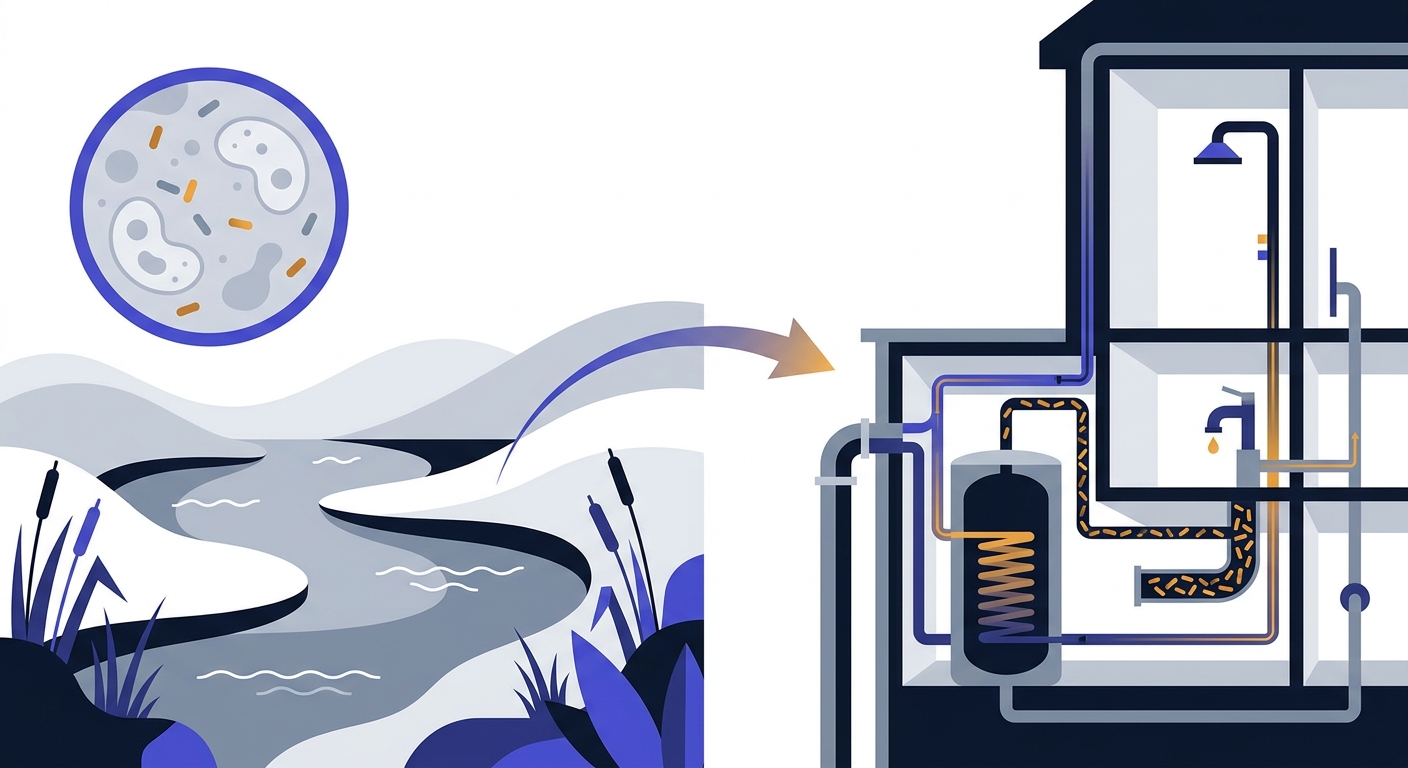
From Harmless to Hazardous: The Amplification Problem
If Legionella is everywhere in nature and yet most of us go through life without ever becoming ill from it, what changes? Why does this organism cause hundreds of confirmed cases of Legionnaires' disease in the UK every year, with a case-fatality rate of around 10%?
The answer is a single word that every Responsible Person needs to commit to memory: amplification.
In a river, Legionella might exist at concentrations of perhaps one or two organisms per litre of water — far too few to cause infection even if you somehow inhaled them as a mist. Cold, flowing, sunlit, oxygen-rich, full of competing microbes — natural water is a hostile environment for Legionella to multiply in. The bacteria persist, but they do not thrive.
Now consider what happens when that same water enters the built environment. It passes through the water treatment works (which removes most, but rarely all, Legionella), travels through the mains, and arrives at your building. From the moment it crosses the boundary into your premises, it enters a world that has been, quite unintentionally, designed to suit Legionella:
- Warmth. The bacteria grow best between 20°C and 45°C — exactly the temperature range found in tepid pipework, lukewarm hot water tanks, the warm parts of calorifiers and the dead-leg pipes that sit in heated ceiling voids.
- Stagnation. Pipework that is rarely used — a guest bathroom in a hotel, a shower in a void flat, a tap at the end of a corridor — allows water to sit still for days or weeks. Flow disrupts biofilm formation; stillness encourages it.
- Nutrients. Rust, scale, sediment, sludge, rubber and natural organic matter all provide nutrients. So do the dead bodies of other microbes. A poorly-maintained shower head accumulates exactly the buffet Legionella needs.
- Surfaces and biofilm. Inside every pipe, tank and fitting, a thin biofilm forms over time. This biofilm is a microbial city — and Legionella, hiding within amoebae that graze on the biofilm, can multiply to enormous numbers while remaining shielded from disinfectants.
This is amplification. A handful of bacteria in the incoming mains supply can, given a few weeks in the right conditions, become millions of bacteria per litre at the outlet. And once you have that kind of population sitting behind a shower head, all it takes is for someone to turn on the tap.
The Aerosol Connection
We will go much deeper into the route of infection in lesson four, but it is worth understanding the basic mechanism now, because it explains why amplification matters so much. Legionella does not cause illness when you drink contaminated water — your stomach acid handles it without difficulty. It causes illness when you inhale it, deep into your lungs, in the form of tiny airborne water droplets known as aerosols.
Aerosols are produced wherever water is sprayed, splashed, agitated or vaporised: showers, spray taps, spa pools, cooling towers, decorative fountains, humidifiers, vehicle wash systems, even the bubbling agitation in a poorly-designed cold water tank. The smaller the droplet, the deeper it can travel into the respiratory tract. Droplets under about 5 micrometres can reach the alveoli — the delicate gas-exchange sacs at the very base of the lung. If those droplets contain Legionella, and if the person inhaling them is susceptible, infection can follow.
This is why every system that produces aerosols, in every building you are responsible for, deserves your attention. A cold tap that fills a kettle is low risk. A shower that has not been used for three weeks in a vacant flat is a different proposition altogether.
The problem isn't that Legionella exists in nature — it's what happens when our buildings give it a home.
Why Buildings Are Such Good Hosts
It is worth pausing to appreciate just how comprehensively the modern built environment caters to this bacterium. We did not set out to design Legionella incubators — but we did, and understanding why is the first step to undoing the damage.
The Engineering Story
Until the mid-20th century, plumbing was relatively simple: cold water in, hot water heated to high temperatures (often well over 60°C) and delivered without much storage, short pipe runs, and frequent use of every outlet because buildings were occupied differently than they are now. There were fewer hidden voids, less complexity, and less of the lukewarm-tepid water that Legionella loves.
Then several things changed at once. Energy-efficiency drives in the 1970s and 1980s encouraged lower hot water storage temperatures to save fuel. Anti-scald regulations in care homes, hospitals and increasingly in domestic settings introduced thermostatic mixing valves (TMVs) that blend hot and cold water at the outlet — creating a small but persistent reservoir of perfectly warm water inside the valve and the short pipe downstream. Modern buildings became larger, more complex, with longer pipe runs, more redundancy, more capped-off branches from refurbishments, and more rarely-used outlets in en-suite bathrooms, accessible toilets, cleaners' sinks and emergency showers.
Add in the rise of cooling towers, evaporative condensers, spa pools, decorative water features, vehicle washes, misting systems for produce displays and humidifiers — and you have a built environment that, from Legionella's perspective, is paradise.
The Occupancy Story
Buildings also changed in how they are used. A hotel might run at 40% occupancy for half the year, leaving rooms and their showers unused for days at a time. A university hall stands empty all summer. A school's swimming pool changing rooms get used for ten weeks then closed for six. The COVID-19 pandemic taught us all, painfully, what happens when entire office blocks sit empty for months — and the surge of Legionella risk that accompanies reopening.
Every gap in use is a gap during which the water in the system sits still, warms or cools to lukewarm, and gives the biofilm time to thicken. Every reopening is a moment when long-undisturbed bacteria can suddenly be aerosolised by a returning user.
The One Idea to Take from This Lesson
Legionella is everywhere in low numbers — that is normal and unavoidable. The job of the duty holder and Responsible Person is not to eliminate the bacterium from the natural world, but to stop your building from amplifying it into dangerous concentrations. Every control measure in this course — temperature regimes, flushing, descaling, design changes, monitoring — is ultimately a way of denying Legionella the four things it needs to multiply: warmth, stagnation, nutrients and surfaces to colonise.
A Short History You Should Know
The bacterium itself only entered medical science in 1976, which is remarkably recent. In July of that year, an outbreak of severe pneumonia struck delegates at the American Legion convention at the Bellevue-Stratford Hotel in Philadelphia. 182 people fell ill and 29 died. The illness had no obvious cause. For six months, public health investigators were baffled.
It was not until January 1977 that scientists at the US Centers for Disease Control identified a previously unknown bacterium, growing in the hotel's cooling tower system, as the cause. They named it Legionella pneumophila — literally, 'lung-loving bacterium of the legionnaires'. The disease took the name of its first famous victims.
What is striking, in retrospect, is that this was not a new disease. Once microbiologists knew what to look for, they were able to go back and identify Legionella as the cause of earlier unexplained outbreaks stretching back to the 1940s and 1950s — including the Pontiac fever outbreak of 1968 in Michigan, and the Lochgoilhead fever outbreak that gave the milder Scottish variant its name. Legionnaires' disease had been killing people for decades; we simply did not have the science to recognise it.
The UK had its own watershed moment in 1985, when an outbreak at Stafford District General Hospital killed 28 people and infected at least 175. The official inquiry that followed laid the groundwork for the regulatory framework you will learn about in Section 2 of this course — the Approved Code of Practice L8, the HSG274 guidance, and the entire culture of risk assessment and written schemes of control that we now take for granted. Every hour you spend on Legionella management today is, in a sense, part of the legacy of Stafford and the dozens of UK outbreaks that have followed it.
What the Bacterium Actually Looks Like
If you put Legionella under a powerful microscope, you would see a small, slender, rod-shaped bacterium — typically about 0.5 micrometres wide and 2 to 20 micrometres long. It is what microbiologists call Gram-negative, meaning it has a particular kind of cell wall that influences how it interacts with antibiotics. It moves using whip-like tails called flagella, which is part of how it gets around inside biofilms and amoebae.
None of this matters much for your day-to-day work as a Responsible Person — you will never need to identify Legionella down a microscope. But it matters for understanding two practical points:
- Legionella is fragile in the open environment. Sunlight, drying out and chlorine all kill it readily. This is why it does not thrive in clean, well-treated, well-flowing water systems.
- Legionella is exceptionally well-protected inside biofilms and amoebae. Once it is hidden in a biofilm or inside a host amoeba, it becomes far more resistant to disinfectants, chlorine residuals and even brief exposures to high temperatures. This is why long-neglected systems are so hard to bring back under control — and why prevention is enormously easier than remediation.
Reframing the Job Ahead
Now that you have met the organism, you are in a position to understand the entire rest of this course differently. Everything that follows — every regulation, every temperature target, every flushing log, every risk assessment review — is a practical answer to one question:
How do we make our building a worse home for Legionella than the river it came from?
That is the question the law asks you. It is the question the HSE inspector asks you. It is the question the bereaved family of an outbreak victim would ask you. And it is the question that, by the end of this course, you will be able to answer with confidence for every system in every building under your care.
In the next lesson, we will look at the three illnesses Legionella can cause — Legionnaires' disease, Pontiac fever and Lochgoilhead fever — so that you understand not just the organism, but the human cost of getting this wrong. Then we will turn to how those bacteria actually reach human lungs, who is most vulnerable, and what the law requires you to do about it.
Try This Before the Next Lesson
Take five minutes now to walk through a single building you are responsible for, and look at it through Legionella's eyes. Where is the water warm but not hot? Where does it sit still? Where are the dead-end pipes, the rarely-used outlets, the shower heads furred with scale? You are not assessing risk yet — that comes later. You are simply learning to see the building the way the bacterium does. This habit of perception is the foundation of everything else you will learn.
Enjoyed this preview? Enrol to unlock all 44 lessons + your certificate.
Training a team? Buy seats for your team →