Welcome: Why Legionella Awareness Matters
By the end of this module, you'll be able to:
- Explain what Legionella bacteria are and describe the illnesses they cause, including Legionnaires' disease, Pontiac fever and Lochgoilhead fever
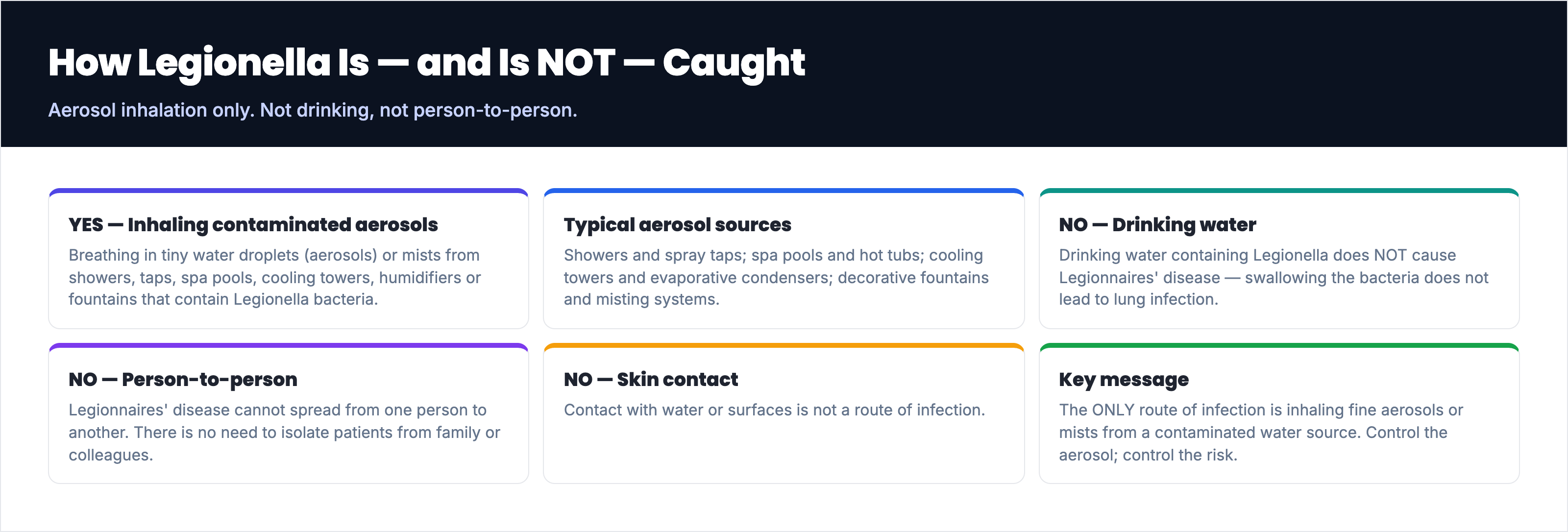
- State the correct route of infection — inhaling contaminated aerosols — and confidently explain why drinking water and person-to-person contact are not routes of transmission
- Identify the people most at risk of serious illness from Legionella
Welcome to the Definitive UK Course on Legionella Awareness
In the time it takes you to read this paragraph, somewhere in the UK a shower will be turned on in a guest room that hasn't been used for three weeks. A tap will run lukewarm in a rented flat between tenancies. A care home maintenance technician will glance at a hot water cylinder gauge reading 54°C and make a mental note to come back to it later. Each of these moments — utterly ordinary, utterly invisible — is where the story of Legionnaires' disease begins.
This course exists because Legionella is not a rare or exotic threat. It is a bacterium that lives, in tiny numbers, in almost every natural water source in Britain. It becomes dangerous only when our buildings give it what it needs to multiply — and then disperse into the air we breathe. Every shower, every spa, every cooling tower, every hot tap is a potential delivery system. And every duty holder, responsible person and frontline worker is a potential line of defence.
Who this course is for
You are in the right place if you have any responsibility — formal or informal — for a building or a water system in the United Kingdom. That includes:
- Landlords and letting agents managing rented housing, HMOs, student lets and holiday properties
- Facilities, estates and maintenance staff in offices, schools, factories and public buildings
- Building and site managers with day-to-day operational oversight
- Care home managers, nurses and support staff caring for elderly and vulnerable residents
- Hotel, B&B, hostel and holiday-let operators with guest rooms that may stand empty between bookings
- Leisure-centre, gym and spa operators running showers, pools, hot tubs and steam rooms
- Dentists, GPs and healthcare premises managers running dental chairs, hand-wash basins and clinical water systems
- Plumbers and heating engineers whose installation and repair decisions shape risk for years afterwards
- Appointed "responsible persons" and duty holders who carry the legal accountability
You do not need a technical background. You do not need to have read ACOP L8 cover to cover. By the end of this course you will have done the equivalent of both — and considerably more. You will understand the bacterium, the diseases it causes, the law that compels you to act, the systems where it thrives, and the practical controls that keep it in check. You will know what good looks like, what bad looks like, and what to do about either.
Be honest about scope: what this course is, and isn't
This is an awareness-level course. Its purpose is to build the knowledge you need to recognise risk, fulfil your legal duties, communicate effectively with specialists, and apply sensible day-to-day controls.
It does not qualify you as a "competent person" to carry out a Legionella risk assessment, design a written scheme of control, or undertake complex remediation on a high-risk system such as a cooling tower. Those tasks require deeper, hands-on training, demonstrable experience and — frequently — specialist contractors.
Your own site's Legionella risk assessment, written scheme of control and the judgement of your appointed competent persons always take precedence over any general guidance in this or any other course. Where this course and your site documents differ, follow your site documents — and ask why the difference exists.
Why awareness saves lives
Legionnaires' disease is a serious pneumonia. In the United Kingdom it hospitalises hundreds of people every year and kills roughly one in ten of those it infects — a case-fatality rate higher than most illnesses you can name. It disproportionately strikes people who are already vulnerable: the elderly, smokers, those with chronic lung or kidney disease, people whose immune systems are weakened by treatment or illness. In other words, the very people who live in the care homes, attend the hospitals, rent the homes and stay in the hotels that you and your colleagues are responsible for.
And here is the part that should sharpen every duty holder's attention: almost every documented outbreak in the UK has been preventable. The conditions Legionella needs to multiply — warm water, stagnation, nutrients, aerosols — are conditions we create or tolerate through neglect, bad design, or simple ignorance. The same conditions are eliminated, just as routinely, by people who know what to look for and what to do.
The eight modules ahead
This course is structured as eight tightly-built modules — thirty-four lessons in total — each layered on the last. We have designed them so that no module assumes specialist knowledge from the one before, but every module rewards attention to detail.
- What Legionella is and the diseases it causes. We start with the science: the bacterium itself, the illnesses it causes (Legionnaires' disease, Pontiac fever, Lochgoilhead fever), how infection actually happens through aerosolised droplets, and who is most at risk. Get this foundation right and everything else makes sense.
- The law and your legal responsibilities. The Health and Safety at Work etc. Act 1974, COSHH 2002, ACOP L8, HSG274 — and the chain of accountability from duty holder to responsible person to frontline staff. We pay particular attention to landlords, because the rented-property duty is widely misunderstood.
- Where Legionella grows: conditions and systems. The four growth conditions in detail; the higher-risk systems from cooling towers to humidifiers; and the hidden risks of dead legs, blind ends and little-used outlets that lurk in almost every building.
- The Legionella risk assessment. What it is, who can do it, what it must contain, and how the written scheme of control turns assessment into action. Crucially: when it must be reviewed.
- Controlling the risk. The practical controls — temperature, flushing, cleaning, design, maintenance, water treatment — and what frontline staff can do every single day to keep a system safe.
- Monitoring, sampling and record-keeping. What you measure, how often, where, and how you prove compliance when an inspector, an insurer or a coroner asks.
- The responsible person, competence and communication. Who should be appointed, what training they need, when to call in specialists, and how to keep information flowing across the team.
- Legionella control in practice. Real UK settings — rented properties, care homes, healthcare premises, hospitality and leisure — and a final synthesis lesson where you build your own action plan.
The modules build on one another, but each lesson is also designed to stand alone as a reference you can return to. Bookmark the ones most relevant to your role; you will come back to them.
Legionnaires' disease is not caused by Legionella bacteria. It is caused by the gap between what we know about Legionella bacteria and what we actually do about them.
What you will be able to do by the end
By the time you complete the final lesson you will be able to:
- Explain in plain language what Legionella is, how it causes disease, and why some people are more vulnerable than others
- Identify the conditions and systems in your own building that pose the greatest risk
- Recognise the legal framework that governs your responsibilities and articulate where your personal duties sit within it
- Interpret a Legionella risk assessment and written scheme of control — and know when one needs reviewing
- Apply the day-to-day controls (temperature checks, flushing regimes, cleaning routines) that prevent bacterial growth
- Maintain the records you need to demonstrate compliance to regulators, insurers and the courts
- Communicate effectively with specialists, contractors, colleagues and tenants about Legionella risk
- Build a personal action plan for your own site, role and circumstances
That is a substantial body of competence. It will not make you a Legionella consultant — and it should not. What it will make you is the kind of duty holder, responsible person or frontline worker who notices the lukewarm tap, asks the right question about the empty flat, queries the cylinder temperature, and quietly prevents the outbreak that nobody ever hears about because it never happened.
Your key takeaway from this lesson
This course builds the knowledge to recognise risk, meet your legal duties, and apply practical controls. It is rigorous, evidence-based, and aligned with current UK guidance (ACOP L8, HSG274 and supporting HSE materials at the time of writing).
Treat it as both a learning experience and a working reference. Take notes. Pause on the case studies. Do the exercises. And when you return to your building tomorrow, look at the water system with new eyes — because the people who depend on it are counting on you to.
In the next lesson we meet the organism itself. Where does Legionella come from? Why does it like our buildings so much more than the lakes and rivers it evolved in? What makes it so successful at finding human lungs? Understanding the bacterium is the foundation for everything that follows — so let's begin.
Enjoyed this preview? Enrol to unlock all 44 lessons + your certificate.
Training a team? Buy seats for your team →