Defining Equality, Diversity and Inclusion
Three Words That Shape Everything
Equality. Diversity. Inclusion. You will hear these three words spoken together so often — in policies, on websites, in training rooms, at conferences — that they can begin to blur into a single concept. EDI. Three letters. One acronym. One vague good thing that organisations are supposed to be 'doing'.
That blurring is dangerous. It is dangerous because each of these three words means something genuinely different, and a workplace can be strong on one whilst being weak — even catastrophically weak — on the others. An organisation can be diverse without being inclusive. It can pursue equality whilst still producing unequal outcomes. It can have an inclusion strategy that never touches the structural barriers that keep certain people out in the first place.
Throughout this course, we are going to ask you to think precisely. EDI work fails most often not because people are uncaring or unwilling, but because they are imprecise. They use 'diversity' when they mean 'inclusion'. They promise 'equality' when what they actually need to deliver is 'equity'. They run unconscious bias training and call it culture change. The vocabulary muddles the action.
So before we go any further — before we open the Equality Act 2010, before we examine microaggressions or reasonable adjustments, before we discuss psychological safety or active bystander skills — we need a shared, precise language. This lesson builds that language. By the end of the next twenty minutes, you will be able to define each term cleanly, explain how they relate, and recognise the very common ways they get confused in practice.
This is foundational work. Get it right here, and everything that follows in this course will land more clearly.
Equality: The Floor, Not the Ceiling
Equality means fair treatment and equal access to opportunity. It is the principle that a person's race, sex, age, disability, religion, sexuality, or any other personal characteristic should not determine how they are treated at work or what doors open to them.
In the UK, equality is not just a value — it is a legal obligation. The Equality Act 2010, which we will study in depth in the next section, makes it unlawful to discriminate against someone on the basis of nine protected characteristics. Equality, in its legal sense, is the baseline. It is the minimum standard below which an employer cannot fall without facing a tribunal claim.
But equality is also a more ambitious idea than the legal floor suggests. Consider a few UK workplace examples:
- A recruitment process where two candidates with identical experience are assessed against the same criteria, regardless of which university they attended or what their surname suggests about their background.
- A promotion panel that uses structured, scored interviews so that the warm rapport some candidates naturally build with senior leaders cannot quietly outweigh the harder evidence of capability.
- A pay review where men and women doing equivalent work are paid equivalently — and where the organisation can prove it, because they have checked.
- A flexible working request from a Muslim employee for prayer time being treated with exactly the same seriousness as a request from a Christian employee for time at Christmas.
Equality, in each of these examples, is about process and treatment. It is procedural fairness. It asks: are the rules the same for everyone, and are they being applied the same way?
That is a vital question. But — and this is where many organisations stop too early — it is not the only question. Treating everyone the same does not always produce fair outcomes. Sometimes treating everyone the same actively produces unfair outcomes, because people are starting from different places. We will explore that distinction in detail in the next lesson, when we look at equality versus equity.
Diversity: The Demographic Reality
Diversity means recognising, respecting and valuing difference. It is, at its simplest, a description of the mix of people. Who is in the room? Who is on the team? Who is at the leadership table? Who is in the boardroom?
Diversity includes the visible: race, ethnicity, gender presentation, age, some disabilities. It also includes the invisible: sexuality, religion or belief, neurodivergence, social class background, caring responsibilities, mental health history, many disabilities, gender identity. And it includes the experiential: people who joined the organisation by different routes, who have worked in different industries, who learned at different kinds of schools, who think in different ways.
A UK workplace might describe itself as diverse if, for example:
- Its workforce reflects the ethnic makeup of the city it operates in.
- Its senior leadership team is not solely composed of one gender.
- It employs people across a wide age range, from apprentices to those well past traditional retirement age.
- It has openly LGBTQ+ employees at every level, not just in junior roles.
- Disabled colleagues are visible in the workforce, not absent from it.
Diversity, in short, is a fact about a group of people. You can measure it. You can count it. You can publish demographic data, as larger UK employers must do for gender pay gaps, and as many now choose to do voluntarily for ethnicity pay gaps too.
And here is the crucial thing to understand: diversity, on its own, is not the goal. Diversity is the precondition. It is necessary. It is wonderful. But a diverse workforce in which certain groups feel constantly othered, ignored, talked over, passed over, or quietly pushed out is not a success story. It is a holding pattern, and often a painful one for the people doing the holding.
This is the trap that many organisations fall into. They run targeted recruitment campaigns. They diversify the intake. They publish the photo. And then, two or three years later, they cannot understand why the people they recruited so visibly have quietly left. The answer, almost always, is that they invested in diversity without investing in inclusion.
Inclusion: Where the Real Work Happens
Inclusion means creating an environment where everyone feels they belong and can contribute fully. If diversity is who is in the room, inclusion is whether they can speak, whether their contribution is heard, whether they have influence on the decision, and whether they want to come back tomorrow.
Inclusion is the feeling that:
- You can be yourself at work without editing, performing, or hiding parts of who you are.
- Your ideas will be listened to on their merit, not filtered through assumptions about your background.
- You are invited to the meetings where real decisions are made — not just the meetings where decisions are announced.
- When you speak up about something that is not right, you will be heard, not punished.
- The social fabric of the workplace — the after-work drinks, the inside jokes, the informal mentoring — does not exclude you by default.
- The physical, digital and procedural environment was designed with you in mind, not retrofitted as an exception.
Notice how much harder inclusion is to measure than diversity. You cannot count belonging on a headcount report. You can survey for it, you can listen for it, you can watch attrition rates and engagement scores and exit interviews — but inclusion is fundamentally about subjective experience. It lives in a thousand small moments: who gets interrupted in meetings, whose name gets remembered, whose ideas get credit, whose jokes land and whose are met with awkward silence.
This is why inclusion is the hardest of the three to deliver. Equality you can legislate. Diversity you can recruit for. Inclusion you have to build, day after day, through the cumulative choices of every person in the organisation. It is cultural, behavioural, and deeply human work.
Diversity is being invited to the party. Inclusion is being asked to dance.
Vernā Myers' famous formulation has been quoted so often it risks becoming a cliché — but it endures because it captures, in a single image, the gap between the two ideas.
Think about what it actually means to be invited to a party. Someone, somewhere, decided you belonged on the list. That is real. That matters. Without the invitation, you are not in the room at all. But arriving at the party and finding that nobody talks to you, that the music is unfamiliar, that the food does not accommodate you, that you stand at the edge whilst others move freely through the space — that is not belonging. That is tolerated presence.
Translate this to the workplace. Being recruited is the invitation. Being given meaningful work, being included in informal networks, having your contributions visibly valued, being developed and sponsored for progression, having a manager who knows how to lead someone whose experience is different from their own — that is being asked to dance.
Some practitioners have built on the metaphor. Belonging, they say, is being able to choose the music. Equity is making sure the dance floor is accessible to everyone in the first place. Each addition reveals a further layer of the work.
What matters is the underlying point: presence is not participation, and participation is not power. Real inclusion gives people not just a seat but a voice, and not just a voice but influence.
How the Three Fit Together
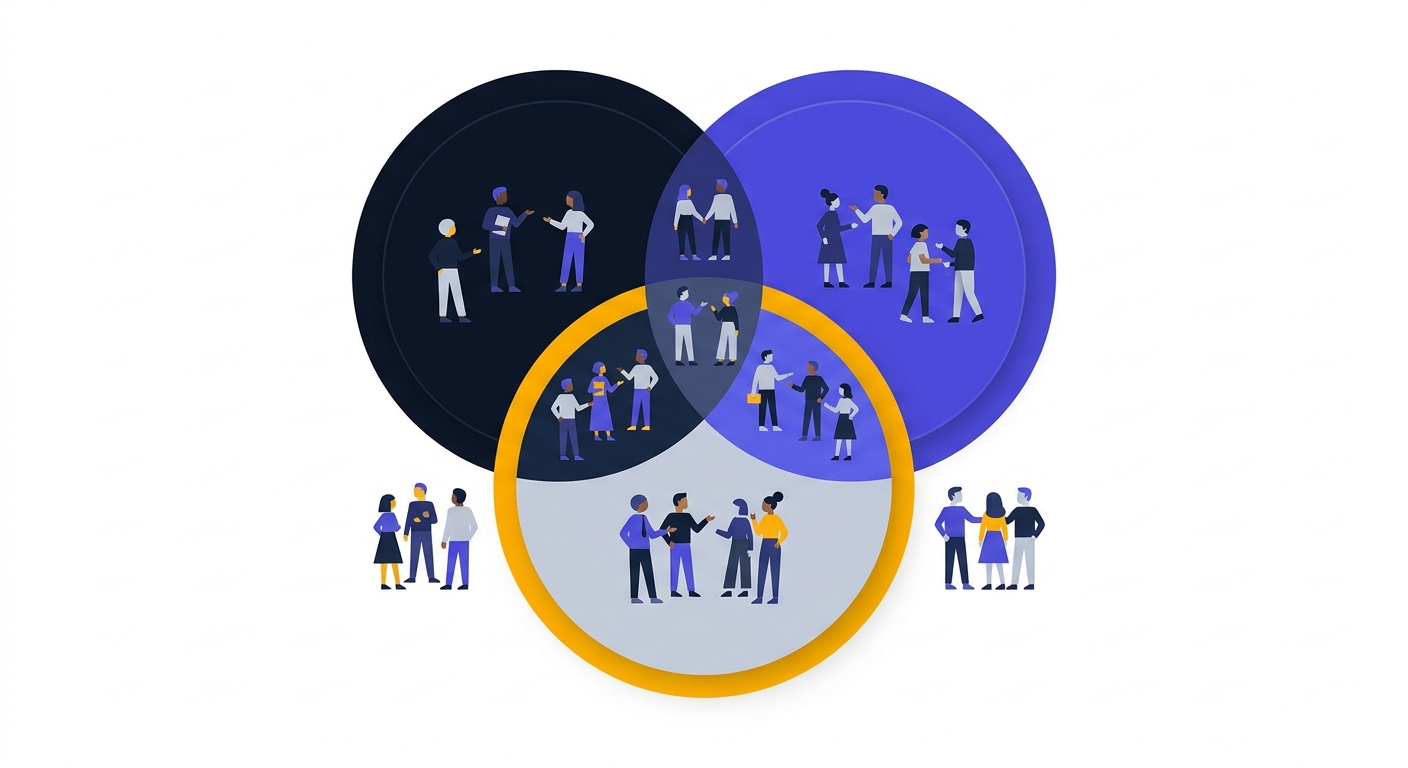
If equality, diversity and inclusion are distinct, how do they relate? Think of them as three legs of a stool. Remove any one and the whole thing falls over.
- Equality without diversity sounds fair in principle but produces homogeneous workplaces in practice. If the rules are 'the same for everyone' but 'everyone' looks remarkably alike, equality has done little more than maintain the status quo.
- Diversity without inclusion is the revolving door problem. You bring people in, but you cannot keep them, and you cannot understand why. Often, the answer is that the culture demanded they assimilate to a dominant norm, and the cost of that assimilation became unbearable.
- Inclusion without equality or diversity can become a cosy culture for a narrow group — a workplace where the existing in-group feels wonderfully included, and nobody quite notices that the in-group has hardly changed in twenty years.
The three concepts also operate at different levels. Equality is largely structural — it lives in policies, procedures, legal compliance, pay systems. Diversity is largely demographic — it lives in who you hire, who you promote, who you retain. Inclusion is largely cultural and behavioural — it lives in how people actually treat each other day to day.
You need all three layers working together. Strong policies cannot rescue a toxic culture. A vibrant inclusive culture cannot survive discriminatory pay practices. Diverse hiring cannot fix a leadership team that does not know how to lead diverse teams.
Exercise: Define It in Your Own Words
Pause and try this. Without looking back at the definitions above, write your own one-sentence definition of each term in your own words:
- Equality is…
- Diversity is…
- Inclusion is…
Then, if you can, share your definitions with a colleague and compare. Notice where you differ. Notice which term you found hardest to define cleanly. That difficulty is information — it usually points to where your organisation's thinking is least developed, and where conversation is most needed.
Where the Vocabulary Goes Wrong
Now that we have the definitions clear, let us look at the most common ways these terms get muddled in real UK workplaces. Recognising these patterns will help you spot — and gently correct — them when you encounter them.
1. Calling a diversity initiative an inclusion initiative
A company launches a targeted recruitment campaign aimed at increasing the number of women in engineering roles. This is announced as an 'inclusion initiative'. It is not. It is a diversity initiative. It changes who gets through the door. Whether the women hired stay, thrive and progress is an inclusion question, and it requires a quite different set of actions: mentoring, sponsorship, managerial capability, examining the culture of meetings, addressing the network gaps that disadvantage outsiders.
2. Treating 'inclusion' as a soft synonym for 'be nice'
Inclusion is sometimes reduced to a vague injunction to be respectful and kind. Kindness matters, but inclusion is more concrete than that. It is about decisions: who gets the project, who gets feedback, who gets credit, whose calendar gets the meeting moved for, whose dietary requirements get accommodated, whose name gets pronounced correctly. Each of those is a small inclusion act or a small exclusion act. Inclusion is built — or eroded — by these daily choices.
3. Confusing equality with sameness
'We treat everyone the same here' is often said with pride, and it sounds like equality. Sometimes it is. Often, however, it is a refusal to acknowledge that people have different needs. The wheelchair user and the non-disabled colleague treated 'the same' when the only meeting room is upstairs are not being treated equally — one of them cannot get into the room. This is the bridge to our next lesson on equity, which examines how identical treatment can produce unequal outcomes.
4. Reducing diversity to one characteristic
In some organisations, 'diversity' becomes shorthand for gender, or for race, or for whichever characteristic the organisation is currently focused on. Real diversity is intersectional. A Black woman's experience at work is not simply 'a woman's experience plus a Black person's experience' — it is its own specific experience. A disabled gay man's working life cannot be understood by considering disability and sexuality separately. We will return to intersectionality later in the course; for now, simply notice when diversity gets flattened into a single axis.
5. Treating EDI as a project, not a practice
'We did EDI last year' is one of the most quietly damaging sentences in workplace culture. Equality, diversity and inclusion are not a deliverable to be completed and signed off. They are an ongoing practice — like safety, like quality, like financial control. The organisations that genuinely lead in this space treat EDI as a permanent operating discipline, not a campaign.
Why Precision Matters for You
You might wonder why we are spending an entire lesson on definitions before we even open the Equality Act. The answer is practical. As we go deeper into this course, you will be asked to think carefully about real situations — situations where a colleague might be experiencing discrimination, where a process might be quietly producing unequal outcomes, where 'banter' has slid into harassment, where good intentions have produced harmful effects.
In every one of those situations, your ability to think clearly depends on your ability to name what is happening. Is this an equality problem — a process or policy issue? Is it a diversity problem — about who is present and who is not? Is it an inclusion problem — about how people are being treated within the system as it stands? Often it is more than one. But you cannot diagnose what you cannot name.
The same precision matters when you talk to others about this work. EDI conversations frequently go wrong because two people are using the same word to mean different things. One person says 'we need more diversity' and means demographic representation. Another hears it and thinks 'they are asking us to lower the standards'. A third hears it and thinks 'finally, someone is going to address the culture'. All three are talking past each other. Shared, precise vocabulary is the prerequisite for productive conversation.
Key Takeaway
The single most important idea to carry forward from this lesson: you can be diverse without being inclusive. In fact, many organisations are. They have invested heavily in recruitment, they have hit their representation targets, and they cannot understand why people from underrepresented groups keep leaving.
Inclusion is where the real cultural change happens. It is also where the work is hardest, because it cannot be solved by a policy document or a recruitment campaign. It is built through thousands of daily decisions made by thousands of individual people — including, crucially, you.
Equality gets you the legal floor. Diversity gets people into the building. Inclusion is what makes them want to stay, contribute fully, and bring their best work. All three matter. None is sufficient alone.
Looking Ahead
In the next lesson, we will tackle one of the most important — and most misunderstood — distinctions in this entire field: the difference between equality and equity. Are we trying to give everyone the same thing, or are we trying to give everyone what they actually need to achieve a fair outcome? The answer matters enormously, and it shapes almost every practical decision an organisation will make about EDI.
For now, sit with the three definitions. Notice where your own organisation is stronger, and where it is weaker. Notice the vocabulary you and your colleagues use, and whether it is precise or muddled. You are already, simply by paying this kind of attention, doing the work.
Enjoyed this preview? Enrol to unlock all 43 lessons + your certificate.
Training a team? Buy seats for your team →