Welcome: Why EDI Matters Now
By the end of this module, you'll be able to:
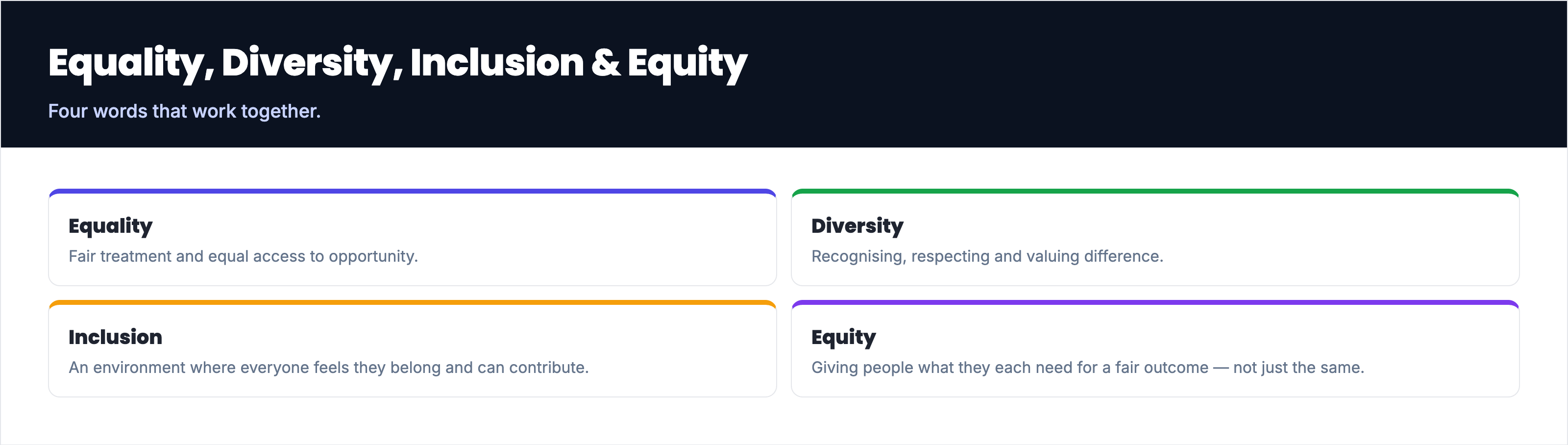
- distinguish between equality, diversity and inclusion and explain why confusing the three leads to ineffective practice.
- explain why identical treatment is not always fair treatment, and give a workplace example where equity rather than equality produces the fairer outcome.
- articulate the moral, legal and business cases for EDI and identify which argument is most appropriate for a given audience.
Welcome — and why this course matters
Welcome to Equality, Diversity and Inclusion at Work. Over the next 33 lessons, we are going to do something genuinely ambitious: build, from the ground up, the knowledge, judgement and practical skill you need to be a confident, capable contributor to an inclusive UK workplace — whether you are a frontline colleague, a team leader, a senior manager, or an HR or EDI professional sharpening your craft.
If you have arrived here expecting a tick-box compliance module, you are in the wrong room. EDI is no longer a peripheral concern handled by a single person in HR with a poster and a SharePoint folder. It has become one of the defining workplace capabilities of our era — sitting at the intersection of law, leadership, ethics, behavioural science, organisational design and basic human decency. The organisations that understand this are pulling ahead. Those that don't are losing talent, customers, tribunals and reputation, often without realising why.
Why now?
Three forces have converged to make EDI literacy non-negotiable in modern UK working life.
- The legal landscape has matured. The Equality Act 2010 consolidated and strengthened decades of anti-discrimination law into a single, coherent framework. Tribunals have grown more sophisticated. The duty on employers to prevent sexual harassment — not merely respond to it — became active in October 2024, signalling a clear shift from reactive to proactive responsibility.
- The workforce has changed. Five generations now share offices and shifts. People are more willing to disclose disabilities, neurodivergence, caring responsibilities and identities that previous generations kept hidden. Hybrid and remote working have rewritten the rules of who is seen, heard and promoted.
- The evidence base has grown. We now know — with research that would have been speculative twenty years ago — that inclusive teams make better decisions, innovate more, retain talent longer and serve diverse customers more effectively. Inclusion is not a moral luxury layered on top of performance; it is a driver of performance.
This course takes all of that seriously. It is rigorous, practical and unflinching about the difficult bits — the awkward conversations, the unintentional harm, the gap between policies on paper and behaviour in corridors.
Scope: what this course is — and what it isn't
This is awareness-level training. It will give you the conceptual foundation, legal literacy and behavioural toolkit to act well and confidently in your role. It does not replace your organisation's EDI, dignity-at-work, grievance or disciplinary policies, and it is not a substitute for qualified HR or legal advice when handling a specific complaint, investigation or tribunal matter. When in doubt about a real situation, escalate to your HR team, your EDI lead, your union representative, or a qualified employment lawyer. Your organisation's policies always apply on top of what you learn here.
How the course is structured
The 33 lessons are grouped into eight thematic sections, each one building deliberately on the last. We move from foundations to law, from law to recognising harm, from recognising harm to understanding the invisible forces (bias, microaggressions) that produce it, and finally to the constructive work of building inclusive cultures and knowing your own rights and responsibilities.
The eight sections at a glance
- Understanding Equality, Diversity and Inclusion — the vocabulary, the distinctions that matter (especially equality versus equity), and the moral, legal and business case.
- The Equality Act 2010 and the Legal Framework — the architecture of UK discrimination law, the nine protected characteristics, and where the Act bites.
- Recognising Discrimination — direct, indirect, harassment, victimisation, and the often-misunderstood concepts of discrimination by association and perception.
- Unconscious Bias — what it actually is (and what it isn't), how it leaks into hiring, promotion and meeting dynamics, and what genuinely reduces its impact.
- Microaggressions and Everyday Inclusion — the small, cumulative interactions that shape belonging, plus inclusive language and practical allyship.
- Reasonable Adjustments and Accessibility — the legal duty, real-world examples, accessibility by default, and the social model of disability.
- Building an Inclusive Workplace — psychological safety, inclusive recruitment, active bystander skills and the role every individual plays in setting tone.
- Rights, Responsibilities and Putting It Into Practice — your rights under the Act, how to report problems, personal liability, and a capstone that turns learning into commitments.
How each lesson works
Every lesson combines four elements: concept (clear explanation of the idea), context (why it matters in UK workplaces specifically), case (realistic scenarios drawn from offices, shops, sites, schools, hospitals and warehouses across the country), and capability (what you can actually do differently tomorrow). You will encounter quiet recruitment shortlists that screen people out, off-colour jokes in team meetings, meetings held in inaccessible venues, banter that has clearly gone too far, and the harder cases where reasonable people disagree. We will think through them together.
Throughout, you will find reflection prompts, mini-exercises and decision points designed to make you pause and apply the material to your own working life. The final lesson is a capstone in which you will draft a set of personal EDI commitments — concrete, specific behaviours you intend to adopt, not vague aspirations.

A note on tone, and on courage
EDI is a field that has, in places, become caricatured — painted as either trivial corporate theatre or as a minefield of unspoken rules where one wrong word ends a career. Neither caricature is accurate, and neither is useful.
The reality is that most people, most of the time, want to do the right thing. They want to treat colleagues fairly, avoid causing harm, and contribute to a workplace where everyone can do their best work. What they often lack is not goodwill but vocabulary, frameworks and confidence — the ability to name what they are seeing, understand why it matters, and know what to do about it. That is what this course provides.
We will be direct about the law because the law is direct. We will be honest about unconscious bias because pretending we don't have it is the surest way to be ruled by it. We will use the language that UK law, regulators and most workplaces currently use, while acknowledging that language evolves and reasonable people sometimes disagree about it. And we will assume you are an intelligent adult capable of handling complexity, ambiguity and the occasional uncomfortable mirror.
What you should expect of yourself
- Engage honestly. The exercises only work if you answer them truthfully, including the parts where you recognise your own blind spots.
- Sit with discomfort. Some material will challenge assumptions. That is the point. Growth happens at the edge of what is comfortable, not in the middle of it.
- Translate learning into action. Knowing about inclusive behaviour and practising it are different things. The course is designed for the second.
- Stay curious about your own organisation. Read your EDI policy. Find out who your EDI lead is. Notice the gap, if there is one, between stated values and lived experience.
Culture is not what is written in the handbook. It is what happens in the corridor, the team meeting and the WhatsApp group when no one in HR is watching.
The core message: EDI is everyone's job
EDI is not the sole responsibility of HR, the EDI lead or senior leadership. Leaders set the tone — that is real and important — but every single person shapes the daily culture through the comments they make, the jokes they laugh at (or don't), the colleagues they include in conversations, the candidates they shortlist, and the moments they choose to speak up or stay silent. By the end of this course, you will understand both your legal responsibilities and your daily, behavioural ones — and you will have the tools to meet them with confidence.
What's next
In the next lesson, Defining Equality, Diversity and Inclusion, we will get precise about the three words at the heart of this field. They are often used interchangeably, but they describe genuinely different things — and confusing them is the source of an enormous amount of well-intentioned but ineffective practice. Once those definitions are sharp, the rest of the course unlocks.
Take a breath. Get a notebook. Let's begin.
Enjoyed this preview? Enrol to unlock all 43 lessons + your certificate.
Training a team? Buy seats for your team →