Welcome: Why Fire Safety Matters at Work
By the end of this module, you'll be able to:
- State the core duties placed on the Responsible Person under the Regulatory Reform (Fire Safety) Order 2005.
- Distinguish between the enforcement notices available to the Fire and Rescue Authority and the consequences of each.
- Identify who bears the Responsible Person duty in a multi-occupied building and explain how Article 22 cooperation applies.
A Quiet Tuesday Morning — Until It Wasn't
Picture a typical UK workplace at 10:47 on a Tuesday morning. Phones are ringing, kettles are boiling, a delivery driver is buzzing at the back door, and someone in accounts is wrestling with the photocopier. It is, by any measure, an ordinary day. Then a wisp of smoke curls from a socket extension hidden behind a stack of cardboard boxes. Within ninety seconds, that socket is alight. Within three minutes, the corridor is filling with thick, black, toxic smoke. Within five, the situation is life-threatening for anyone still inside.
This is not a Hollywood scenario. It is the unremarkable arithmetic of fire — and it plays out in British workplaces more often than most people realise.
According to Home Office fire statistics, Fire and Rescue Services in England attend in the region of 150,000 fires every year, of which roughly 15,000 occur in non-domestic buildings — offices, shops, warehouses, factories, schools, care homes, hotels and restaurants. Fires kill around 250–300 people annually in England alone, and injure several thousand more. Behind every one of those numbers is a person who left for work that morning expecting an entirely normal day.
The financial cost is equally sobering. The Association of British Insurers reports that commercial fire claims regularly exceed £1 billion a year, and the British Chambers of Commerce estimates that around 60% of businesses that suffer a serious fire never reopen, or close within three years. A fire does not just damage a building; it dismantles livelihoods, supply chains, and communities.
Why This Course, and Why Now
Fire safety in the UK changed profoundly after the Grenfell Tower tragedy of June 2017, in which 72 people lost their lives. The inquiry that followed exposed failings not only in building materials and design, but in the everyday culture of fire safety — risk assessments that were treated as paperwork rather than as living documents, fire doors that did not perform as expected, evacuation strategies that had never been properly tested, and a widespread assumption that someone else was responsible.
The legislative response — the Fire Safety Act 2021, the Building Safety Act 2022, and the Fire Safety (England) Regulations 2022 — has raised the bar significantly. But laws and regulations only work when the people on the ground understand them, believe in them, and act on them. That is where you come in.
Fire Safety Is Everyone's Business
There is a stubborn myth in British workplaces that fire safety is the concern of a specialist — the facilities manager, perhaps, or the person who happens to hold the clipboard during the annual drill. This is wrong, and dangerously so. Fire safety is a shared duty. The Regulatory Reform (Fire Safety) Order 2005 places legal obligations on the "Responsible Person" — usually the employer, owner or occupier — but it also requires every member of staff to take reasonable care, cooperate with fire safety arrangements, and report risks.
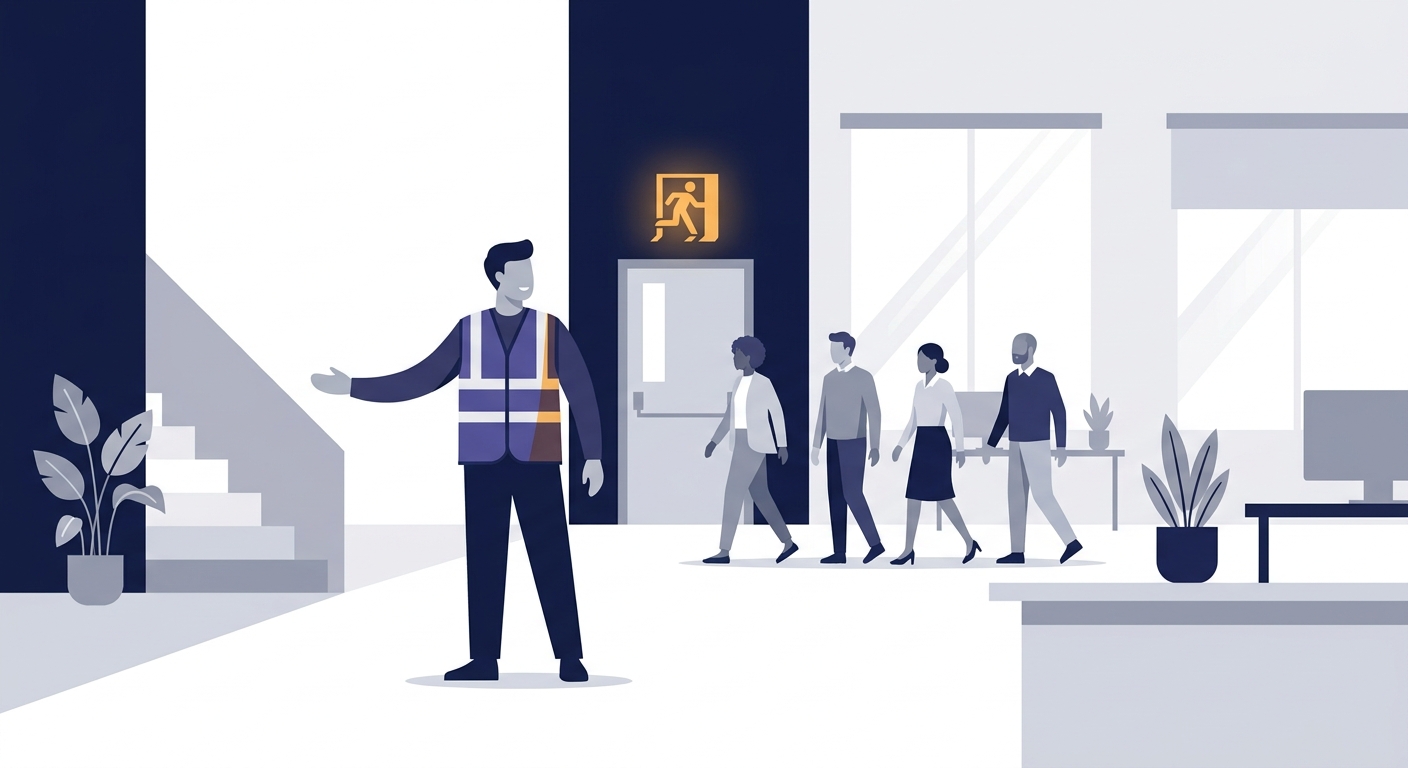
For fire marshals — sometimes called fire wardens — the responsibility goes further still. When the alarm sounds, you are the calm, trained voice that turns potential chaos into orderly evacuation. You sweep rooms, close doors, guide colleagues, assist those who need help, and account for everyone at the assembly point. Done well, the role is almost invisible — and that is precisely the point.
What You Will Learn
This course is structured across eight focused modules, building from legal foundations through fire science to the practical skills of the marshal role:
- Fire Safety Law and the Responsible Person — the legal framework, duties and enforcement landscape.
- How Fire Behaves — combustion, heat transfer, and why smoke kills more people than flames.
- Fire Hazards and Prevention — identifying ignition sources, controlling fuels, and the discipline of good housekeeping.
- Fire Detection, Warning and Means of Escape — alarms, emergency lighting, signage, travel distances and the critical role of fire doors.
- Fire Extinguishers and First-Aid Firefighting — the six classes of fire, matching the extinguisher, the PASS technique, and — just as important — when not to fight a fire.
- The Fire Risk Assessment — the five-step process, PEEPs, and keeping the assessment alive.
- Evacuation and the Fire Marshal's Role — the core duties, assisting people who need help, refuge points, and the roll call.
- Drills, Practice and Continuous Improvement — embedding safety through rehearsal, testing, and learning from every incident and false alarm.
The Level and Standard of This Course
This is a Level 2 awareness course, aligned with UK fire safety law, British Standards (notably BS 9999 and BS 5839), and the principles set out in Government-published fire safety guidance for non-domestic premises. It goes considerably deeper than the fire module in a general health and safety induction, and equips you with the knowledge expected of a competent fire marshal.
By the end of the course, you will be able to:
- Explain the legal framework and identify who the Responsible Person is in your workplace.
- Describe how fire starts, grows and spreads — and why early action saves lives.
- Recognise and reduce common fire hazards in your environment.
- Interpret fire safety signage, alarms and protective systems.
- Select the correct extinguisher for a given fire and apply the PASS technique — while knowing the limits of first-aid firefighting.
- Understand the structure and purpose of a fire risk assessment.
- Carry out the duties of a fire marshal confidently, including assisting people with additional needs.
- Contribute to a culture of continuous fire safety improvement through drills, maintenance and learning.
Fires do not announce themselves. They do not wait for a convenient moment. They reward preparation and punish complacency — and the difference between a near miss and a tragedy is almost always measured in the actions of ordinary people in the first three minutes.
Honest Scope: Knowledge Plus Practice
This course delivers the knowledge you need to prevent fires, respond correctly when one occurs, and lead an evacuation as a fire marshal. However, it cannot replace two things that must happen on your premises:
- Hands-on extinguisher practice — ideally on a live-fire training rig with a qualified instructor, so that muscle memory takes over under pressure.
- Site-specific evacuation drills — walking your actual escape routes, knowing your assembly points, and rehearsing your building's particular layout, refuge points and procedures.
Treat this course as the indispensable foundation. Treat the on-site practice as the essential complement. You need both.
A Word About Mindset
Before we begin Module 1, a brief word about how to approach this material. Fire safety can feel, on the surface, like a subject of rules, signs and equipment — a checklist to be ticked. It is not. It is a discipline of attention. The fire marshal who notices the wedged-open fire door on the way to the kitchen, who mentions the overloaded socket to facilities, who insists — politely but firmly — that the corridor must be kept clear, is doing the most important work of all. Most workplace fires are prevented not by extinguishers but by people who notice things and act.
As you work through the lessons that follow, try to map the content onto your own workplace. Walk your floor. Look at the exits. Notice the signage. Ask yourself the "what would you do?" questions honestly. The learners who get the most from this course are those who treat it not as a qualification to be earned but as a lens through which to see their daily environment differently.
In the next lesson, we will turn to the cornerstone of UK fire safety law: the Regulatory Reform (Fire Safety) Order 2005. Understanding this piece of legislation — what it requires, who it applies to, and how it is enforced — is the foundation on which everything else in this course rests.
Key Takeaways from Lesson 1
- Fire is a serious and present risk in UK workplaces, with thousands of non-domestic fires each year and devastating human and economic consequences.
- Fire safety is a shared duty — legally placed on the Responsible Person, but practically owned by everyone in the building.
- Fire marshals are pivotal: trained, calm, and visible leaders who turn potential chaos into orderly evacuation.
- This course equips you to prevent, react and lead — across eight modules covering law, fire science, prevention, systems, extinguishers, risk assessment, evacuation and continuous improvement.
- Knowledge plus on-site practice is the formula. Bring this material to life by applying it to your own premises.
Enjoyed this preview? Enrol to unlock all 41 lessons + your certificate.
Training a team? Buy seats for your team →