What a Food Allergy Actually Is
The Body's Bodyguard, Misfiring
Imagine your immune system as a highly trained security team. Its job is to scan everything that enters your body — bacteria, viruses, parasites — and neutralise anything that could do you harm. Most of the time, it does this work brilliantly and silently. You never even notice the millions of micro-decisions it makes every day.
A food allergy is what happens when that security team gets it spectacularly wrong. It looks at something completely harmless — a fragment of peanut, a wisp of milk protein, a trace of egg — and identifies it as a deadly threat. Then it responds with overwhelming force. The damage that follows isn't caused by the food itself. It's caused by the body's own emergency response.
Step by Step: What Actually Happens Inside
To understand why allergic reactions behave the way they do — why they can be sudden, severe, and triggered by amounts so small you cannot see them — it helps to walk through the biology in plain language.
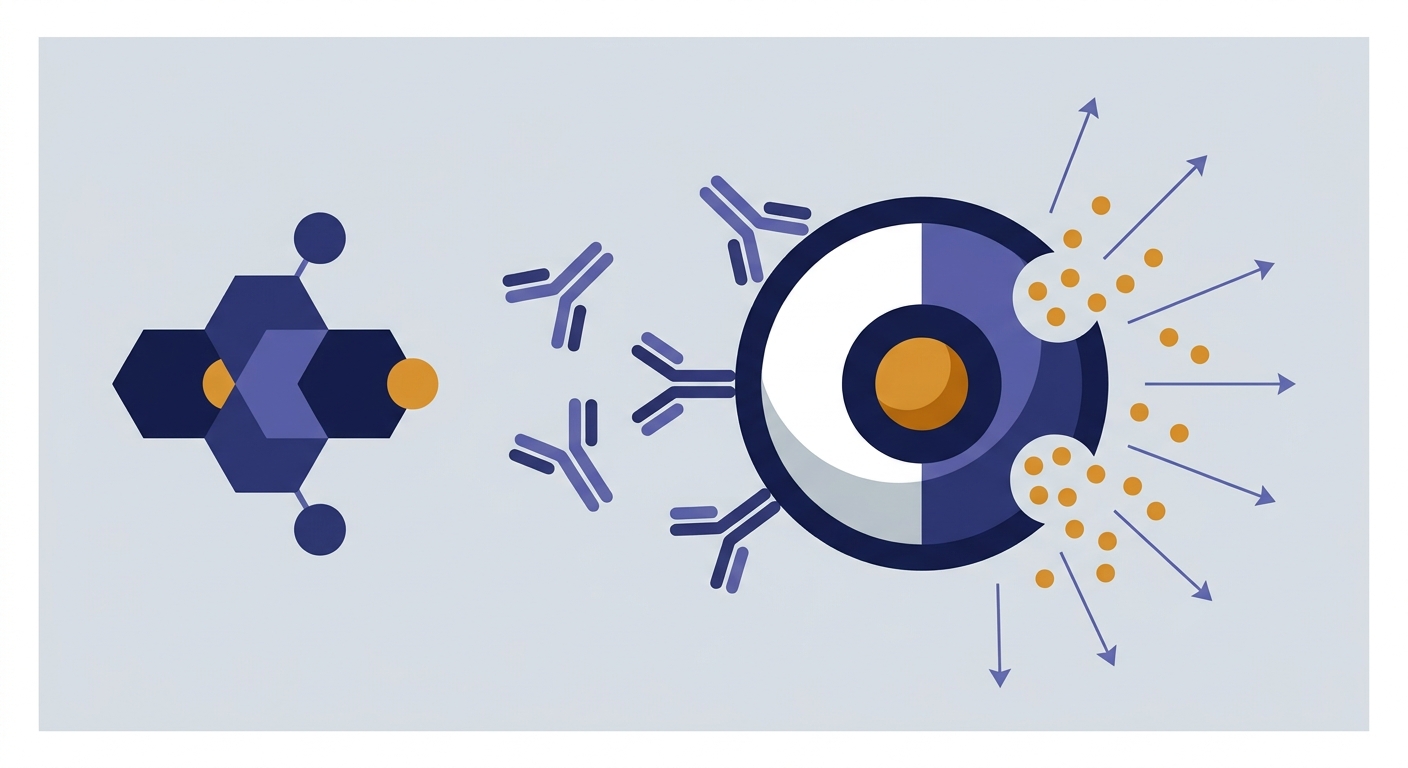
- First contact (sensitisation). The very first time someone is exposed to an allergen, they usually don't have a visible reaction. Instead, their immune system makes a mistake quietly behind the scenes. It tags the harmless food protein as 'dangerous' and produces a specific antibody to remember it. This antibody is called Immunoglobulin E, or IgE.
- The antibodies take up position. Those IgE antibodies attach themselves to mast cells — specialist immune cells found throughout the skin, gut, lungs and blood vessels. Think of mast cells as armed guards stationed all over the body, now holding a 'wanted poster' of the allergen.
- Second contact. The next time the person eats — or even touches or inhales — that same protein, the IgE antibodies recognise it instantly. They signal the mast cells to act.
- The chemical cascade. Mast cells burst open and release a flood of chemicals into the surrounding tissue. The most famous of these is histamine, but there are many others: tryptase, leukotrienes, prostaglandins. Together they cause blood vessels to widen and leak, smooth muscle to contract, mucus to flood the airways, and nerve endings to fire.
- The visible reaction. What we see — the hives, the swelling, the wheezing, the vomiting, the drop in blood pressure — is the downstream effect of all those chemicals being released at once. The food is long gone. The body is reacting to its own alarm system.
This is why telling someone with an allergy to 'just try a little bit' is not just unhelpful — it's dangerous. Their reaction has nothing to do with willpower, taste preference, or how brave they are. It's a hard-wired biological response that has been primed and is now waiting to fire.
The Spectrum: From a Tingling Lip to a Stopped Heart
One of the hardest things for people new to allergen awareness to grasp is that allergic reactions don't have a fixed 'size'. They sit on a spectrum, and that spectrum can shift — sometimes from one exposure to the next, in the same person.
Mild Reactions
At the milder end, someone might experience:
- Itching or tingling in the mouth, lips or throat
- A few hives or a localised rash
- A runny nose or watery eyes
- Mild stomach discomfort or nausea
These reactions are unpleasant but usually self-limiting. The person is uncomfortable; they are not in immediate danger.
Moderate Reactions
A step further along, we see:
- Widespread hives across the body
- Noticeable swelling of the face, lips or eyelids
- Vomiting or significant abdominal pain
- A persistent cough or tight chest
Severe Reactions — Anaphylaxis
At the dangerous end of the spectrum is anaphylaxis — a whole-body reaction that can kill within minutes. Signs include:
- Difficulty breathing, wheezing, or a hoarse voice
- Swelling of the tongue or throat that obstructs the airway
- A sudden drop in blood pressure causing dizziness or collapse
- Pale, clammy skin and a racing or weak pulse
- Loss of consciousness
Anaphylaxis is a medical emergency. We will return to it in depth in Section 3 and again in Section 8, because recognising and responding to it is one of the most important skills you will learn in this course.
Why the Same Allergen Affects People Differently
Two customers can be allergic to exactly the same protein — say, hazelnut — and have completely different reactions to the same plate of food. Why?
- Individual immune sensitivity. Some people produce vastly more IgE antibodies to a given allergen than others. A small dose can trigger a massive response in a highly sensitive individual.
- Co-factors. Exercise, alcohol, illness, stress, hormonal changes and certain medications can all amplify a reaction. A nut that caused a mild rash last month might cause anaphylaxis after a glass of wine on a hot day.
- Asthma. People with asthma — particularly poorly controlled asthma — are at significantly higher risk of severe respiratory reactions.
- How the allergen is delivered. A protein eaten on an empty stomach is absorbed faster than one eaten with a heavy meal. Liquids and oils can deliver allergens differently to solids.
- Reaction history is not destiny. A person who has only ever had mild reactions can, without warning, have a severe one. Past mildness offers no guarantee of future safety.
This unpredictability is precisely why we don't 'risk-assess' a customer's allergy on their behalf. We don't decide that 'a little bit will probably be fine' because they 'only get a rash'. The reaction they had last time tells us very little about the reaction they will have today.
The Trace Amount Problem
Perhaps the most counter-intuitive fact about food allergies is this: the dose required to trigger a reaction can be vanishingly small. We are not talking about a spoonful, or a mouthful, or even a bite. For some people, a quantity invisible to the human eye is enough.
Consider what this means in practice:
- A chef who chops walnuts and then, without washing the board, prepares a 'nut-free' salad has transferred enough protein to cause a reaction.
- A pair of tongs used to lift a sesame-topped bun and then a plain bun has carried the allergen across.
- Frying oil that was previously used for battered prawns will contain shellfish protein, even after the prawns are long gone.
- A wooden spoon stirred through a milk-based sauce and then a dairy-free one has cross-contaminated the second dish.
- Flour dust hanging in the air of a bakery can settle on supposedly gluten-free products.
This is why the rest of this course will spend so much time on cross-contact — the invisible movement of allergens from one surface, tool, or food to another. It is not paranoia. It is a direct consequence of the biology we have just described.
Allergies are increasing, and reactions can be caused by tiny traces of an allergen.
Allergies on the Rise
Food allergies are not a fashionable diagnosis or a cultural fad. They are a measurable, documented public health phenomenon, and they are becoming more common.
In the UK, around 2 million people are estimated to be living with a diagnosed food allergy, and a further large group live with food intolerances or coeliac disease (which we'll distinguish carefully in Section 3). Hospital admissions for food-induced anaphylaxis have risen significantly over the past two decades, with the steepest increases seen in children and young adults.
Researchers continue to investigate why. Theories include:
- The hygiene hypothesis — reduced exposure to microbes in early life may leave the immune system poorly calibrated.
- Changes in weaning practices — historic advice to delay introduction of allergenic foods may, paradoxically, have increased sensitisation.
- Environmental factors — pollution, vitamin D deficiency, and changes in the gut microbiome.
- Better diagnosis — some of the rise reflects improved recognition rather than new cases.
For our purposes, the cause matters less than the consequence: the population of people who depend on your accuracy is growing every year. Whatever you served safely a decade ago, you are now serving a wider, more diverse range of allergic customers, and the legal and ethical bar is higher than ever.
It Is Not Just About Eating
A common misconception is that you only react to a food if you eat it. For most people, most of the time, that's true. But for highly sensitive individuals:
- Skin contact can trigger a reaction — touching a surface contaminated with the allergen, then touching the mouth or eyes.
- Airborne particles can affect people with severe allergies — steam from boiling shellfish, flour dust in a bakery, the aerosolised oil from frying.
- Kissing someone who has recently eaten the allergen has caused documented reactions.
This is rare, but it is real. It is why some customers will ask whether a dish is being prepared near their allergen, not just whether it contains the allergen. They are not being difficult. They are managing a condition you may not fully appreciate from the outside.
The Key Takeaway: This Is Medical, Not Personal
An allergic reaction is not a preference, a lifestyle choice, or a sign of fussiness. It is an involuntary immune response that the customer has no control over once it begins. They cannot 'tough it out', they cannot 'just have a bit', and they cannot predict the severity of the next reaction from the last one.
When a customer tells you they have a food allergy, you are not being asked to accommodate a preference. You are being trusted with a piece of medical information that, if mishandled, could kill them.
What This Means for Your Role
You don't need to become an immunologist to handle allergens safely. But you do need to carry three core understandings with you into every shift:
- The reaction is in the body, not in the food. Once an allergen reaches a sensitised person, the harm has already begun. There is no way to 'cook out' a protein allergen. Heat does not destroy peanut protein. Washing a fruit does not remove milk residue. The only safe strategy is prevention — keeping the allergen away from the customer in the first place.
- Tiny amounts matter. The threshold for a reaction can be a fraction of a gram. This makes diligent cleaning, careful separation of utensils, accurate labelling and clear communication absolutely non-negotiable. 'Mostly clean' is not clean. 'Probably fine' is not fine.
- You cannot judge the severity in advance. The customer who waves off your concern with 'oh, I just get a bit itchy' may be the one who ends up in resuscitation tonight. Every allergy disclosure must be treated with the same seriousness, regardless of how the customer describes their history.
In the next lesson, we'll move from the biology to the human reality. You'll meet Natasha Ednan-Laperouse, the young woman whose death changed UK food law, and you'll see what happens when the systems we are about to learn fail. It is, in places, a difficult lesson. But it is the reason this course exists — and it is the reason your work matters.
Check Your Understanding
Before moving on, pause and check you can answer these in your own words:
- What is the role of IgE antibodies in an allergic reaction?
- Why can the same allergen cause different reactions in different people — or in the same person on different days?
- Why is it dangerous to assume a customer with a 'mild' allergy history is at low risk today?
- Why does cooking not make an allergen safe?
If any of these feel shaky, scroll back and re-read the relevant section. The rest of the course builds directly on this foundation.
Enjoyed this preview? Enrol to unlock all 40 lessons + your certificate.
Training a team? Buy seats for your team →