Child Protection vs Safeguarding: The Critical Distinction
The Two Words That Get Confused Every Day
Walk into any school staffroom, care home, leisure centre or community group in the UK and ask staff what "safeguarding" means. You'll get a flurry of answers. Then ask what "child protection" means. You'll often get the same answers. The two terms are used interchangeably — in policies, in casual conversation, even in some training materials — and that confusion is not harmless. It is one of the most consequential misunderstandings in the entire field, because it changes what people notice, what they report, and crucially, what they ignore.
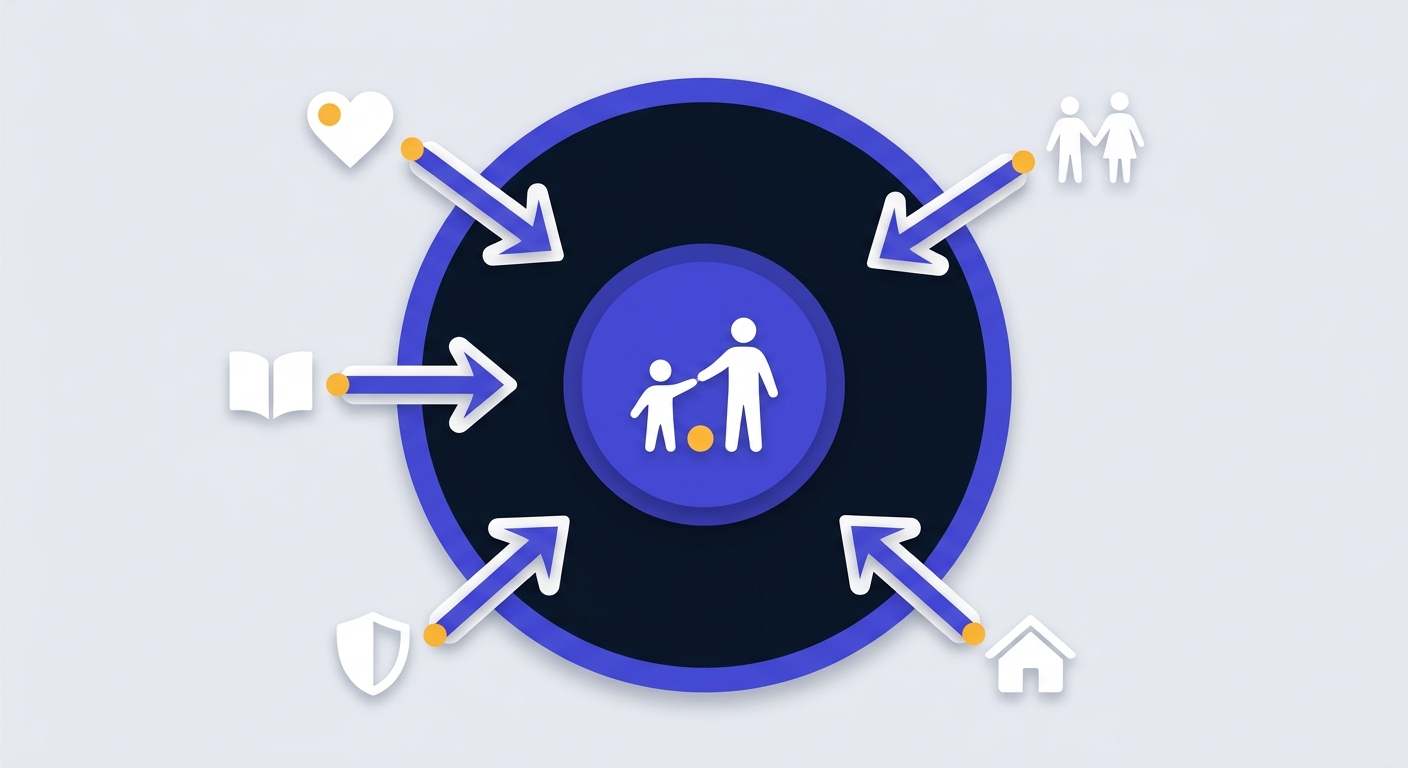
If you remember nothing else from this lesson, remember this: safeguarding is the umbrella; child protection is one specific part of what sits underneath it. They are not synonyms. They are not interchangeable. And the gap between them is precisely where vulnerable children fall through the cracks.
Safeguarding: The Wide-Angle Lens
Safeguarding is the broad, proactive, preventative work of protecting people's health, wellbeing and human rights, and enabling them to live free from harm, abuse and neglect. It is not triggered by a crisis. It does not wait for bruises. It begins long before anything has gone wrong, and it continues long after a specific incident has been resolved.
Safeguarding includes:
- Prevention — creating environments where abuse is less likely to occur (safer recruitment, codes of conduct, supervision, anti-bullying culture, online safety education).
- Promotion of welfare — supporting children to thrive: helping with attendance, mental health, friendships, transitions, basic needs like food and warmth.
- Early help — stepping in when a family is wobbling but no one is yet at risk of significant harm. Think: a parent struggling with debt, a child becoming withdrawn after bereavement, a family new to the area with no support network.
- Protection — the sharp end, when harm is occurring or significant harm is likely.
Child Protection: The Sharp End
Child protection is a specific, narrower activity. It is the part of safeguarding that activates when a child is suffering, or is likely to suffer, significant harm. The language matters. "Significant harm" is the statutory threshold set out in section 47 of the Children Act 1989 — and it is the gateway to formal investigation by local authority children's social care, often with police involvement, sometimes leading to a child protection plan or, in the most serious cases, removal from the family home.
Child protection is reactive in the sense that something has happened or is imminent. It is forensic. It is high-stakes. It involves strangers — social workers, police, paediatricians — entering a family's life with statutory authority.
Why The Distinction Matters In Practice
Here is the danger of conflating the two: if staff believe safeguarding is child protection, they will only act when they see something dramatic. They wait for the visible bruise, the explicit disclosure, the obvious crisis. Everything else — the quiet child losing weight, the family not coping, the boy whose new "older friend" gives him expensive trainers — gets filed away as "not really a safeguarding issue".
It is. It absolutely is. It is just not, yet, a child protection issue. And the entire point of safeguarding is to intervene at the early end of the spectrum so that the sharp end becomes unnecessary.
Serious case reviews — the formal learning exercises commissioned after a child dies or is seriously harmed — return to this theme again and again. Practitioners noticed something. They thought, "It's probably nothing. It doesn't reach the threshold." They did not act because they were waiting for child protection-level evidence before doing anything at all. The lesson is bleak and consistent: by the time something reaches the child protection threshold, opportunities to help have usually been missed for months or years.
The Prevention–Protection Spectrum
It helps to picture safeguarding as a spectrum rather than a switch. On the far left is universal provision — every child receives this just by being a child (good schools, healthcare, safe public spaces). Moving rightward, we pass through:
- Universal services — everyone benefits. Example: PSHE lessons about healthy relationships.
- Early help / additional needs — a child or family needs a bit more support. No statutory involvement required. Example: a school referring a family to a local food bank and offering attendance mentoring.
- Child in need (s17 Children Act 1989) — the child is unlikely to achieve a reasonable standard of health or development without local authority services. A social worker is involved, but on a supportive footing.
- Child protection (s47 Children Act 1989) — reasonable cause to suspect significant harm. Formal investigation. Multi-agency strategy meetings. Possible child protection plan.
- Care proceedings / removal — the most serious end, where the local authority seeks court orders.
All five sit under the safeguarding umbrella. Only levels 4 and 5 are child protection. The lower levels are arguably more important, because effective work there means a child never reaches the higher levels.
Three Scenarios, One Spectrum
Let's place real situations on this spectrum. Read each carefully and notice the shift in language, threshold and response.
Scenario A: The Hungry Child
Aaliyah, aged seven, comes to school visibly hungry on Mondays. She's not malnourished, but she eats two portions at lunch and asks if she can take a piece of fruit home. Her uniform is clean. She talks affectionately about her mum, who recently lost her job.
Where on the spectrum? This is safeguarding, specifically early help / promoting welfare. There is no significant harm. There is a family under pressure and a child whose welfare could be better promoted. The right response is a conversation with mum, a referral to local food support, perhaps a breakfast club place. This is not a child protection referral — and treating it as one would be heavy-handed, stigmatising, and would likely close down the family's willingness to engage. But ignoring it because "it's not child protection" would be a failure of safeguarding.
Scenario B: The Bruise of Concern
Marcus, aged nine, arrives at his football club with a large hand-shaped bruise across his upper arm. When the coach gently asks what happened, Marcus says, "Dad got angry because I broke a mug." He then says, "Please don't tell anyone, he said I'm not to tell."
Where on the spectrum? This is child protection. There is a visible injury, a disclosure of how it occurred consistent with physical abuse, and a clear instruction to maintain secrecy — a classic indicator. The threshold of "reasonable cause to suspect significant harm" is met. The coach should not investigate further, should not promise confidentiality, should record what was said verbatim, and should refer to the Designated Safeguarding Lead immediately, who will contact children's social care and likely the police.
Scenario C: The Parent Who Is Struggling
James is a single father raising two children, aged four and six. His mental health has deteriorated since the death of his partner. The children's nursery and school have both noticed he sometimes seems overwhelmed at pickup. The four-year-old has been arriving in yesterday's clothes occasionally. The children are happy, affectionate, and clearly loved.
Where on the spectrum? This is firmly safeguarding at the early help / child-in-need end. There is no abuse. There is a grieving father whose capacity is reduced and whose children's welfare could deteriorate without support. The right response is a coordinated, compassionate offer — bereavement counselling, a family support worker, perhaps a Team Around the Family meeting. Treat this as child protection and you risk traumatising a family who needs support, not investigation. Ignore it entirely, and in six months it may well become a child protection case.
Notice how each scenario calls for a different response, a different threshold, a different tone. The skill of the safeguarding-literate practitioner is not just "spot abuse" — it is calibrating where on the spectrum a situation sits, and acting proportionately.
Exercise: Place It On The Spectrum
Read each vignette below and decide: is this primarily a safeguarding (general welfare / early help) concern, or has it crossed into child protection (significant harm)? Make a note of your reasoning before checking the answers underneath.
- A 14-year-old girl tells her drama teacher she's been talking online to a 22-year-old man who has started asking for photos.
- A six-year-old has missed 14 school days this term. His mum says he's had tummy aches. He seems quiet but well.
- A 15-year-old boy is regularly seen being collected by an older male in a different car each week. He has new trainers, a new phone, and is increasingly secretive.
- A reception child has nappy rash and arrives in damp clothes twice in two weeks. Mum has just had a baby and looks exhausted.
- A 10-year-old discloses that her older brother sometimes hits her hard enough to leave marks when their parents are out.
Suggested answers:
- 1 — Child protection. Online grooming with sexual element involving a significant age gap. Immediate DSL referral.
- 2 — Safeguarding / early help. Persistent absence is a welfare concern; investigate sensitively before escalating.
- 3 — Child protection. Strong indicators of child criminal exploitation / county lines. Urgent referral.
- 4 — Safeguarding / early help. Family under strain; offer health visitor and family support, not investigation.
- 5 — Child protection. Sibling-on-sibling physical abuse with significant lack of supervision. Refer.
Why People Get This Wrong
If the distinction is so important, why do so many practitioners conflate the two? Three reasons recur:
- The language of policy documents. Many organisational policies are titled "Child Protection Policy" when they really mean their entire safeguarding approach. The title teaches staff that everything safeguarding-related is "child protection", which sets the bar too high for action.
- Fear of overreacting. Staff worry about "making a fuss over nothing" or damaging a relationship with a family. So they wait. They wait for certainty that does not exist. And while they wait, they miss the early window.
- Threshold anxiety. Some practitioners are told (often informally) that social care will only accept "serious" referrals, so they convince themselves a concern doesn't reach the threshold. The truth is more nuanced — and it is not your job to apply the threshold. It is your job to share the concern with someone who can.
The Same Logic Applies to Adults
Although this lesson focuses on children, the same architectural principle applies to adult safeguarding under the Care Act 2014. Adult safeguarding is the wide umbrella — promoting wellbeing, preventing abuse, ensuring people with care and support needs can live free from harm. "Adult protection" enquiries under section 42 of the Care Act are the equivalent sharp-end activity, triggered when an adult at risk is experiencing or at risk of abuse or neglect. We will explore the adult framework in detail in Section 2. For now, just notice the structural parallel: a wide preventative umbrella, with a narrower statutory response activity inside it.
All child protection is safeguarding. But not all safeguarding is child protection. Forget that, and you will only ever act when it is already too late.
Key Takeaway
The single sentence to carry forward from this lesson:
Safeguarding is the wide, preventative, welfare-promoting work that surrounds every child and adult at risk every day. Child protection is the specific, statutory response activated when significant harm is suspected. You are responsible for noticing concerns anywhere on this spectrum — not only at the dramatic end.
In the next lesson, we'll define precisely who is protected by these frameworks — including the often-misunderstood concept of an "adult at risk" and why the old phrase "vulnerable adult" has been retired.
Enjoyed this preview? Enrol to unlock all 45 lessons + your certificate.
Training a team? Buy seats for your team →