The UK Food Safety Legal Framework
Why Supervisors Must Understand the Law — Not Just the Rules
There is a profound difference between knowing the rules and understanding the law. A team member can follow rules. A supervisor must understand why those rules exist, where they come from, and what happens when they're broken. This is the line you have just crossed.
When you stepped into a supervisory role, you became something the law recognises in a very specific way: a person whose acts or omissions can be used as evidence in a criminal prosecution against your business — and, in some circumstances, against you personally. The Environmental Health Officer who walks through your door does not see you as 'just the supervisor on shift'. They see you as the person legally responsible for what is happening in that kitchen at that moment.
This lesson is the foundation on which everything else in this course is built. Every temperature you record, every probe you calibrate, every staff member you correct, every cleaning schedule you sign off — all of it ultimately exists because UK law requires it. Understanding the legal architecture transforms your work from compliance theatre into something far more powerful: defensible practice.
The Hierarchy of UK Food Safety Law
UK food safety law is not a single book. It is a layered structure, and supervisors who try to learn it as a flat list of dos and don'ts will always be lost. Picture it instead as three tiers stacked on top of one another:
- Primary legislation — Acts of Parliament passed by the UK Government or, in the case of Scotland, the Scottish Parliament. These set out the high-level offences, powers and principles. The cornerstone is the Food Safety Act 1990.
- Secondary legislation (regulations) — Statutory instruments made under the powers granted by the primary Acts. These contain the operational detail: temperatures, structural requirements, traceability, allergen rules. In England, the principal instrument is the Food Safety and Hygiene (England) Regulations 2013.
- Assimilated (retained) EU law — Regulations that originated in the European Union and were kept on the UK statute book after Brexit. The most important is Regulation (EC) 852/2004 on the hygiene of foodstuffs, which gives us HACCP, the prerequisite programmes and the general hygiene obligations.
The Acts tell you what is illegal. The Regulations tell you how to comply. Retained EU law tells you what systems you must operate. None of these stands alone — they interlock, and you, as supervisor, sit at the point where all three meet the chopping board.

The Food Safety Act 1990: The Cornerstone
If you read only one piece of legislation in your career, read the Food Safety Act 1990. It is not long. It is not complicated. And it is the document under which most serious food safety prosecutions in England, Wales and Scotland are still brought more than three decades after it was passed.
The Act covers anyone in the food chain — growers, manufacturers, distributors, caterers, retailers — and it creates a small number of broad, powerful offences. Three of them matter to you above all others.
Section 7: Rendering Food Injurious to Health
It is a criminal offence to render any food injurious to health with the intent that it shall be sold for human consumption. 'Rendering injurious' includes adding something to it, taking something from it, subjecting it to a process, or using any ingredient. In plain English: if something you or your team did — or failed to do — made the food capable of causing harm, you have committed an offence.
Consider the chef who reheats a beef chilli to 50°C because the service rush is on. He has subjected food to a process that allows surviving spores of Clostridium perfringens to multiply. If a customer is hospitalised, the prosecution will not need to prove malice. They will need to prove only that the act occurred and that it rendered the food injurious. Section 7 is a strict offence in its operation, and the supervisor who saw it happen and said nothing is squarely in the frame.
Section 8: Selling Food Not Complying with Food Safety Requirements
Section 8 makes it an offence to sell, offer for sale, or have in your possession for the purpose of sale, any food that fails to comply with food safety requirements. Food fails to comply if it has been rendered injurious (Section 7), if it is unfit for human consumption, or if it is so contaminated that it would be unreasonable to expect it to be eaten.
This is the section that catches the mouldy bread served to a child, the mouse-droppings in the dry store, the salad rinsed in water from a contaminated tank. You do not need to have caused the contamination to commit a Section 8 offence. You need only to have offered the food for sale in that condition. Possession with intent to sell is enough — which is why the EHO who finds unfit food in your walk-in fridge does not need to wait until you serve it.
Section 14: Selling Food Not of the Nature, Substance or Quality Demanded
Section 14 is the consumer protection heart of the Act. It is an offence to sell, to the purchaser's prejudice, any food which is not of the nature, substance or quality demanded by the purchaser.
- Nature — the food is not what was asked for. You sell hake and call it cod. You sell beef mince that is actually a beef-and-pork blend.
- Substance — the food contains something it should not. A piece of blue plaster in a sandwich. A wood splinter in a soup.
- Quality — the food is below the standard a reasonable customer would expect. Stale, off-flavour, decomposed but not yet 'unfit'.
Section 14 is enormously powerful because it does not require proof of harm. The customer was promised one thing and received another. That is enough.
Section 15: False or Misleading Descriptions
Although prosecutions under Section 15 are less common in catering than in manufacturing, you should know it exists. It is an offence to label, advertise or present food in a way that falsely describes it or is likely to mislead the consumer about its nature, substance or quality. In the modern world of menu boards, table-talkers and online ordering platforms, the risks have multiplied. A 'homemade' soup that arrived frozen from a wholesaler. A 'gluten-free' brownie made on a flour-dusted surface. These are Section 15 territory — and, increasingly, the bridge into allergen offences we will meet later in the course.
Any person who renders any food injurious to health with intent that it shall be sold for human consumption shall be guilty of an offence.
The Food Safety and Hygiene (England) Regulations 2013
If the 1990 Act is the cornerstone, the 2013 Regulations are the working drawings. These regulations do three jobs at once. They enforce the retained EU hygiene regulations in England (most importantly EC 852/2004 and EC 853/2004). They create specific offences for failing to comply with those EU-origin rules. And they give enforcement officers the powers they need — to enter, inspect, sample, seize, and serve notices.
For a catering supervisor, the most important practical effects of the 2013 Regulations are:
- Registration of food premises. Every food business must be registered with the local authority at least 28 days before opening. No registration, no business — and operating an unregistered premises is a criminal offence in itself.
- The duty to operate to EC 852/2004. This is where the requirement for a HACCP-based food safety management system, hygiene of premises, equipment, transport, water, waste and personal hygiene all flow from.
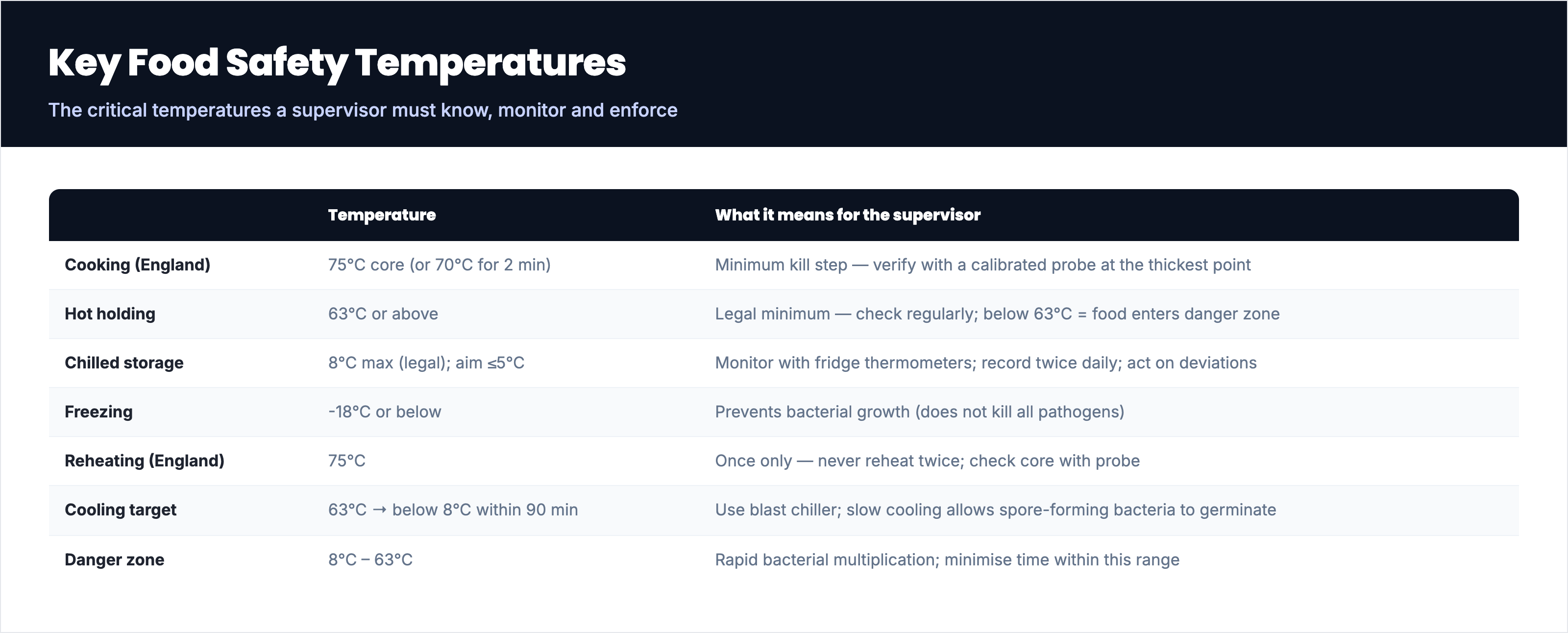
- Specific temperature controls. Schedule 4 of the 2013 Regulations sets out the famous 8°C maximum for chilled food on display and the 63°C minimum for hot holding — with the defences for short-period display we will examine in the temperature module.
- Enforcement powers. Improvement notices, hygiene emergency prohibition notices, remedial action notices, and detention or seizure of food.
Retained EC Regulation 852/2004 — The Hygiene Backbone
EC 852/2004 is, in operational terms, the single most important document a catering supervisor needs to understand. It applies across all four UK nations as assimilated law, and it sets out the foundational obligations on every food business operator:
- Identify food safety hazards and put in place procedures based on HACCP principles to control them.
- Provide premises that are clean, maintained, designed and constructed to permit good hygiene practices and prevent contamination.
- Ensure equipment is kept clean and, where necessary, disinfected, and is constructed of materials that minimise contamination risk.
- Manage food waste, by-products and other refuse so that they do not become a source of contamination.
- Supply potable water and prevent contamination via water.
- Ensure personal hygiene of food handlers — appropriate clothing, hand washing, fitness to work.
- Ensure food handlers are supervised and instructed and/or trained in food hygiene matters commensurate with their work activity.
Read that final point again. The legal obligation to train and supervise staff is not invented by your employer. It is a direct, named requirement of retained EU law, and it places the supervisor at the very heart of the regulatory framework. When you correct a chef who isn't washing their hands properly, you are not being officious. You are delivering a statutory obligation.
EC Regulation 178/2002 — Traceability and Withdrawal
Alongside 852/2004 sits retained Regulation (EC) 178/2002, the General Food Law Regulation. It introduces three obligations every catering supervisor must understand operationally, even if you never read the regulation itself:
- Traceability — one step back, one step forward. You must be able to identify who supplied you with any food, and who you supplied it to (in catering, this typically means business customers rather than retail diners). In practice this means keeping delivery notes, invoices and supplier lists in retrievable form.
- Withdrawal and recall. If you have reason to believe food you have placed on the market is unsafe, you must withdraw it and inform the competent authority — your local Environmental Health team.
- Food safety requirements. Food shall not be placed on the market if it is unsafe. 'Unsafe' means injurious to health or unfit for human consumption — echoing the language of the 1990 Act.
The Three Documents You Must Know
Three documents form the operational legal core of your role: the Food Safety Act 1990, the Food Safety and Hygiene (England) Regulations 2013 (or equivalent for your nation), and retained EC 852/2004. If you can describe what each one does in one sentence, you are already ahead of most managers in this industry.
The Four Nations: Same Backbone, Different Skin
Food safety is a devolved matter. That means that while the underlying EU-origin regulations and the 1990 Act apply across England, Wales, Scotland and Northern Ireland, each nation has its own implementing regulations, its own enforcement structures and — in some cases — its own substantive differences. As a supervisor, you must know which set applies to your premises.
England
The principal regulations are the Food Safety and Hygiene (England) Regulations 2013, as amended. Enforcement is by local authority Environmental Health departments. The Food Standards Agency (FSA) is the central competent authority. The Food Hygiene Rating Scheme (FHRS) operates on a voluntary display basis in England — businesses receive a rating from 0 to 5 but are not legally required to display it (although the Government has committed to making display mandatory and Wales and Northern Ireland already require it).
Wales
The mirror regulations are the Food Hygiene (Wales) Regulations 2006, as amended, supplemented by the Food Safety (Wales) Regulations 2013. Crucially, Wales operates under the Food Hygiene Rating (Wales) Act 2013, which makes display of the FHRS rating mandatory at every food business establishment that is open to the public. A business that achieves a 2 and hides the sticker in the back office is committing a criminal offence in Wales — and many supervisors moving from England to Wales have learned this the hard way.
Scotland
Scotland has its own legal architecture: the Food Safety Act 1990 still applies as primary legislation, but the implementing regulations are the Food Hygiene (Scotland) Regulations 2006, supplemented by the Food (Scotland) Act 2015. The competent authority is Food Standards Scotland, which split from the FSA in 2015 and operates independently. The voluntary rating scheme in Scotland is the Food Hygiene Information Scheme (FHIS) — Pass or Improvement Required, rather than a numeric rating — and is steadily being modernised.
Northern Ireland
In Northern Ireland, the equivalent rules are the Food Hygiene Regulations (Northern Ireland) 2006, and the Food Safety Act applies through the Food Safety (Northern Ireland) Order 1991. The FSA in Northern Ireland is the lead authority. As in Wales, display of the FHRS rating is mandatory under the Food Hygiene Rating Act (Northern Ireland) 2016.
Why This Matters in Practice
If you supervise a single site in Bristol, knowing the England regime is enough. But the modern catering industry is dominated by chains, group caterers, contract caterers and central production units that operate across multiple nations. A supervisor promoted from a Liverpool unit to a Cardiff unit needs to know on day one that the FHRS sticker is no longer optional. A central HACCP plan written for England will reference the wrong regulations for Scotland. A supplier audit programme that fits the FSA model may need adapting for Food Standards Scotland's enforcement priorities.
This is not pedantry. It is the difference between a competent supervisor and an exposed one.

The Allergen Layer: Natasha's Law and the Information Regulations
No legal framework discussion in 2020s catering is complete without addressing allergens, because this is the area where law has changed most dramatically in the last decade. We will dedicate an entire lesson to allergen management in Section 3, but you must know the legal scaffolding now.
Retained EU Regulation 1169/2011 on the Provision of Food Information to Consumers (FIC) sets out the requirement to declare the 14 named allergens when they are used as ingredients. This is implemented in England by the Food Information Regulations 2014, with equivalents in the other nations.
In 2021, following the death of Natasha Ednan-Laperouse from an undeclared sesame allergen in a baguette, the regulations were amended by what is universally known as Natasha's Law. Foods that are prepacked for direct sale (PPDS) — items prepared and packaged on the same premises from which they are sold, before the customer orders them — must now carry a full ingredients label with allergens emphasised. This caught out enormous numbers of cafes, sandwich bars, hotel grab-and-go counters and delicatessens, and the supervisor is typically the person whose signature is on the labelling SOP.
The Direction of Travel: Owen's Law
At the time of writing, the FSA has been consulting on what campaigners call Owen's Law, named after Owen Carey who died in 2017 after being assured a chicken dish contained no buttermilk when it did. The proposed change would require allergen information to be provided in writing at the point of order in non-prepacked catering settings, rather than verbally as is currently permitted. Whether or not this becomes law in its proposed form, the direction is clear: verbal allergen communication is being squeezed out. A supervisor who relies on 'the team will just tell the customer' is operating on borrowed time.
Personal Liability: Section 36 and the Word 'Manager'
Section 36 of the Food Safety Act 1990 contains a phrase every supervisor must absorb: where an offence is committed by a body corporate and is proved to have been committed with the consent or connivance, or to be attributable to any neglect, on the part of a director, manager, secretary or similar officer, that individual as well as the body corporate is guilty of the offence.
'Manager' includes you. A supervisor who knows the chef is reheating cooled rice the next day and says nothing has connived. A supervisor who failed to check that the fridge temperature log was completed for three weeks may have been neglectful. Personal prosecution is rare but it is real — and the threshold is lower than most people realise. Custodial sentences for individuals in serious cases are not unknown.
Sentencing: The Real Numbers
For many years, food safety prosecutions resulted in modest fines that were frankly absorbed as a cost of doing business by larger operators. That era has ended. Since the Sentencing Council's Definitive Guideline on Health and Safety, Corporate Manslaughter and Food Safety and Hygiene Offences came into force in 2016, fines are calibrated against the offender's turnover, the culpability involved, and the harm caused or risked.
For a 'large' organisation (turnover £50m+), a high-culpability food safety offence with high harm category can attract a starting point in excess of £1.2 million, with a range up to £3 million. For a small business (turnover under £2m), the starting point can still exceed £100,000. Individual defendants face fines on the standard scale (effectively unlimited in the Crown Court) and, for the most serious offences, imprisonment of up to two years.
This guideline matters to you for a specific reason: culpability is assessed largely on the systems and supervision in place. A business that can demonstrate robust procedures, trained staff and proper records will be assessed as lower culpability even when something has gone wrong. A business where the supervisor cannot produce a single temperature record will be assessed as high culpability. The paperwork you sign tonight is the prosecution-mitigation document of next year.
Civil Consequences and Reputation
Criminal prosecution is only one channel of consequence. The civil channel — personal injury claims by ill customers — can be financially devastating, particularly where multiple claimants are linked to a single outbreak. And then there is reputation: a single viral social media post about a hair in a meal can do more commercial damage in 48 hours than an EHO improvement notice will do in a year. The supervisor sits at the convergence of all three risk channels.
How the Law Talks to Your Daily Work
It is easy to read all this and feel that food safety law is something done to you by lawyers and inspectors. The opposite is true. The framework only functions because supervisors translate it into action every single shift. Here is how the abstract becomes the practical:
- When you check a delivery temperature, you are operating a HACCP-based procedure required by EC 852/2004 and creating a record that supports the due diligence defence under Section 21 of the Food Safety Act 1990.
- When you brief the team on a new allergen ingredient, you are discharging the training and supervision duty in EC 852/2004 Annex II Chapter XII and supporting FIC Regulation 1169/2011 compliance.
- When you send home a kitchen porter with diarrhoea, you are complying with the fitness to work provisions of Annex II Chapter VIII and avoiding a Section 7 offence under the 1990 Act if that person were to contaminate food.
- When you sign off a cleaning schedule, you are evidencing compliance with the cleanliness and maintenance obligations in Annex II Chapters I and II and contributing to your Food Hygiene Rating.
Every routine act has a legal lineage. The supervisor who can see those lineages — who can stand in the kitchen and say, 'I am doing this because of that' — is the supervisor who builds a defensible operation.
What 'Reasonable' Means in Law
You will hear, repeatedly through this course, the words reasonable and practicable. UK food safety law is not a perfectionist regime. It does not require you to eliminate every conceivable risk — that would be impossible. It requires you to take steps that a reasonable person, operating a similar business with similar resources, would take. The test is objective and contextual.
A five-table village pub is not expected to operate the documented HACCP system of a 400-cover hotel. But both must operate something proportionate. The voluntary Safer Food, Better Business (SFBB) pack — published by the FSA precisely to give small caterers a workable HACCP-based system — is the FSA's own statement of what 'reasonable' looks like at the smaller end. We will study SFBB in depth in Section 5.
Your Legal Map: Know What Applies to You
Your single most important takeaway from this lesson is this: you must know which specific regulations apply to your operation, in your nation, for your type of business. Before the next lesson, write down on one side of A4: (1) the four pieces of law that apply to your premises, (2) the name of your local authority enforcement team, (3) your current Food Hygiene Rating, and (4) the date of your last EHO inspection. If you cannot answer any of these, that is your first action point.
A supervisor who can produce these four answers in the first 30 seconds of an EHO conversation has already established a position of credibility that will shape the entire visit.
Bringing It Together
The UK food safety legal framework is not, in the end, complicated. It is layered, but logical. The 1990 Act tells you what is illegal. The 2013 Regulations (or their national equivalents) tell you how to comply and give enforcement officers their powers. Retained EU law — particularly 852/2004 and 178/2002 — tells you what systems to run and what information to keep. Devolution gives each UK nation its own implementing regulations and enforcement body. Sentencing guidelines tie the size of penalty to the quality of your systems and the level of harm.
You sit at the centre of all of it. The chef sees ingredients. The director sees turnover. The customer sees a plate. The supervisor — uniquely — sees the legal machinery operating in real time, and is the only person on the premises whose entire job is to keep that machinery running.
In the next lesson, we will examine the most important defensive concept in the entire framework: due diligence. We will look at what Section 21 actually says, what 'all reasonable precautions and all due diligence' really means in court, and how the records you generate every shift become the shield that protects your business — and you personally — when something goes wrong. Because in food safety, it is not a question of if something will eventually go wrong. It is a question of whether you will be ready.
Enjoyed this preview? Enrol to unlock all 51 lessons + your certificate.
Training a team? Buy seats for your team →