What Counts as Working at Height
By the end of this module, you'll be able to:
- state the legal definition of "working at height" and explain why there is no minimum height threshold
- give at least two examples of working at height that do not involve being above ground level
- explain why falls from height are a priority risk in UK workplaces, citing their place among the leading causes of workplace fatalities
Welcome — and why this lesson matters more than you think
Welcome to Working at Height: The Definitive UK Safety Course. Over the next twenty-eight lessons, we will build — brick by careful brick — the most comprehensive understanding of working safely at height available anywhere in the United Kingdom. We will dissect the law, master the hierarchy of control, scrutinise every category of access equipment from the humble stepladder to the most sophisticated mobile elevating work platform, and confront uncomfortable truths about why competent, experienced workers still die in falls every single week.
But before any of that, we must answer a deceptively simple question: what actually counts as working at height?
If you ask a hundred site workers, supervisors or even managers, you will get a hundred different answers. Most will give you a number — "anything above two metres," perhaps, or "if you need a harness." Some will gesture at scaffolds and roofs. Almost all of them will be wrong. And that misunderstanding — the belief that "working at height" is something exotic, something done by specialists in hard hats halfway up a tower crane — is precisely why people continue to die in falls from stepladders, from the back of flatbed lorries, from loading bays, and from kerbside cherry-picker baskets that never rose more than a metre off the ground.
The trap of common sense
The phrase "working at height" sounds self-explanatory. Height implies altitude. Altitude implies something obviously dangerous — vertigo, exposure, the kind of work that makes the back of your neck prickle. Our intuition wants a clean threshold: below this line, ordinary work; above this line, special precautions.
The law refuses to give us that comfort. And it refuses for a very good reason: the human body is far more fragile than common sense suggests. A fall of less than a metre, onto the wrong surface, at the wrong angle, with the head striking the wrong object, can be every bit as fatal as a fall from a third-storey window. The statistics, which we will examine in detail in the next lesson, are unambiguous on this point.
So if we cannot trust intuition, and we cannot trust an arbitrary height threshold, what can we trust? We must trust the definition — the precise legal formulation that the Work at Height Regulations 2005 use to draw the boundary of their protection. Let us look at it directly.
Work at height means work in any place where, if precautions were not taken, a person could fall a distance liable to cause personal injury.
Unpacking the definition, word by word
Read that sentence again, slowly. There is no number in it. There is no mention of metres, feet, storeys or floors. Instead, the definition rests on three pivotal phrases, and each one deserves careful attention.
"Any place"
Not a specific location. Not a roof, a scaffold or a ladder. Any place. The drafters chose this phrase deliberately to defeat the natural human tendency to compartmentalise risk. Working at height is not a category of place; it is a category of circumstance. The same square metre of concrete can be a perfectly ordinary workspace on Monday and a working-at-height hazard on Tuesday, simply because somebody has lifted a manhole cover beside it.
"If precautions were not taken"
This phrase is doing enormous quiet work. It tells us that we judge whether a task counts as working at height by imagining the situation stripped of its safeguards. If a worker on an elevated platform is protected by guardrails on all sides, they are still working at height — because remove those guardrails and they could fall. The presence of protection does not exempt the activity from the regulations; on the contrary, it is evidence that the regulations apply.
"A distance liable to cause personal injury"
And here is the heart of it. Not a distance liable to cause death. Not a distance liable to cause serious injury. Simply a distance liable to cause personal injury — which, in legal terms, includes any harm to the body more than a passing inconvenience. A sprained ankle counts. A fractured wrist counts. A bang to the head requiring stitches counts. The bar is set at the lowest reasonable level of bodily harm, which means the threshold for what counts as "working at height" is correspondingly low.
Above, at, and below ground level
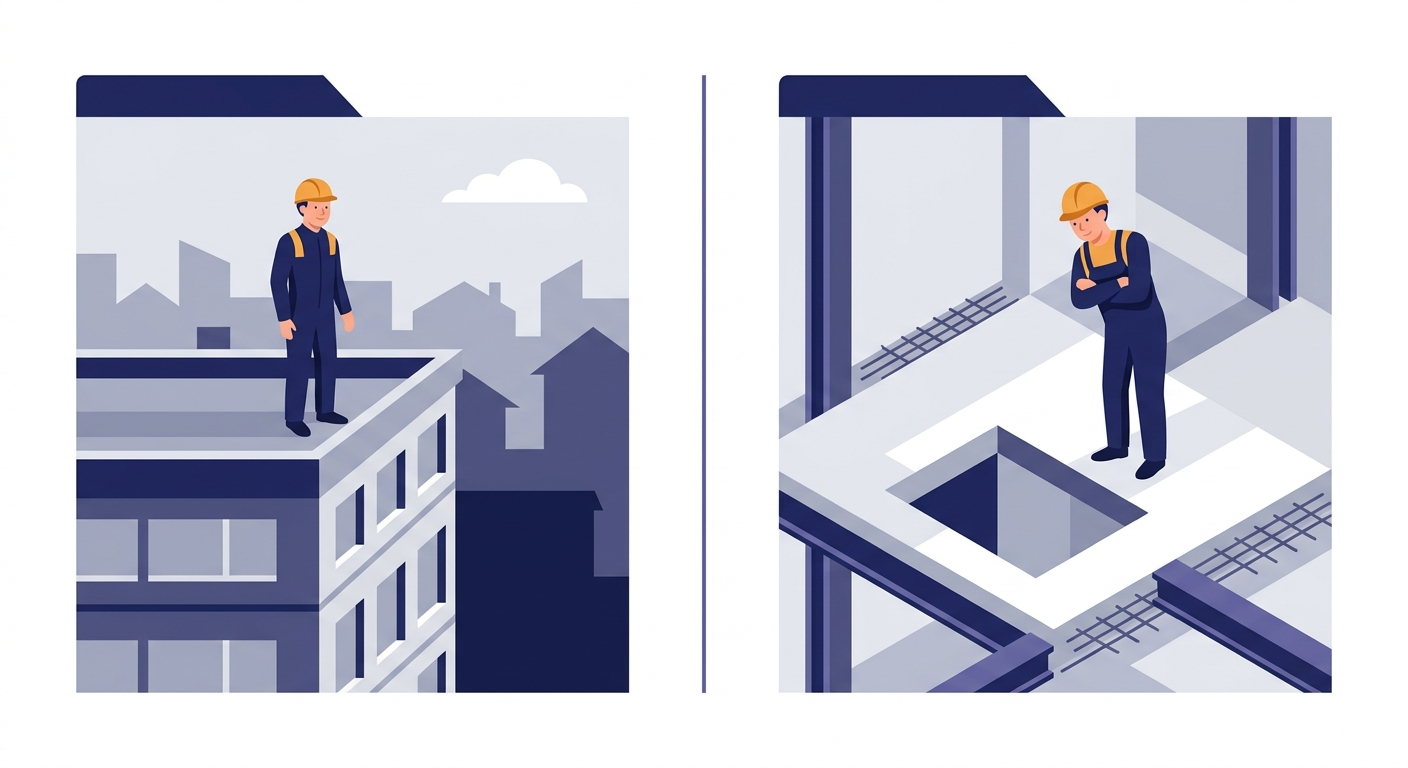
One of the most counterintuitive consequences of the legal definition is that working at height includes work performed below ground level. This single fact, properly understood, transforms how a competent person sees a worksite.
Consider the scenarios that the regulations are designed to capture:
- Above ground level — the obvious cases. Roof work, scaffolding, ladders against gutters, MEWPs, working on top of vehicles, accessing high storage racking, inspecting plant from elevated walkways, fitting signage to building facades.
- At ground level, near an open edge or opening — working beside an unprotected loading bay, a service trench, a lift shaft entrance on the ground floor, an open inspection pit in a vehicle workshop, or a stairwell void during construction. The worker may have both feet on the ground, but if they could step or stumble into a void, they are working at height in law.
- Below ground level — working in or near excavations, manholes, basements with open access shafts, cellars accessed by steep ladders, or any underground space where a fall into a deeper void is possible. The mechanic who steps onto a vehicle inspection pit cover to reach a wheel is working at height. So is the utilities worker beside a trench.
- On or near fragile surfaces — an asbestos-cement roof, a corroded steel sheet, a rooflight, a skylight, fibre-cement panels, old plasterboard ceilings. We will devote an entire section of this course to these treacherous surfaces, because they account for a disproportionate share of fatalities.
- Where someone could fall through a surface or into an opening — a partly decked floor, an unguarded floor opening for service risers, a covered hole where the cover is not secured or marked.
The trade examples that catch people out
Once you internalise the definition, you start to see working-at-height scenarios that nobody on site has labelled as such. A few examples that consistently catch experienced workers by surprise:
- The flatbed lorry. A driver standing on the bed of a curtainsider to re-strap a load is roughly 1.3 to 1.5 metres above the ground. Falls from vehicles are one of the largest sub-categories of fatal and major-injury height incidents in the UK, and the haulage sector knows it.
- The mezzanine edge. A warehouse operative pushing a cage near the open edge of a mezzanine pick face is working at height — even if they never intend to go near the edge — because the foreseeable consequence of a stumble is a fall.
- The stepladder "just for a second." An electrician standing on the second tread of a stepladder to swap a ceiling tile is working at height. The fall distance is small. The injury potential is not.
- The bottom of the ladder. Yes — even the bottom rungs. We will return to this in a moment, because it is one of the most important and most resisted facts in the entire field.
- The kerbside MEWP at one metre. A signfitter in a basket elevated just above head height is, legally and practically, working at height. The fact that they could almost step out of the basket onto the pavement is irrelevant to the duties owed.
No minimum height — and why the old "two-metre rule" was abolished
There is no minimum height in the Work at Height Regulations 2005. None. The previous "two-metre rule" that some older workers still cite was abolished when the current regulations came into force in April 2005, precisely because it was killing people. Falls from below two metres — from the bottom rungs of ladders, from low platforms, from the backs of vehicles, from kerbs onto sunken courtyards — were being treated as ordinary slips and trips, and the controls were inadequate.
The Health and Safety Executive's incident data consistently shows that a significant proportion of serious and fatal height-related injuries occur from falls of less than two metres. A fall from the second rung of a ladder onto a concrete floor can fracture a skull just as effectively as a fall from a scaffold. The body does not know how impressive the height was; it only knows the deceleration it has been subjected to.
If a person could fall, and that fall could cause injury, you are working at height. Full stop.
Why the law is drawn this way
It is worth pausing to ask why Parliament and the HSE chose such a deliberately broad definition. The answer reveals something fundamental about the philosophy of modern UK safety law.
Earlier regimes tried to define working at height by setting numerical thresholds — most famously the two-metre rule in the Construction (Health, Safety and Welfare) Regulations 1996. The logic seemed sensible: below two metres, you are unlikely to be killed; above two metres, you are. Draw the line there and concentrate effort on the dangerous end.
The problem, as coroners' courts repeatedly demonstrated through the 1990s, was that the rule created a false sense of security at heights just below the threshold. Employers and workers reasoned, quite logically, that if the law did not require precautions below two metres, then precautions below two metres must be unnecessary. People stopped using sensible controls for low-level work. People died.
The Work at Height Regulations 2005 — which we will study in forensic detail in Section 2 of this course — were drafted in response to that failure, and to implement the European Temporary Work at Height Directive. The drafters deliberately removed the numerical threshold and replaced it with a consequence-based definition: if a fall could injure someone, the regulations apply. This forces every duty-holder to think about each task on its own merits, to assess the actual risk, and to apply the hierarchy of control accordingly.
A consequence-based, not threshold-based, regime
This shift from threshold to consequence is one of the most important conceptual moves in modern occupational safety. It mirrors the same shift in COSHH (consequences of exposure, not arbitrary substance lists), in DSEAR (consequences of ignition, not arbitrary flammability cut-offs), and in the management regulations more broadly.
The practical effect for you, whether you are a worker, supervisor, manager, designer or director, is this: you cannot delegate the question of whether the regulations apply to a number on a tape measure. You must think. You must look at the task, imagine it stripped of precautions, ask what could happen if someone fell, and decide accordingly.
The scale of the problem
To close this opening lesson, let us briefly note the scale of what we are dealing with — though we will examine the human and business cost in much greater depth in the next lesson.
Falls from height are, year after year, one of the leading causes of workplace fatalities in Great Britain. They are also a major source of life-changing major injuries — spinal cord damage, traumatic brain injury, multiple fractures, internal organ damage. The economic cost runs into hundreds of millions of pounds annually when you aggregate medical treatment, lost productivity, insurance, civil claims, criminal prosecutions, and the diffuse but very real cost of damaged organisational reputation.
None of this is abstract. Every fatality is a person who left for work in the morning and did not come home. Every major injury is a life — often a young, working-age life — permanently altered. Every prosecution is an organisation, sometimes a family business, facing fines that can run into millions and individual directors facing prison sentences under the Health and Safety at Work etc. Act 1974.
That is the territory we are entering. And it begins, always, with the simple discipline of recognising when work at height is happening — including in all the unglamorous, low-level, "it's only a stepladder" moments that the statistics tell us are killing people every week.
Key takeaway: recognition is the first competence
Working at height is any work where a person could fall a distance liable to cause personal injury — above, at, or below ground level. It includes work near open edges, on or near fragile surfaces, and anywhere someone could fall through a surface or into an opening.
There is no minimum height threshold. The old two-metre rule is gone, abolished precisely because it was contributing to deaths. If a fall could cause injury, the Work at Height Regulations 2005 apply — whether the worker is on the top of a wind turbine or on the second rung of a stepladder.
Recognising work at height is the first competence. Everything else in this course — the hierarchy of control, the equipment choices, the inspection regimes, the rescue plans — depends on you correctly identifying when a task falls within the regulations in the first place. Get this recognition right, and the rest of the discipline becomes possible. Get it wrong, and no amount of expensive PPE will save the worker you never realised needed protecting.
In the next lesson, we will examine in detail what happens — to people, to families, to businesses, to directors — when this recognition fails.
Enjoyed this preview? Enrol to unlock all 38 lessons + your certificate.
Training a team? Buy seats for your team →