Choosing Your Platforms: Google, Meta, or Both
The Wrong Question, The Right Question
Almost every business owner who comes to paid advertising opens with the same question: "Should I be on Google or Meta?" It feels like the most important decision you can make — choose right, and the money flows; choose wrong, and you burn cash watching strangers ignore your ads. So they ask around, read a blog post written by someone with an agenda, pick a platform, and pour budget into it.
This is the wrong question. Or rather, it's a question asked at the wrong altitude. The right question is: given what I sell, who buys it, and how they currently find solutions like mine — which platform captures existing demand, which one creates new demand, and what does the relationship between them look like over the next twelve months?
That sentence is longer and uglier, but it's the one that produces profitable accounts. In the previous lesson we drew the foundational line between intent (Google) and interruption (Meta). In this lesson we turn that distinction into a decision framework — a structured way to map your business onto the platform landscape and emerge with a defensible answer, not a guess.
The Five Variables That Decide Platform Fit
Platform choice is not a matter of taste or familiarity. It's a function of five interlocking variables. Work through them honestly and the answer usually reveals itself before you've finished the exercise.
1. Search volume for what you sell
The most important question in all of Google Ads is brutally simple: are people actually searching for this? If someone has typed "commercial dehumidifier hire Birmingham" into Google this morning, there is a market on Search waiting for you. If nobody has ever typed your category name because the category itself is new or obscure, Google Search has nothing to sell you.
You can check this in roughly fifteen minutes using Google Keyword Planner, Google Trends, or a third-party tool like Ahrefs or Semrush. Look at the monthly search volumes for your core terms, your competitor brand names, and the problem-statement phrases your customers might use. Three patterns tend to emerge:
- High volume, established demand — plumbers, accountants, hotels, replacement car parts, established e-commerce categories. Google Search is non-negotiable here; competitors are already capturing those clicks every minute.
- Moderate volume, growing demand — newer product categories where awareness exists but isn't universal. Google Search works, but Meta is often required to expand the pool.
- Thin or zero volume — genuinely novel products, new brand names, problems people don't know have solutions. Google Search cannot fix this. You need Meta (or another interruption channel) to manufacture demand first.
2. Product or service type
Some things sell beautifully through interruption; others do not. A vibrant photo of a new ceramic skillet stops a thumb. A photograph of an industrial water-treatment compliance service does not — that buyer will only respond when they have a problem and search for a fix.
The rough rule of thumb: if your product is visual, emotional, lifestyle-adjacent, or solves a problem people don't yet realise they have, Meta is a natural home. If your product is functional, urgent, or chosen through deliberate comparison, Google's intent surface is where the money is. Most businesses fall somewhere in between, which is precisely why "both" is so often the answer.
3. Brand maturity and recognition
A 15-year-old brand with strong organic search traffic, branded search volume, and a loyal customer base has a fundamentally different paid media profile than a six-month-old DTC start-up nobody has heard of. Mature brands can lean heavily into Google because demand for their name already exists. New brands must spend on Meta to build that name in the first place — otherwise their Google Search account has nothing to capture.
4. Margin per customer
We will dedicate an entire lesson to this in two sessions' time, but it intrudes on platform choice early. Google clicks in competitive categories can cost £8, £15, even £40 each. If your average order value is £25 and your gross margin is 30%, you simply cannot afford a £12 click — the maths is over before the campaign starts. Meta's cost-per-click is typically lower, but its conversion rate is also lower because you're interrupting, not capturing intent. The right platform is partly a function of what your unit economics can absorb.
5. Speed of result you need
Google Search, when search volume exists and tracking is clean, can produce sales within days. Meta, especially for cold prospecting, often takes weeks to find its rhythm and longer still to scale profitably. If you have payroll due in three weeks and need cash now, that constraint is a real input into your choice.
The Decision Matrix
Let's compress the five variables into something you can actually use. When I sit down with a new client, I draw a 2x2 on a whiteboard with search volume on one axis and visual/emotional appeal on the other. Four quadrants emerge:
- High search volume + low visual appeal (emergency plumbers, B2B services, replacement parts): Google-led. Meta is optional, mostly for retargeting.
- High search volume + high visual appeal (fashion, established beauty brands, furniture): Both, equally weighted. Meta builds the desire, Google captures the comparison-shopping that follows.
- Low search volume + high visual appeal (new DTC products, novel gadgets, lifestyle brands nobody has heard of): Meta-led. Google plays a small but vital supporting role on brand and category searches.
- Low search volume + low visual appeal (genuinely niche B2B, complex services): LinkedIn, outbound, content, partnerships. Paid social and search are often the wrong tools entirely — an honest answer worth millions in saved spend.
This matrix is a starting point, not a verdict. But it gets you 80% of the way to the right answer in five minutes, which is better than most agencies manage in five weeks.
The Synergy Most Advertisers Miss
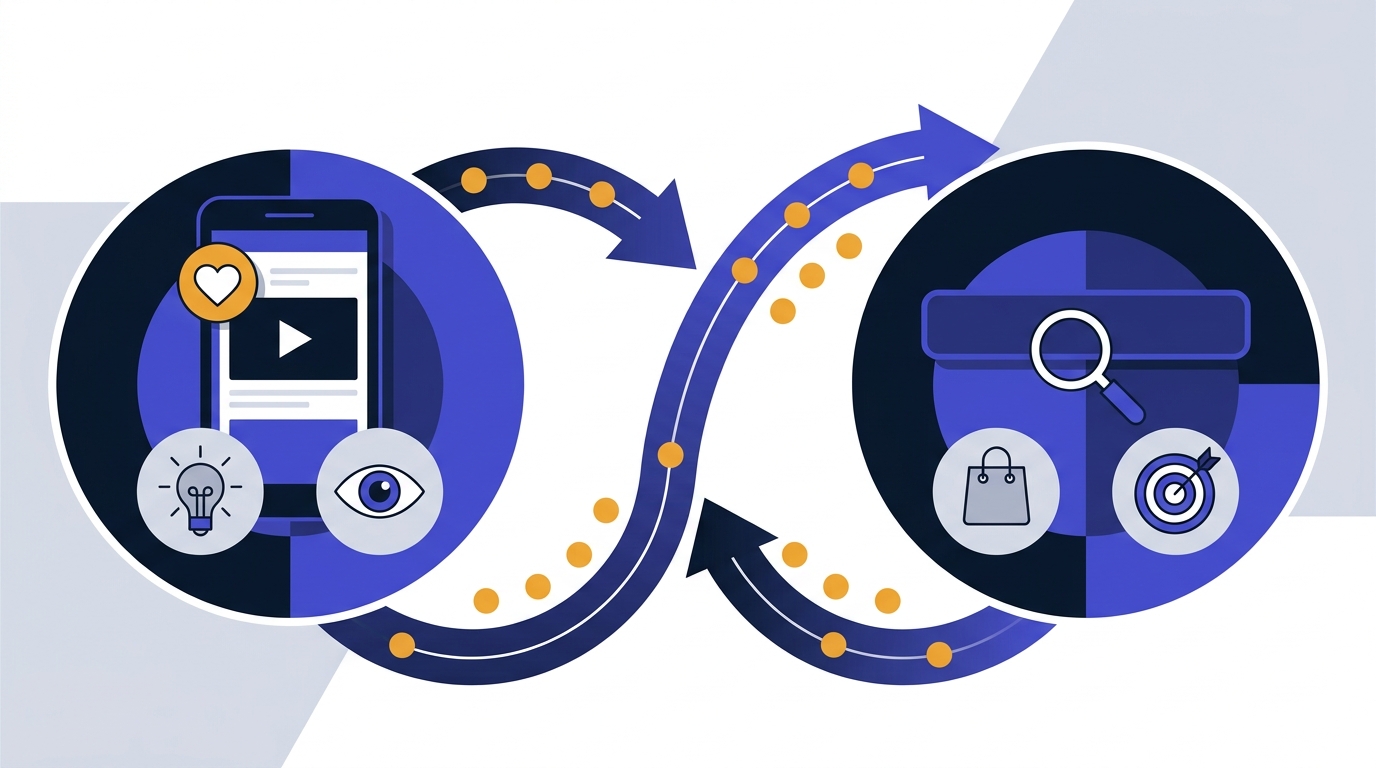
Here is the insight that separates the £50k/month advertisers from the £5k/month ones: Meta and Google are not competing channels — they are sequential stages of the same customer journey.
When someone sees your Meta ad on Tuesday for a vitamin C serum they'd never heard of, they probably don't buy. They scroll past. But on Friday, in the bathroom mirror, they notice a dark spot and remember that ad. They open Google and type "vitamin C serum for hyperpigmentation" — or your brand name, if it stuck. That search is your search. Meta planted it. Google harvests it.
If you only run Meta, you'll see a mediocre return because half your conversions happen on a Google click you didn't run. If you only run Google, you'll find your branded search volume slowly evaporating because nobody is being introduced to your brand. The two platforms create a flywheel: Meta manufactures the demand, Google captures it, and the resulting customer data feeds back into both platforms' algorithms to find more people like the buyer.
A worked example: the new skincare brand
Let me make this concrete. Imagine "Lumen Skincare" — a new DTC brand launching a vitamin C serum at £42. Founder has £8,000/month to spend. She comes to us asking: Google or Meta?
Step one: search volume check. We pull keyword data. Her brand name — "Lumen Skincare" — has zero monthly searches. Of course it does; it's three months old. The generic category — "vitamin C serum" — has 22,000 monthly UK searches, but cost-per-click is £3-£6 and the page is dominated by The Ordinary, Garnier, and Cult Beauty. As a brand-new entrant with no reviews and no authority, she will get crushed bidding on generic terms. Her £8k disappears in 11 days for negligible return.
Step two: product type check. Vitamin C serum is highly visual, lifestyle-adjacent, scroll-stopping (the texture, the glass dropper, the before-and-after of skin). It's a near-perfect Meta product.
Step three: brand maturity. Zero recognition. Nobody is searching for her.
The answer is now obvious. Meta does the heavy lifting up top. We run prospecting campaigns with UGC-style video — a woman in her thirties applying the serum, talking about her dark spots fading, the dropper catching the bathroom light. We target broad audiences and let Meta's algorithm find buyers. CPMs are reasonable. Some people buy directly from the ad — great. Many don't.
But here is what else happens. Three weeks in, we check Google Search Console. "Lumen Skincare" searches have appeared — 40 last week, 80 this week, 150 the week after. People saw the Meta ad, didn't buy, but remembered the name and Googled it later. We launch a small, cheap Google Search campaign on the brand name. CPC is £0.30 because nobody else bids on "Lumen Skincare." Conversion rate is 8%. ROAS is 14x.
That branded Google campaign is the most profitable thing in the entire account — and it only exists because Meta is running. Turn Meta off and within a month branded search dies and the Google campaign withers with it. The two platforms are not alternatives. They are partners.
Six months in, when Lumen has 4,000 customers and reviews and recognition, we can revisit the generic terms. "Vitamin C serum" might now be affordable because Lumen has authority, retargeting pools, and a customer-match audience to layer onto Search. The platform mix evolves with the brand.
When Google-Only or Meta-Only Actually Makes Sense
I've made the case for synergy, but let me be honest: there are genuine cases where running just one platform is the right answer — at least for now.
Google-only candidates
- Emergency and urgent services: locksmiths, emergency plumbers, boiler repair, towing. Nobody scrolls Instagram looking for an emergency plumber; they search the moment the water hits the floor. Meta brand-building offers diminishing returns versus dominating local Search.
- Pure B2B with long sales cycles: enterprise software, specialist consulting, industrial equipment. Decision-makers research on Google; LinkedIn may help but Meta usually doesn't.
- Replacement-part and aftermarket businesses: where the customer knows exactly what they need ("Bosch dishwasher pump WAS24462GB") and conversion happens on near-zero-friction intent.
Meta-only candidates
- Novel products with no search volume: a new category, a clever invention, a problem-solver people didn't know existed. There is literally nothing on Google to capture.
- Impulse, low-consideration goods with strong visual appeal: certain fashion accessories, gift items, lifestyle gadgets — where the buying decision is emotional and quick, and where Google's intent-based traffic isn't large enough to scale.
- Very early-stage brands with tiny budgets: when £2,000/month is the entire spend, splitting it across platforms can mean neither learns. Concentrating on the more demand-generative platform first, then layering Google as branded volume appears, is often wiser.
Even in these cases, the "only" status is usually temporary. As businesses mature, search volume catches up to brand awareness, and the second platform earns its place.
Workshop Exercise: Map Your Business onto the Framework
Take 25 minutes and complete this exercise before moving to the next lesson. Open a document and answer:
- Search volume audit — Using Google Keyword Planner or Google Trends, list the top five terms a customer might search to find what you sell. Record monthly UK volume and estimated CPC for each. Then check branded search volume for your own name and your two closest competitors.
- Visual appeal score — On a 1–10 scale, how visual, emotional or scroll-stopping is your product? Justify the score in two sentences.
- Brand maturity — How many people typed your brand name into Google last month? (Use Search Console if you have it, or Keyword Planner.) Under 50 means you are unknown. Over 1,000 means you have meaningful recognition.
- Plot your quadrant — Using the 2x2 matrix from this lesson, place your business in one of the four quadrants. Write one paragraph defending the placement.
- Declare a primary platform and a supporting platform — Based on the above, which platform gets 70% of your initial budget and why? What role does the other one play (even if at £0 for now)?
- State the trigger that changes the mix — What metric or milestone would cause you to rebalance? (e.g. "When branded search hits 500/month, I'll launch a Google brand campaign.")
Bring this answer to the live workshop session. Strong, defensible reasoning here saves you thousands of pounds in the first 90 days.
Meta and Google are not competing channels — they are sequential stages of the same customer journey. Meta manufactures the demand, Google captures it, and the resulting customer data feeds back into both platforms' algorithms to find more people like the buyer.
Budget Splits That Actually Work
Once you've identified your primary and supporting platforms, the next question is allocation. Here are the splits I see in healthy accounts at various stages — these are starting points, not laws, and your data should refine them within the first 60 days.
- Brand-new, low-search-volume product (Lumen scenario): 85% Meta / 15% Google (brand + category-defence only). Re-evaluate at month three.
- Established demand, mature brand (e.g. a 10-year-old furniture retailer): 50% Google (Search + Shopping + Performance Max) / 50% Meta (prospecting + retargeting). Often the most profitable configuration in e-commerce.
- Local service with urgent demand (e.g. emergency plumber): 90% Google / 10% Meta (mostly retargeting and local awareness). Don't overthink this.
- B2B SaaS with a 60-day sales cycle: 60% Google / 30% LinkedIn / 10% Meta (retargeting only). Meta cold prospecting rarely pays back in pure B2B.
- Premium DTC at scale (£100k+/month): 40% Meta / 35% Google / 25% other channels (TikTok, YouTube, Pinterest, affiliates). Diversification becomes a risk-management decision once volume is meaningful.
What to Do Next
You've now got a framework that produces a defensible answer to the "Google or Meta" question. Three things should happen between this lesson and the next:
- Complete the workshop exercise above. Genuinely — not in your head, on paper.
- Resist the temptation to launch yet. Platform choice is necessary but not sufficient. The next four lessons cover the metrics, margins, tracking and expectations you need before a single pound is spent.
- Notice the framing shift that has happened. We are no longer asking "which platform?" We are asking "what role does each platform play in my customer journey, at this stage of my business?" That is the question a mature advertiser asks, and you are now asking it.
In the next lesson we move from platform selection to platform mathematics — the metrics that decide whether your account makes you rich or quietly bleeds you dry. ROAS, CAC, AOV, break-even thresholds, and the brutal difference between top-line return and actual profit. It is the lesson most courses skip and most advertisers learn the expensive way.
Key Takeaway: The Two Platforms Amplify Each Other
The single biggest mindset shift in this lesson is this: stop thinking of Google and Meta as competing options and start thinking of them as complementary stages of a customer journey you are orchestrating.
For most businesses that grow past £10k/month in ad spend, the answer to "Google or Meta?" is eventually both — but the sequence matters. New brands lead with Meta to manufacture demand, then layer Google to capture the searches Meta generates. Established brands lead with Google to harvest existing demand, then layer Meta to expand the pool and defend mindshare. The platform mix evolves with the brand; treating it as a one-time decision is a beginner's mistake.
Decide your starting configuration with discipline. Revisit it every 90 days with data. And never, ever choose a platform because you find it more comfortable to use — that is the most expensive bias in paid media.
Enjoyed this preview? Enrol to unlock all 66 lessons + your certificate.
Training a team? Buy seats for your team →