Intent vs Interruption: The Foundational Split
The single mental model that determines whether your money makes money
Picture two people, both about to encounter an advert in the next sixty seconds. The first is sitting at her kitchen table at 11:47 pm. The kitchen ceiling is leaking. She grabs her phone, types "emergency plumber Manchester open now" into Google, and scans the first three results. She isn't browsing. She isn't comparing brand values. She wants a phone number, a price range, and someone in a van within the hour.
The second is on the train home from work, half-watching Instagram Reels. A short video appears: a woman demonstrating how a £29 silicone food cover replaces clingfilm forever. He wasn't looking for it. He didn't know it existed. Thirty seconds ago, the problem of "too much clingfilm in my life" didn't even exist in his head. By the time the train pulls into the station, he's bought two.
These two encounters look superficially similar — both involve a screen, an advert, and a purchase decision. But they are governed by completely different physics. Treat them the same and you will lose money with mathematical certainty. Understand the difference and almost every other decision in this course — platform choice, creative style, budget allocation, what to measure, how long to wait before judging results — falls into place with stunning clarity.
That difference is the foundational split of paid advertising: intent versus interruption. Or, put more usefully: demand capture versus demand generation. This is lesson one of fifty-four because nothing else in this masterclass makes sense without it. Get this single mental model right, and the rest of the course becomes a set of tactical refinements on a sound foundation. Get it wrong, and you'll be tactically excellent at running the wrong campaigns on the wrong platform with the wrong expectations.
Demand capture: meeting people at the moment of need
Google Search is, fundamentally, a demand-capture machine. When someone types a query, they have already done the hardest work an advertiser could ever ask of them: they have identified a problem, articulated it in words, and gone looking for a solution. Your job as an advertiser is simply to be present, relevant, and credible at the moment they go looking.
The mechanics of this are profound. The searcher's intent has been pre-qualified by the search itself. "Emergency plumber Manchester" is not curiosity — it is need, location, and urgency packaged into three words. "Best CRM for small accounting firms" is not idle browsing — it is a defined buyer, a defined use case, and an active comparison process. The further down the funnel the query, the hotter the intent, and the higher the conversion rate you can reasonably expect.
Because the user came to you, the relationship is consensual. They are not annoyed by your ad — they are grateful for it, provided it answers their question. This changes everything about how the advert should look and sound. You don't need to entertain. You don't need to interrupt a scroll. You don't need to generate desire. You need to demonstrate that you are the most relevant, trustworthy answer to the question already in their head. Clarity beats cleverness. Specificity beats spectacle.
Demand generation: creating desire that didn't exist sixty seconds ago
Meta — Facebook, Instagram, and increasingly Threads — operates on the opposite principle. Nobody opens Instagram to shop. They open it to be entertained, to see friends, to kill ten minutes in a queue. Your ad is, by definition, an interruption. The user did not ask for it. They did not articulate a need. They were not in a buying mindset.
This is not a weakness of the platform — it is the source of its power. Because Meta knows extraordinary amounts about who its users are, what they engage with, and what they've bought before, it can put your product in front of people who didn't know they wanted it but who, on seeing it, realise they do. This is the engine that built billion-pound brands like Gymshark, Allbirds, and a thousand direct-to-consumer brands you've never heard of but whose ads you've definitely seen.
Demand generation has a different job than demand capture. It must, in sequence: stop the scroll, communicate a problem the viewer didn't know they had, present your product as the solution, and create enough desire — usually in fifteen to thirty seconds — to push them off the platform and onto your site. This is a fundamentally creative task. The ad has to earn the attention it interrupted. It has to feel native to the feed it lives in. And it has to do emotional work that a Google Search ad would never need to do.
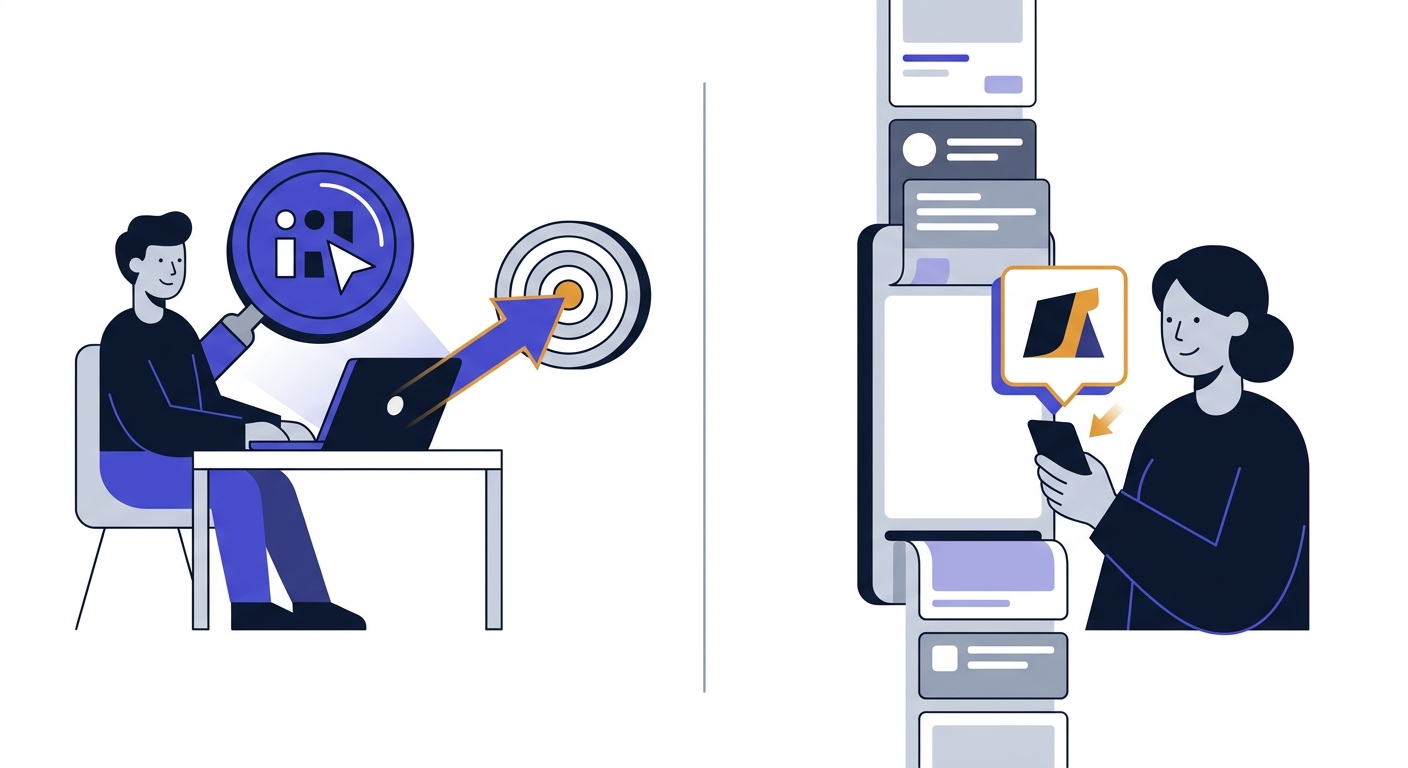
Google is primarily demand capture: someone is actively searching and you intercept that intent at the moment of need. Meta is primarily demand generation: you interrupt someone scrolling who wasn't looking for you and create desire. This single distinction drives everything — messaging, creative, expectations, and how fast results come.
Why this split drives every downstream decision
If this were merely a theoretical distinction, it wouldn't deserve to be lesson one. The reason it matters is that almost every practical decision you'll make as a paid advertiser — and almost every mistake beginners make — flows directly from getting this split right or wrong. Let's walk through the consequences.
1. Messaging tone and structure changes completely
On Google Search, the searcher has already named the problem. Your headline doesn't need to. "24/7 Emergency Plumbers — Manchester — Average Arrival 45 Mins" works because it confirms you can solve the exact problem they typed. The ad copy is functional: who you are, what you do, why you're credible, and a clear call to action. There is no need for emotional storytelling because the emotion (panic about a leaking ceiling) is already present.
On Meta, the viewer hasn't named anything. They were watching a recipe video. So your ad must do the naming for them. "Sick of clingfilm tearing every time?" — now there's a problem in their head that wasn't there a second ago. The structure is hook, problem, solution, proof, call to action. The tone is conversational, often entertaining, often emotional. Google ads inform. Meta ads persuade from scratch.
2. Creative format and production style diverge sharply
Google Search ads are largely text. The creative job is writing — headline combinations, descriptions, sitelinks. You'll spend your craft on word choice, not video editing.
Meta is a creative arms race. Static images work, but increasingly the workhorses are short vertical videos — UGC (user-generated content) style clips, founder-to-camera explainers, demonstration footage, and editorial-style mini-stories. You will need a steady pipeline of fresh creative because creative fatigue on Meta is real and brutal (we devote an entire section to this in Section 7). On Google Search, the same ad can run effectively for months. On Meta, the same ad may stop working in three weeks.
3. Speed of results is fundamentally different
Google Search ads, properly set up, can produce conversions on day one. The demand is already there; you're just intercepting it. If your offer is solid and your landing page works, you'll see leads or sales within hours of launching.
Meta is slower and lumpier. There is a learning phase — typically requiring around fifty conversions per ad set per week before the algorithm finds its footing — during which results are volatile. You might spend £500 on creative tests before you find a winner. Then that winner scales beautifully for six weeks before fatiguing. This is normal and not a sign of failure. The biggest beginner error on Meta is panic-killing campaigns after three days because they haven't matched the immediacy of Search.
4. The role of audience targeting inverts
On Google Search, the keyword is the targeting. "Buy running shoes size 10" tells you everything you need to know about who this person is right now. You don't need demographic targeting on top — the search itself is the segmentation.
On Meta, in the modern AI-driven era, audience targeting has actually weakened in importance while creative has strengthened. We'll explore why in Section 6, but the headline is this: Meta's algorithm is now so good at finding buyers from broad audiences that the lever you pull is creative, not interest selection. On Google, you choose keywords. On Meta, you increasingly choose creative and let the machine find the audience.
5. What you measure, and how you judge success, shifts
Google Search conversions tend to be last-click clean. Someone searched, clicked, and bought — the attribution is fairly honest. ROAS reported in Google Ads is usually close to reality.
Meta conversions are messier. Meta will often claim credit for sales it merely influenced, because someone saw an ad, then later searched the brand name, then bought. We have an entire section (Section 9) on attribution and why platforms over-claim, but the implication for lesson one is this: the platforms measure success differently because they do different jobs, and judging Meta by Google-style metrics — or vice versa — will lead you to kill campaigns that are actually working.
The most common answer is "both" — but in sequence
So which platform should you use? For most mature businesses, the honest answer is both — but the two platforms do different jobs, and understanding that division of labour is where strategy lives.
Consider a new skincare brand launching a vitamin C serum. Nobody is searching for their unknown brand name yet, so a Google Search campaign on the brand term would have almost zero volume. Generic searches like "vitamin C serum" exist but are expensive and dominated by established players with big budgets and better Quality Scores. So Search alone would be a slow, costly grind.
Meta does the heavy lifting at the top of the funnel. Beautiful UGC videos of real women applying the serum, before-and-after testimonials, founder-story content — all of this generates demand from people who weren't searching for anything. Some of them buy directly from the ad. But many don't. They scroll past, vaguely remember it, and three days later think "what was that serum brand?" and go to Google. That Google search — branded, high-intent, cheap — is captured by a small Search campaign on the brand name. Meta created the demand. Google captured it.
This pattern repeats across thousands of businesses. Meta generates the demand and brand awareness. Google captures the searches that demand creates. Run only Google, and you cap out at existing search volume — you can't grow beyond what the market is already typing. Run only Meta, and you leave money on the table by letting competitors intercept the branded and category searches your own ads created. The two platforms aren't alternatives; they're a system.
When one platform genuinely beats the other
That said, there are scenarios where one platform clearly leads:
- Google-first scenarios: Emergency services (plumbers, locksmiths, lawyers), B2B software with clear category names, replacement parts, anything where customers articulate the need in clear search terms. If the search volume exists, capture it before generating new demand.
- Meta-first scenarios: Visually-driven impulse products, novel inventions that don't have a search category yet, lifestyle and fashion brands, anything where the buyer needs to see it to want it. If nobody is searching for what you sell because they don't know it exists, you must generate the demand first.
- Both, equal weight: Most established e-commerce, most service businesses past the start-up phase, most situations where the category is mature enough to have search volume but not so saturated that Search alone can grow you.
Reflection exercise: classify these three businesses
Before reading on, classify each of these three businesses as Google-first, Meta-first, or both — equal weight, and write down a one-sentence reason for each:
- A locksmith covering five postcodes in Birmingham, average job value £140.
- A new direct-to-consumer brand selling a £45 weighted eye mask that helps with sleep — nobody has heard of the brand and "weighted eye mask" gets thin search volume.
- An established mid-market accounting software company with a known brand name, competing against three large rivals in a category that prospects actively research.
There are no trick answers. The point of the exercise is to feel the framework click into place. Suggested answers: (1) Google-first — emergency, location-specific, clear intent. (2) Meta-first — no brand awareness, no category search volume, visual product that benefits from demonstration. (3) Both — established brand searches to capture, but also a competitive category requiring demand-generation content to win consideration before the search happens.
The mistakes this framework prevents
Once you've internalised the intent-versus-interruption split, you become immune to a surprising number of expensive beginner mistakes. Here are the ones I see most often, and how the framework prevents each.
Mistake one: running clever, brand-led copy on Google Search. A consultancy writes a Search ad that says "Reimagine Your Possibilities." The searcher typed "management consultant for healthcare M&A." The clever copy gets ignored because it doesn't confirm relevance. Framework fix: on Google, match the language of the query. Save the brand poetry for places where attention isn't already yours.
Mistake two: running dry, feature-led ads on Meta. A SaaS company runs a Facebook ad listing six product features. The viewer was watching cat videos. They scroll past without registering a word. Framework fix: on Meta, you must create the problem before you sell the solution. Lead with a relatable pain, not a feature list.
Mistake three: judging Meta on day-three performance. A founder spends £600 on Meta in three days, sees no sales, panics, kills the campaign, declares Meta dead. They have not allowed the learning phase to complete and have starved the algorithm of data. Framework fix: Meta is a slower, lumpier game. Budget and patience must match the platform's physics.
Mistake four: expecting Google to grow you beyond the market's existing demand. A brand maxes out their Google Search account, hits a volume ceiling, and concludes that paid ads "don't scale." In reality, they've captured all available demand; to grow, they must generate more, which is Meta's job. Framework fix: when Google plateaus, you don't need more Google — you need Meta upstream creating the searches Google will then capture.
Mistake five: setting one ROAS target across both platforms. A business demands 4x ROAS on every campaign. Google delivers it on branded search (cheap, last-click clean) and Meta misses it on prospecting (expensive, influence-not-claim). The business kills Meta. Six months later, branded Google search volume has collapsed because nothing is feeding the top of the funnel. Framework fix: different platforms do different jobs at different points in the customer journey, and should be judged accordingly — a topic we'll dive into in Section 9 on attribution.
How this lesson shapes the rest of the course
Look back at the course outline and you'll notice it's structured around this split. Sections 2 through 4 are predominantly about Google — keywords, match types, Quality Score, Shopping, Performance Max, Smart Bidding. The mental model is demand capture: how do we intercept existing intent more efficiently than competitors? Sections 5 through 7 pivot to Meta — pixel setup, audience structures, the dominance of creative, the hook-in-three-seconds principle. The mental model shifts to demand generation: how do we earn attention from people who weren't looking for us?
Sections 8 onward — landing pages, tracking, attribution, optimisation — apply to both, but you'll see the intent/interruption distinction keep resurfacing. Message match on a landing page means something different when the visitor came from a high-intent search versus a scroll-stopping Meta ad. Attribution behaves differently across the two platforms. Even the AI tools we'll discuss in Section 10 work differently depending on which paradigm you're feeding them into.
The next lesson — Choosing Your Platforms: Google, Meta, or Both — takes the conceptual framework you've just built and turns it into a concrete decision-making tool. We'll work through a diagnostic that lets you classify your own business (or a client's) in under ten minutes and arrive at a defensible platform-mix recommendation. But the diagnostic only works because you now have the underlying mental model. Without intent versus interruption clearly in mind, platform choice becomes guesswork. With it, the right answer becomes almost self-evident.
Key takeaway: the framework in one paragraph
The foundational split, in one paragraph: Google captures demand that already exists by intercepting active search intent — your job is to be the most relevant, credible answer to a question someone has already typed. Meta generates demand that didn't exist by interrupting a feed with creative compelling enough to make someone want something they weren't looking for. Capture is faster, cleaner, and capped by existing search volume. Generation is slower, messier, and the only way to grow beyond what the market is already asking for. Most mature businesses need both, because Meta creates the demand that Google then captures — they're not alternatives, they're a system. Every downstream decision in paid advertising — messaging, creative format, audience strategy, speed of results, what to measure, how patient to be — flows from which side of this split you're operating on at any given moment.
Enjoyed this preview? Enrol to unlock all 66 lessons + your certificate.
Training a team? Buy seats for your team →