The Language of Health & Safety: Key Terms Decoded
Why words matter in health and safety
Every profession has its own language, and health and safety is no exception. But unlike, say, the jargon of marketing or finance, the words we use in safety carry legal weight, shape decisions, and — quite literally — determine whether people go home unharmed at the end of their shift. A manager who confuses hazard with risk may pour resources into the wrong problem. A supervisor who doesn't understand SFAIRP may either spend recklessly or fail to do enough. A worker who can't articulate what a competent person is may unknowingly take instructions from someone unqualified to give them.
This lesson is your vocabulary toolkit. By the end of the next fifteen minutes, you will be able to use six core terms with the precision of a seasoned practitioner: hazard, risk, control measure, so far as is reasonably practicable (SFAIRP), competent person and safety culture. These are the building blocks of every conversation, document and decision in the rest of this course — and, more importantly, the rest of your working life.
Think of this lesson as the moment a medical student learns the difference between symptom and diagnosis, or a lawyer learns to separate fact from opinion. The distinctions feel subtle at first. They become second nature. And they change how you see the workplace.
The six terms, decoded
1. Hazard — the source of potential harm
A hazard is anything with the potential to cause harm. It is a property of an object, substance, situation or activity — not an event. A hazard exists whether or not anyone is currently exposed to it.
Examples from real workplaces:
- A trailing cable running across a corridor — the hazard is the cable itself, because of its potential to trip someone.
- A bottle of bleach in a cleaner's cupboard — the hazard is the corrosive chemical inside.
- Working at height on a flat roof — the hazard is the height, and the potential fall energy it represents.
- A 25 kg sack of flour on a high shelf — the hazard is the load and its position.
- A noisy compressor in a workshop — the hazard is the sound energy capable of damaging hearing.
Notice the pattern: a hazard is something that could cause harm. It hasn't yet, and it might never. But the potential is there.
2. Risk — the likelihood and severity of harm actually occurring
A risk combines two things: how likely the hazard is to cause harm in your particular circumstances, and how serious that harm could be. Risk is dynamic. It changes depending on who is exposed, how often, in what conditions, and what controls are in place.
Return to the trailing cable. The hazard is constant — a cable on the floor is always a hazard. But the risk varies enormously:
- In a quiet, well-lit storeroom visited once a week by one trained employee: low risk.
- In a busy corridor used by 200 staff and visitors in poor lighting: high risk.
- At the top of a staircase used by elderly care home residents: very high risk, because the severity of a fall is far greater.
Same hazard. Wildly different risks. This is why risk assessment exists — and why simply listing hazards is not enough.
3. Control measure — what you do about it
A control measure is anything you put in place to eliminate or reduce a risk. Controls are the practical actions — the substance of safety management. They range from the dramatic (redesigning a process so a hazard no longer exists) to the everyday (a sign, a guard, a training course, a pair of gloves).
For the trailing cable, controls might include: rerouting the cable through a wall conduit (elimination of the trip hazard), using a cable cover ramp (engineering control), restricting access to authorised staff only (administrative control), or — least effective — telling people to watch where they walk (relying on behaviour).
You will learn in Section 2 that controls follow a strict hierarchy: some are far more reliable than others. For now, simply remember that a control is a deliberate action taken to reduce risk — not a wish, not a hope, not a poster.
4. So far as is reasonably practicable (SFAIRP)
This is perhaps the most important phrase in British health and safety law, and the one most often misunderstood. SFAIRP — sometimes written as ALARP (as low as reasonably practicable) — is the legal test that determines how much an employer must do to control a risk.
It does not mean "do everything possible regardless of cost." Nor does it mean "do whatever is cheap and convenient." It means: weigh the risk against the time, trouble and cost of controlling it, and control it unless the cost is grossly disproportionate to the benefit.
In practice, the higher the risk, the more an employer is expected to spend. A trivial risk may justify only a trivial response; a risk of death or permanent disability must be controlled even at significant expense. The burden of proof sits with the employer — they must demonstrate that further control was not reasonably practicable, not the other way around.
This is why courts rarely accept "it would have been expensive" as a defence in serious cases. If a £500 guard could have prevented an amputation, the cost is not grossly disproportionate. If a £500,000 ventilation upgrade would reduce an already-low cancer risk by a tiny fraction, the calculus is different.
5. Competent person
A competent person is someone with the skills, knowledge, experience and training to manage health and safety in a particular area. Note the four ingredients — all are required. A person can be highly knowledgeable in theory but lack practical experience; another may have decades of experience but no current training in modern controls. Competence is the combination.
The Management of Health and Safety at Work Regulations 1999 require every employer to appoint one or more competent persons to help them comply with their duties. Crucially, competence is task-specific. Someone competent to assess office DSE risks is not automatically competent to assess working-at-height risks, or to inspect scaffolding, or to conduct a fire risk assessment for a hospital.
When you hear "a competent person must do this," ask: competent in what? Evidence of competence might include qualifications (NEBOSH, IOSH), professional membership (IOSH, IIRSM), documented training, and a demonstrable track record.
6. Safety culture
Finally, the most human of the six terms. Safety culture describes the shared attitudes, values, beliefs and behaviours towards safety across an organisation. It is the answer to the question: what really happens around here when no one is watching?
A strong safety culture is one where workers report near misses without fear, where managers visibly prioritise safety over short-term production pressures, where challenging unsafe practice is welcomed rather than punished, and where learning from incidents is genuine rather than performative. A weak safety culture is one where rules exist on paper but are routinely bypassed, where reporting is discouraged, and where blame replaces inquiry.
You cannot buy safety culture. You cannot mandate it in a policy document. It is built — slowly, deliberately, and from the top — through thousands of small decisions and conversations. We will return to this concept in the capstone lesson of the course, because it is the soil in which every other control either flourishes or fails.
The most common mistake in safety assessments
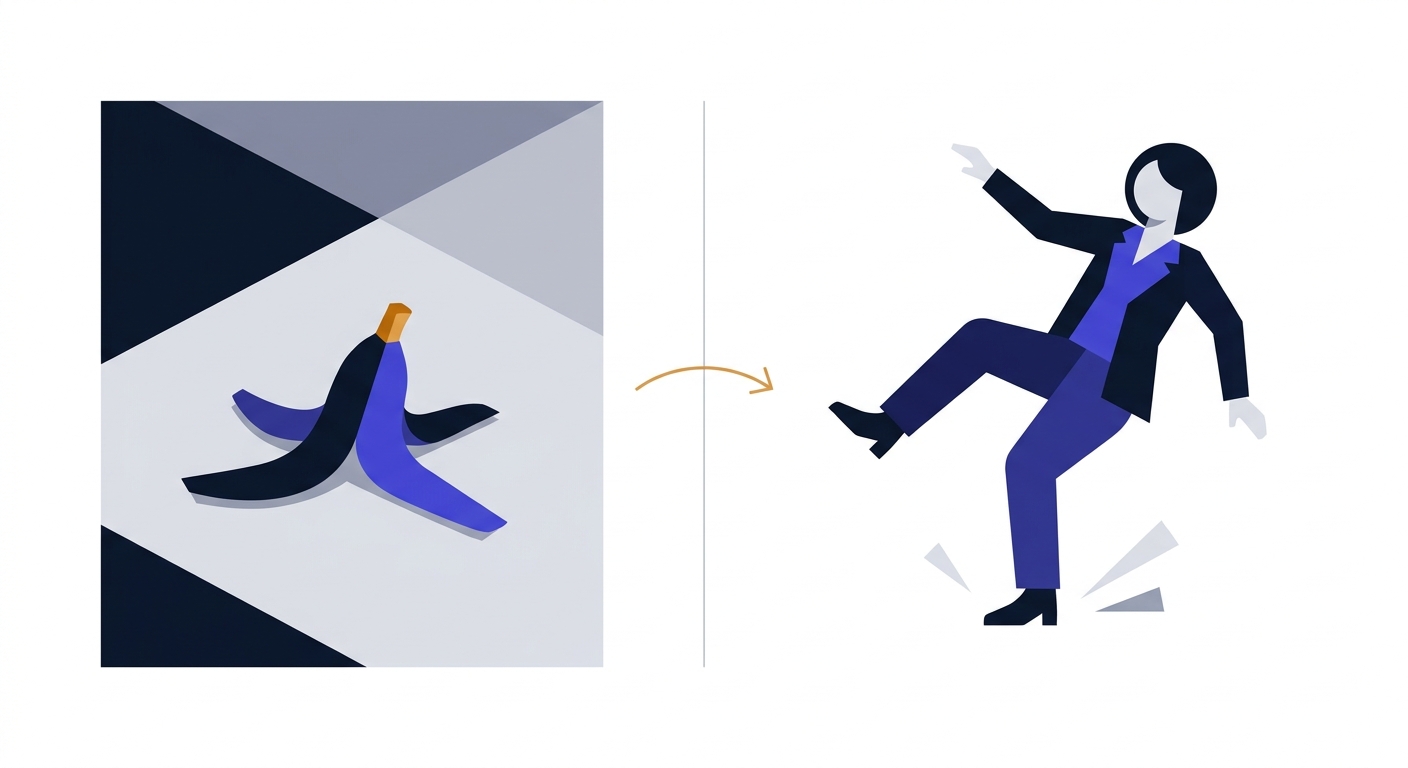
The single most common mistake in workplace risk assessments — made by experienced managers as often as new starters — is to treat hazard and risk as interchangeable words. They are not. A hazard is a thing or condition; a risk is a calculation about that thing in a specific context. Writing "the risk is the chemical" or "the hazard is high" reveals confused thinking that will produce confused controls. Whenever you find yourself uncertain, ask two separate questions: What could cause harm? (the hazard) and How likely is it, and how bad would it be? (the risk).
SFAIRP in the words of the law
The phrase "so far as is reasonably practicable" appears throughout the Health and Safety at Work Act 1974. Its meaning has been refined through decades of case law, but the underlying principle remains a simple balancing act — one that every supervisor, manager and director should understand intuitively.
Weigh the risk against the time, trouble and cost of controlling it; you must control it unless the cost is grossly disproportionate to the benefit.
Hold that sentence in mind. It will guide almost every practical decision you make in this course. When you are debating whether to install a guard, replace a chemical, redesign a process or buy better PPE, the question is never "is this perfectly safe?" — nothing ever is — but rather "have I done what is reasonably practicable, given the risk?"
How the terms work together
The six terms are not independent. They form a chain of reasoning that runs through every risk assessment you will ever perform:
- You identify a hazard — something with potential to harm.
- You evaluate the risk — likelihood multiplied by severity, in your specific context.
- You select control measures, working down the hierarchy from most to least effective.
- You apply them so far as is reasonably practicable — proportionate to the risk.
- You ensure a competent person oversees the work and verifies the controls.
- You embed all of this in a strong safety culture so it survives staff changes, production pressure and the passage of time.
Master this chain and you have mastered the logic of the entire discipline.
Exercise: apply the language to your workplace
Pause the lesson and try this now. Look around your current workplace — or, if you're studying at home, mentally walk through one you know well.
- Identify three hazards. Be specific: not "electricity" but "the frayed extension lead behind the printer."
- For each, describe who might be harmed and how.
- Rate the associated risk as low, medium or high, considering both how likely harm is and how serious it could be.
- For your highest-rated risk, suggest one control measure that would reduce it — and ask yourself whether more could reasonably be done.
Write your answers down. We will return to this exercise in Section 2, when we introduce the five-step risk assessment process formally — and you'll see how much you already understand.
A note on language as a professional signal
One final point before we summarise. The way you use these terms in conversation signals your level of professional competence — to colleagues, to managers, to inspectors and, if it ever comes to it, to a court. Practitioners who say "the hazard is high" or "we've assessed the risks of the chemical" mark themselves as imprecise. Practitioners who say "the hazard is the corrosive substance; the risk depends on how it's used; we've controlled it as far as is reasonably practicable through substitution and local exhaust ventilation" mark themselves as fluent.
That fluency is not pedantry. It is clarity of thought made audible. And clarity of thought, in this field, saves lives.
Lesson summary
Key takeaways — the six core terms
- Hazard: anything with the potential to cause harm. A property, not an event.
- Risk: likelihood combined with severity, in a specific context. Dynamic and situational.
- Control measure: a deliberate action taken to eliminate or reduce risk.
- So far as is reasonably practicable (SFAIRP): the legal test — control the risk unless the cost is grossly disproportionate to the benefit.
- Competent person: someone with the right skills, knowledge, experience and training for a specific task.
- Safety culture: the shared attitudes, values and behaviours that determine what really happens when no one is watching.
In the next lesson, we apply this vocabulary to the foundation of British health and safety law: the Health and Safety at Work Act 1974, and the duties it places on employers and employees alike.
Enjoyed this preview? Enrol to unlock all 44 lessons + your certificate.
Training a team? Buy seats for your team →