Why Health & Safety Matters: The Human and Business Case
By the end of this module, you'll be able to:
- Explain the moral, legal and financial case for health and safety, referencing the scale of harm recorded annually in Great Britain
- Identify the key duties placed on employers under HASAWA 1974 Section 2 and on employees under Sections 7 and 8
- Describe the five categories of RIDDOR-reportable event and state the correct reporting timeframe for each
The Stakes: Why This Subject Demands Your Attention
Before we open a single regulation, examine a risk matrix, or learn how to choose the correct fire extinguisher, we need to confront something more fundamental: why does any of this matter? If you cannot answer that question with conviction — to a sceptical director, a busy colleague, or a tired apprentice on a Friday afternoon — then every technique you learn in the next 32 lessons will sit on weak foundations.
Health and safety, properly understood, is the discipline of preventing human beings from being harmed by the work they do. That is its purpose. Not paperwork. Not high-visibility vests. Not signing a form so that someone else can be blamed when it all goes wrong. Its purpose is to ensure that the person who walked into the workplace this morning walks back out tonight — and walks back out in twenty years' time too, with their hearing intact, their lungs clear, their back unbroken, and their mind unburdened.
To grasp why this is urgent, we need to look at the scale of harm. In Great Britain, in a typical recent year, the Health and Safety Executive recorded the following figures from work activity:
- Around 135 workers killed in workplace accidents — a figure that does not include the public killed by work activities (which adds roughly 90 more), nor the estimated 12,000 deaths per year linked to past occupational exposures, particularly to asbestos, dust and chemicals.
- Approximately 561,000 non-fatal injuries reported by workers under the Labour Force Survey, with around 61,000 of these formally reported under RIDDOR.
- An estimated 1.8 million working people suffering from work-related ill health, with stress, depression and anxiety, and musculoskeletal disorders dominating the figures.
- Some 33.7 million working days lost annually to work-related illness and injury.
- A total economic cost to Britain estimated at £21.6 billion per year.
Read those numbers again. Slowly. Because the temptation is to glide over them as abstractions — and that is exactly the cognitive trick we must refuse to perform. Each fatality is a specific human being. A scaffolder named Tom whose three-year-old daughter does not understand why Daddy isn't coming home. A care worker named Aisha whose mother received a phone call she will replay for the rest of her life. Each case of occupational asthma is a thirty-year career cut short, a pension undermined, a hobby surrendered, a flight of stairs that becomes a barrier.
The single most important reframe in this entire course is this: health and safety is not about hazards, it is about people. Hazards are simply the mechanism by which people get hurt. Our subject is human welfare, and the technical apparatus — risk assessments, the hierarchy of control, PUWER, COSHH, RIDDOR — is the toolkit by which we deliver it.
Good health and safety is not red tape — it keeps people alive and well, keeps businesses running, and is a legal duty for everyone at work.
The Consequences of Getting It Wrong
Let us be unflinching about what happens when health and safety is neglected. The consequences cluster into four interlocking categories, and a serious failure typically triggers all four simultaneously.
1. Human consequences
This is the category that should always come first, because it is the only one that cannot be reversed by a cheque. The human consequences of poor health and safety include:
- Death — sudden, traumatic, and often witnessed by colleagues who will carry that memory permanently.
- Life-changing injury — amputation, paralysis, brain injury, severe burns, loss of sight. The person survives, but the life they had does not.
- Long-term occupational ill health — chronic back pain, occupational asthma, dermatitis, hand-arm vibration syndrome, noise-induced hearing loss, occupational cancers (particularly mesothelioma from asbestos).
- Psychological harm — post-traumatic stress, depression, anxiety, both in the directly affected worker and in colleagues, witnesses and family members. This is one of the most under-recognised costs.
- Cascade harm to families — children whose parents cannot work, partners who become full-time carers, parents who outlive their children.
2. Legal consequences
The Health and Safety at Work Act 1974 carries real teeth. When the HSE or local authority enforces, the consequences for the organisation and named individuals can include:
- Improvement Notices requiring specified action within a set period.
- Prohibition Notices stopping a dangerous activity immediately — sometimes shutting whole production lines or sites.
- Fee for Intervention (FFI) — currently around £174 per hour of HSE time when a material breach is found. Investigations can run to tens of thousands of pounds before any prosecution.
- Unlimited fines in the Crown Court. Under the Sentencing Council guidelines, fines for large organisations regularly run into millions of pounds, scaled to turnover.
- Imprisonment for individual directors, managers and workers found guilty of serious breaches, with sentences of up to two years in the magistrates' courts and unlimited in the Crown Court.
- Corporate manslaughter charges under the Corporate Manslaughter and Corporate Homicide Act 2007 where gross management failures lead to death.
- Director disqualification for up to 15 years.
3. Financial consequences
Even when no one is prosecuted, the economic damage of a serious incident is severe. Consider the full cost of a fatality or major injury:
- Lost production while the scene is preserved and investigated — often days or weeks.
- Replacement labour, overtime, agency costs.
- Investigation time — legal, HR, operations, senior management.
- Civil compensation claims (which insurance covers only partially, and which drive up future premiums for years).
- Insurance excess and exclusions.
- Lost contracts — many large clients now require near-zero LTIFR (Lost Time Injury Frequency Rate) figures from suppliers.
- Recruitment and retraining costs after staff leave a workplace they no longer trust.
The HSE's own research suggests that the uninsured costs of a workplace accident typically outweigh the insured costs by a ratio of 10 to 1. An injury that triggers a £10,000 insurance payout might cost the business £100,000 in disruption, investigation and lost opportunity.
4. Reputational consequences
Reputation, once damaged, is the slowest thing in business to repair. A serious incident lives forever on Google, on news archives, on the HSE's published prosecutions database, and in the memories of customers, suppliers, recruits and regulators. Companies have lost contracts, had IPOs delayed, seen share prices collapse, and been forced to rebrand entirely following high-profile safety failures. In sectors like construction, where pre-qualification questionnaires demand safety statistics, a poor record can simply close the door to tendering for major work.
The Positive Case: What Good Health and Safety Delivers
So far we have framed the case negatively — the costs of failure. But the most persuasive argument for health and safety, particularly when speaking to commercial leaders, is the positive return on investment. Organisations that do this well do not merely avoid disaster; they unlock measurable performance gains. Here is how.
Fewer accidents, lower absence, more output
The mechanism is simple. A worker injured at work is not at work. A worker worried about a hazard is distracted. A team interrupted by an incident loses days or weeks of momentum. When risks are properly controlled, output rises naturally — not because people work harder, but because they work uninterrupted by avoidable harm. Studies consistently show that high-performing safety organisations have absenteeism rates 20–40% lower than peers.
Higher engagement and retention
People want to work where they are valued. A workplace that demonstrably cares about whether you go home in one piece sends a powerful signal that you matter. This translates into measurable engagement scores, lower voluntary turnover, easier recruitment, and a stronger employer brand. In tight labour markets — care, construction, manufacturing, logistics — this can be the difference between a viable business and one that cannot staff its shifts.
Quality and safety are the same discipline
This is a deep insight that experienced practitioners know in their bones: a well-controlled workplace produces better products. The habits that prevent injury — orderly housekeeping, clear procedures, maintained equipment, trained operators, attention to detail — are the same habits that produce consistent quality. Toyota, Rolls-Royce, and the UK's best NHS trusts all treat safety and quality as expressions of the same underlying operational excellence.
Lower insurance and finance costs
Employer's Liability and Public Liability premiums are increasingly underwritten on the basis of detailed safety performance data. A strong record translates directly into lower premiums. Lenders and investors, particularly under modern ESG (Environmental, Social and Governance) frameworks, scrutinise safety performance as a proxy for management quality.
Licence to operate and contract eligibility
Major clients — government, infrastructure operators, supermarkets, hospitals — require safety pre-qualification (SSIP schemes like CHAS, SafeContractor, Constructionline). Without it, you cannot bid. Good standards open doors that bad standards permanently close.
A positive safety culture: the compound interest of safety
The deepest benefit is cultural. When safety is genuinely embedded, you stop relying on rules being enforced and start relying on people doing the right thing because that is who they are. People challenge unsafe acts. They report near misses without fear. They suggest improvements. They look out for each other. This is the safety culture we will return to throughout the course, and it is the single greatest predictor of long-term safety performance — far more powerful than any individual control measure.
The Three Lenses: Moral, Legal, Financial
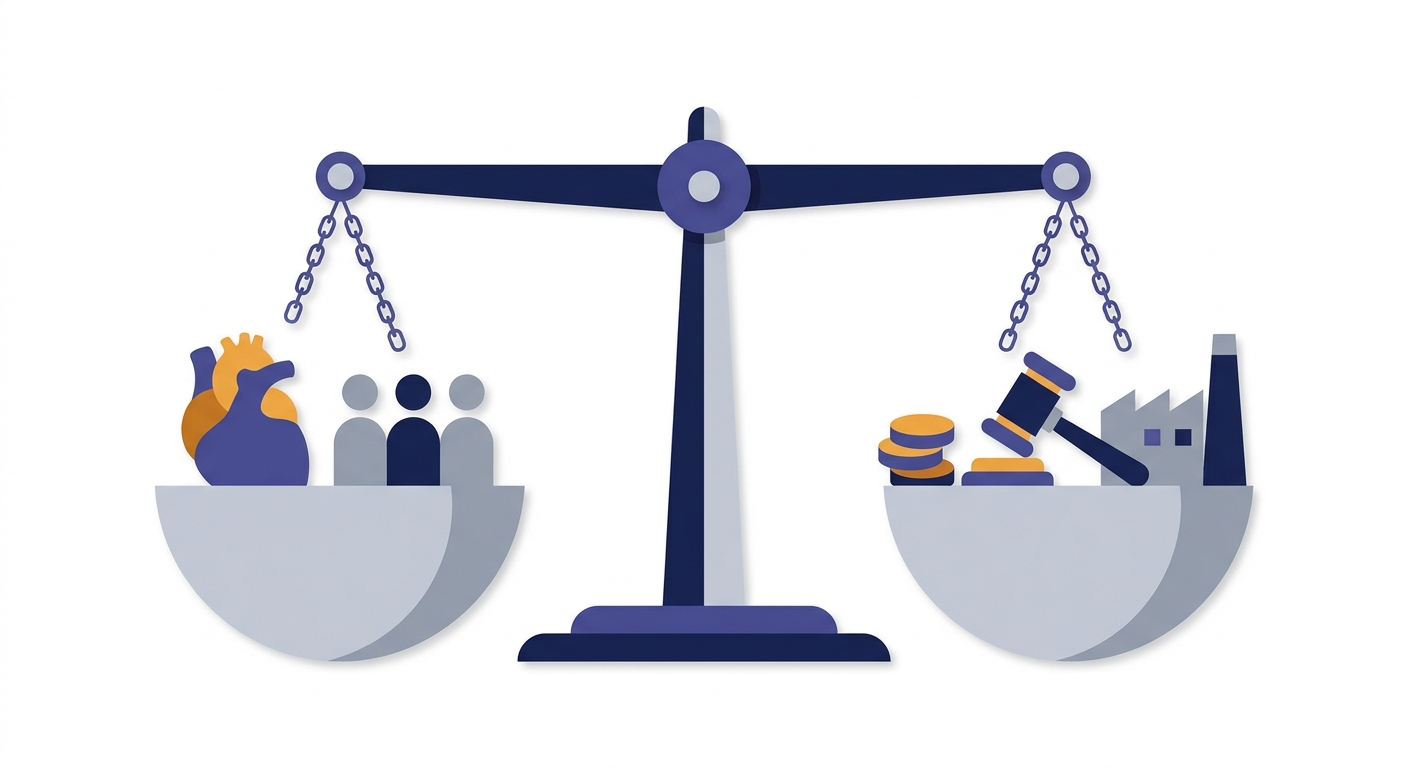
Health and safety practitioners traditionally summarise the case for action under three headings — sometimes called the three pillars or the moral, legal and financial arguments.
- The moral case — we have an ethical duty not to harm people, and a positive duty to look after those we employ and those affected by our work. Most people, asked directly, accept this without argument. The hard work is keeping the moral case visible when production pressure mounts.
- The legal case — UK law, principally the Health and Safety at Work Act 1974, imposes binding duties on employers, employees, the self-employed and others. Breach carries criminal sanctions including unlimited fines and imprisonment. This is not optional, and ignorance is not a defence.
- The financial case — as we have seen, good safety is good business. The hidden costs of incidents are vast; the returns on prevention are substantial and measurable.
The best practitioners learn to pitch all three depending on their audience — moral arguments to colleagues, legal arguments to directors with compliance duties, financial arguments to commercial leaders focused on the P&L. The truly skilled practitioner uses all three simultaneously, because they are not in conflict: they reinforce each other. The cheapest, most legally compliant workplace is the one where people are genuinely safe.
Reflection Exercise: Your Personal Case for Safety
Pause the lesson here and take five minutes for this exercise. It will anchor everything that follows.
- Write down three specific reasons health and safety matters in your workplace — not in the abstract, but in the actual building, with the actual people, doing the actual tasks you know.
- For each reason, identify which of the three lenses it primarily speaks to: moral, legal, or financial.
- Now rank them in the order you believe your most senior leader would rank them.
- Finally, rank them in the order you would rank them.
The gap between those two rankings is one of the most useful diagnostic insights you will gain in this course. It tells you which arguments you need to develop further if you want to influence change in your organisation.
Everyone Has a Part to Play
One final foundational point before we close this opening lesson. Health and safety is sometimes spoken about as if it were the responsibility of a single person — "the safety officer" or "the health and safety manager." That framing is profoundly mistaken, and the law explicitly rejects it.
Under the Health and Safety at Work Act 1974, every single person in a workplace has duties. Employers have the broadest duties — to provide safe systems of work, safe equipment, training, supervision, and so on. But employees have personal legal duties too: to take reasonable care of themselves and others affected by what they do (or fail to do), to cooperate with their employer on safety matters, and not to misuse or interfere with anything provided in the interests of safety. Self-employed people, contractors, designers, manufacturers, suppliers and even members of the public who are affected by work all sit within the framework.
This matters because the great victories in safety — the genuine, sustained reductions in harm — never come from one person trying harder. They come from everyone in the system taking ownership of their slice of the risk. The forklift driver who slows down at the blind corner. The cleaner who reports the broken tile rather than walking past it. The team leader who actually stops the job when something doesn't feel right. The director who asks safety questions in every board meeting, not just after an incident. The new starter who admits they don't understand the procedure rather than guessing.
This is the spirit in which this course is written. You are not learning health and safety so that you can pass an exam. You are learning it so that you can take your part — whatever your role — in keeping yourself, your colleagues, and everyone affected by your work alive and well. That is the only standard worth holding yourself to.
What Comes Next
In the next lesson, we'll decode the precise vocabulary of our discipline — the difference between a hazard and a risk, what "so far as is reasonably practicable" really means in court, who counts as a "competent person," and why these distinctions are not pedantic but fundamental. Get the language right, and the rest of the course will fall into place with surprising clarity.
Key Takeaways from Lesson 1
- Prevention is the point. Health and safety exists to stop real people being killed, injured or made ill by work. The technical apparatus serves that purpose; it is not the purpose itself.
- The harm is real and the scale is large. Around 135 workplace fatalities, 1.8 million cases of work-related ill health, and £21.6 billion in annual costs in Great Britain. The vast majority of incidents are preventable.
- The case rests on three pillars. Moral (we shouldn't harm people), legal (we must not, on pain of criminal sanction), and financial (good safety is measurably good business).
- The costs of failure cascade. Human, legal, financial and reputational consequences typically arrive together, and the uninsured costs of incidents outweigh the insured costs by roughly 10 to 1.
- The benefits of success compound. Lower absence, higher productivity, better quality, easier recruitment, lower premiums, contract eligibility, and a culture in which people genuinely look out for each other.
- Everyone has a role. Employers, employees, the self-employed, contractors and designers all carry legal duties. Safety is never one person's job.
Enjoyed this preview? Enrol to unlock all 44 lessons + your certificate.
Training a team? Buy seats for your team →