Defining Manual Handling
What Exactly Is Manual Handling?
Before we can prevent manual-handling injuries, we need to agree on what manual handling actually is. And here is where most workplaces — and most workers — get caught out. Ask ten colleagues to define manual handling and you will likely hear ten variations on the same theme: lifting heavy things. It is an understandable answer. The image of someone hoisting a heavy box is so embedded in the cultural shorthand of workplace safety that it has become a kind of mental shortcut. Lifting equals manual handling. Everything else is just… work.
That shortcut is wrong, and it is a dangerous kind of wrong. It is dangerous because it allows the majority of manual-handling activity in any given workplace to slip beneath the radar of risk assessment, training and supervision. If you only see manual handling when somebody is squatting beside a heavy box, you will miss the carer adjusting a patient on a bed, the office worker dragging a stuffed archive box across a carpet, the chef reaching into a low freezer for a 5 kg bag of frozen chips, and the warehouse operative pushing a roll cage along a slightly sloped yard. All four of those people are doing manual handling. All four are exposed to risk. And in many workplaces, none of them are being properly trained for it.
So let us start with a precise, legal definition — one that is broad enough to capture the reality of modern work, and specific enough to be useful when you are actually trying to apply it.
The Formal Definition
Under UK health and safety law, and consistent with the Manual Handling Operations Regulations 1992 (which we will examine in detail later in the course), manual handling is defined as follows:
Manual handling means any transporting or supporting of a load by hand or bodily force — including lifting, lowering, pushing, pulling, carrying or moving.
Read that definition again, slowly. Notice what it does not say. It does not say heavy loads. It does not say large loads. It does not say in a warehouse, or at a building site, or only when you can feel the strain. The definition is deliberately, beautifully broad.
Three phrases in the definition deserve close attention, because each one expands the scope of what counts as manual handling well beyond the cultural shorthand of 'lifting'.
'Transporting or supporting'
The word transporting covers movement — taking a load from point A to point B, however brief that journey. But the word supporting is the one most people overlook. Supporting a load means holding it in position. Static holding. No movement. If you are standing still, holding a tray of drinks above your shoulder for a waiter's photograph, you are manual handling. If you are a nurse supporting a patient's leg while a colleague applies a dressing, you are manual handling. Holding counts. The body is under load whether or not the feet are moving.
'By hand or bodily force'
This phrase is critical. Manual handling is not just about your hands. It is about any use of bodily force — your shoulder pressing against a door, your hip nudging a trolley, your back braced against a heavy object you are stabilising. If your body is generating force to move or support a load, you are manual handling, regardless of which body part is doing the work.
'Any … load'
A load in legal terms is any discrete moveable object. That obviously includes boxes, crates, sacks and equipment. But it also includes people (a major consideration in healthcare and social care), animals (think veterinary work, farming), and materials being shaped or assembled. There is no weight threshold built into the definition. A 200 g item lifted from the floor 400 times an hour is still manual handling, and depending on the posture and frequency, it may carry significant injury risk.
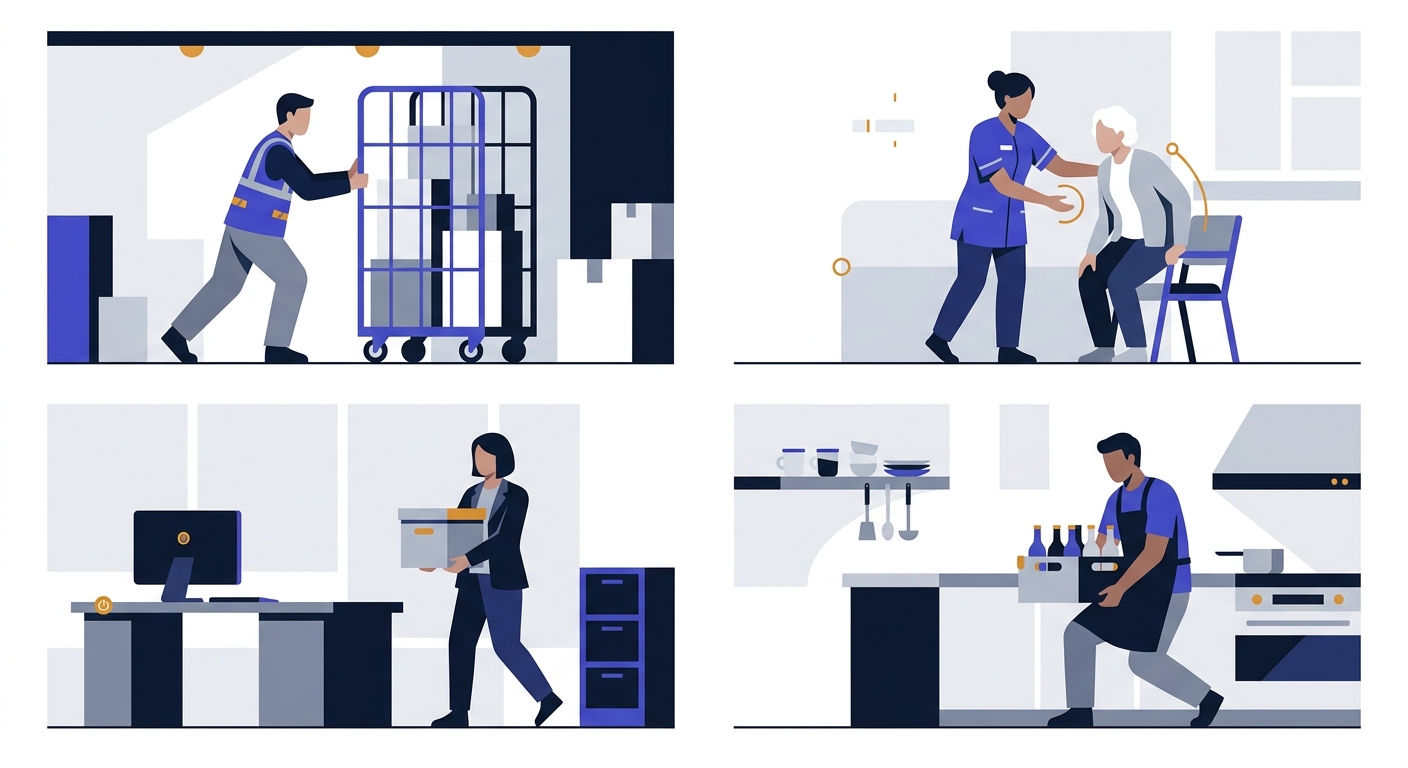
The Six Verbs of Manual Handling
The definition lists six actions that constitute manual handling: lifting, lowering, pushing, pulling, carrying and moving. Each one deserves a closer look, because each one shows up in workplaces in ways that people routinely fail to recognise.
1. Lifting
Lifting is the action everyone thinks of first, and it is also the action with the highest cultural visibility. It means raising a load against gravity — from floor to waist, from waist to shoulder, from shoulder to overhead. The injury risk in lifting is heavily influenced by where the lift starts and ends, how far the load is from the body, and whether the spine is twisted at any point. A short, light lift from a poor position can do more damage than a heavier lift performed well.
Workplace examples: a builder lifting a bag of plaster from a pallet; a librarian taking a book from a low shelf; a parent in a nursery picking up a child; a mechanic lifting a wheel into place.
2. Lowering
Lowering is often treated as 'lifting in reverse', but it is its own beast. The eccentric muscle contractions involved in controlled lowering — where the muscle lengthens under load — generate significant strain, and lowering injuries are common precisely because people relax their technique once they think the hard part is over. Dropping the last few centimetres, twisting to deposit a load, or letting the back round at the end of the movement are classic lowering errors.
Workplace examples: a delivery driver lowering a parcel onto a doorstep; a stock replenisher placing tins on a low shelf; a care worker easing a service user back into a wheelchair.
3. Pushing
Pushing involves applying force horizontally (or near-horizontally) to move a load away from the body. The forces involved can be considerable — far higher than people realise, especially when starting a heavy wheeled load from a standstill, or pushing across an uneven or slightly inclined surface. Pushing injuries tend to involve the shoulders, lower back and knees.
Workplace examples: pushing a hospital bed along a corridor; pushing a roll cage out of a delivery lorry; pushing a wheelbarrow up a slight ramp; pushing a heavy door open with the shoulder.
4. Pulling
Pulling applies force horizontally to bring a load toward the body. Pulling is generally more biomechanically risky than pushing, because the operator often cannot see clearly where they are going, the posture tends to be more compromised, and the body's leverage is weaker. Many workplaces have informal cultures of pulling when they should be pushing.
Workplace examples: dragging a sack of feed across a barn floor; pulling a wheelie bin to the kerb; pulling a heavy floor cleaner backwards; pulling a patient up the bed by the bedsheet (a now strongly discouraged practice).
5. Carrying
Carrying means supporting and transporting a load over a distance. The risk in carrying compounds over time and distance: a load that is comfortable for five metres can become a hazard at fifty. Add stairs, a slope, a doorway, or a sudden need to change direction, and the risk multiplies. Carrying also encourages people to take loads in single trips that should really be two.
Workplace examples: a porter carrying luggage up a flight of stairs; a chef carrying a stockpot across a busy kitchen; a postal worker carrying a satchel of parcels along a delivery round.
6. Moving (and Supporting)
The sixth verb is the catch-all — and the one most often missed. It captures everything that does not neatly fit the first five: rolling, sliding, tilting, restraining, repositioning, holding. This is where so much of the unrecognised manual handling lives, particularly in healthcare, where 'repositioning a patient' is one of the highest-risk activities in the entire workforce.
Workplace examples: rolling a barrel along the floor; sliding a heavy box across a desk; tilting a wheelie bin to drain it; holding a ladder steady; repositioning a patient in bed; restraining an animal during examination.
Exercise: Spot the Hidden Manual Handling in Your Day
Take a moment — genuinely, pause the lesson — and write down five manual-handling tasks from your own working day. Push yourself beyond the obvious. Include at least two that you would never previously have labelled as 'manual handling'. Think about:
- Tasks you do so often you no longer notice them (kettle, files, equipment, doors)
- Tasks involving holding or supporting rather than moving
- Tasks where you use a shoulder, hip or knee rather than your hands
- Tasks involving people, animals, or awkward shapes rather than boxes
- Tasks that feel light individually but happen dozens of times a day
Keep this list. We will return to it in later modules when we start applying the TILE risk assessment framework. Your own real tasks, in your own real workplace, are the most powerful learning material this course has to offer.
Why the Definition Matters So Much
You might reasonably ask: does it really matter whether we call something 'manual handling' or just 'work'? The answer is yes, and for two reasons — one legal, one practical.
Legally, the moment an activity falls within the definition of manual handling, it triggers specific duties on the employer under the Manual Handling Operations Regulations 1992. These duties — which we will unpack in Section 2 — include the obligation to avoid hazardous manual handling so far as reasonably practicable, to assess what cannot be avoided, and to reduce the risk to the lowest level reasonably practicable. If a task is not recognised as manual handling, none of those duties get applied to it. The legal protections simply do not engage.
Practically, the definition determines whether an activity gets included in your workplace's risk assessments, your training programmes, your supervision arrangements, and your incident reporting. A task that is invisible to the system is a task that will eventually injure somebody — and when it does, the injury will appear to come from nowhere, because the system was not looking.
The 'Invisible' Manual Handling Problem
In every workplace audit I have ever seen, there is a category of activity I think of as invisible manual handling: tasks that are clearly captured by the legal definition, but are not recognised as manual handling by the workers performing them or the managers supervising them. Some classic examples:
- Restocking and merchandising in retail — endless small lifts, lowers, reaches and twists, often from awkward shelf heights, often performed at pace. Each individual movement is small. The cumulative load on the body is substantial.
- Office archiving and IT moves — the once-or-twice-a-year box shuffle is a notorious source of strains. It does not happen often enough to feel like 'manual handling', so nobody trains for it, and the boxes are often heavier and more awkwardly shaped than people anticipate.
- Cleaning and janitorial work — wringing mops, pushing floor scrubbers, hauling bin bags, reaching to clean high surfaces, kneeling and twisting in confined spaces. A vast amount of manual handling, often performed by lone workers with minimal supervision.
- Healthcare repositioning — the single most underreported manual-handling category in the UK. Small adjustments to a patient's position happen many times per shift, are rarely logged, and contribute enormously to the cumulative injury burden of nursing and care staff.
- Hospitality service — carrying trays, lifting crates of glassware, manoeuvring kegs, reaching into low fridges, all at speed and often in cramped working areas.
None of these activities involve picking up a single heavy object in a single dramatic moment. All of them are manual handling under the legal definition. And all of them can — and do — cause serious injury.
Key Takeaway
The single most important idea in this entire lesson:
Manual handling is far broader than 'lifting'. It covers most physical work performed in most jobs in the UK.
If your body is generating force to move, hold, push, pull, carry or reposition any load — object, person, animal or material — you are doing manual handling, and the protections of the law apply. Recognising the activity is the first, indispensable step in managing the risk. You cannot prevent what you cannot see.
What Comes Next
Now that you have a precise definition and a sharpened eye for spotting manual handling in your own working life, the next lesson turns to the question of why this matters so urgently. We will look at the scale of musculoskeletal injury in the UK workforce, the costs to individuals and businesses, and the reasons that manual-handling injury remains one of the largest preventable causes of work-related ill health in the country. The numbers, frankly, are sobering — and they are exactly the foundation you need before we move into the law, the anatomy, and the techniques that make up the rest of this course.
Enjoyed this preview? Enrol to unlock all 43 lessons + your certificate.
Training a team? Buy seats for your team →