Welcome: What This Course Will Do For You
By the end of this module, you'll be able to:
- define manual handling precisely — including all six verbs and the scope of loads — and recognise it across a full range of workplace tasks beyond obvious lifting.
- distinguish between acute and cumulative musculoskeletal injury, explaining why cumulative strain accounts for more lost working days and career-ending harm in the UK workforce.
- describe the human and business costs of manual handling injury and explain why most such injuries are preventable rather than accidental.
Welcome — you've made an excellent decision
Welcome to Manual Handling Mastery: The Definitive Level 2 Course. Whatever brought you here — a new job, a refresher requirement, a recent near-miss, a nagging back pain that finally got your attention, or simply a determination to do this properly — you are in exactly the right place. Over the next thirty-two lessons we are going to build, brick by brick, the kind of working knowledge that genuinely changes how you move, lift, push, pull and carry for the rest of your working life.
Let me be candid about the ambition here. Most manual-handling training is forgettable. It ticks a box, the certificate goes in a drawer, and three weeks later the learner is back to lifting awkwardly from the floor with locked knees. This course is designed to do something different. It is designed to make you competent — meaning you understand not just what to do, but why, in enough depth that you can adapt safely to situations no instructor could ever fully anticipate.
Who this course is for
This course is written for adults working in any UK setting where manual handling is part of the job — warehousing, logistics, retail, construction, manufacturing, healthcare, social care, hospitality, education, office work, agriculture and the trades. The principles are universal. The examples span sectors. Whether you spend your day moving pallets, repositioning patients, stocking shelves, carrying tools across a site, or simply lifting the occasional heavy box of printer paper, what you learn here applies directly.
It is also for supervisors, team leaders, line managers and small-business owners who need to understand their legal duties, organise risk assessments, and lead by example. You will leave this course able to coach your team, challenge unsafe practice constructively, and make defensible decisions about how work is organised.
What you will be able to do by the end
- Recognise manual-handling risk in any environment — including the subtle, cumulative risks that build over months and years.
- Apply the legal framework — the Health and Safety at Work etc. Act 1974, the Manual Handling Operations Regulations 1992, and supporting regulations — to real decisions at work.
- Explain how the spine works, how it gets injured, and why certain postures and movements are so much more damaging than they look.
- Carry out a structured manual-handling risk assessment using the TILE framework and the HSE weight filters.
- Execute safe technique for lifting, lowering, pushing, pulling, carrying and team handling — and know when to refuse a task and ask for an aid instead.
- Select and use manual and powered handling aids appropriately, and understand the basics of LOLER and PUWER inspection.
- Spot early warning signs of injury in yourself and colleagues, and know how to report and respond.
A tour of the nine sections
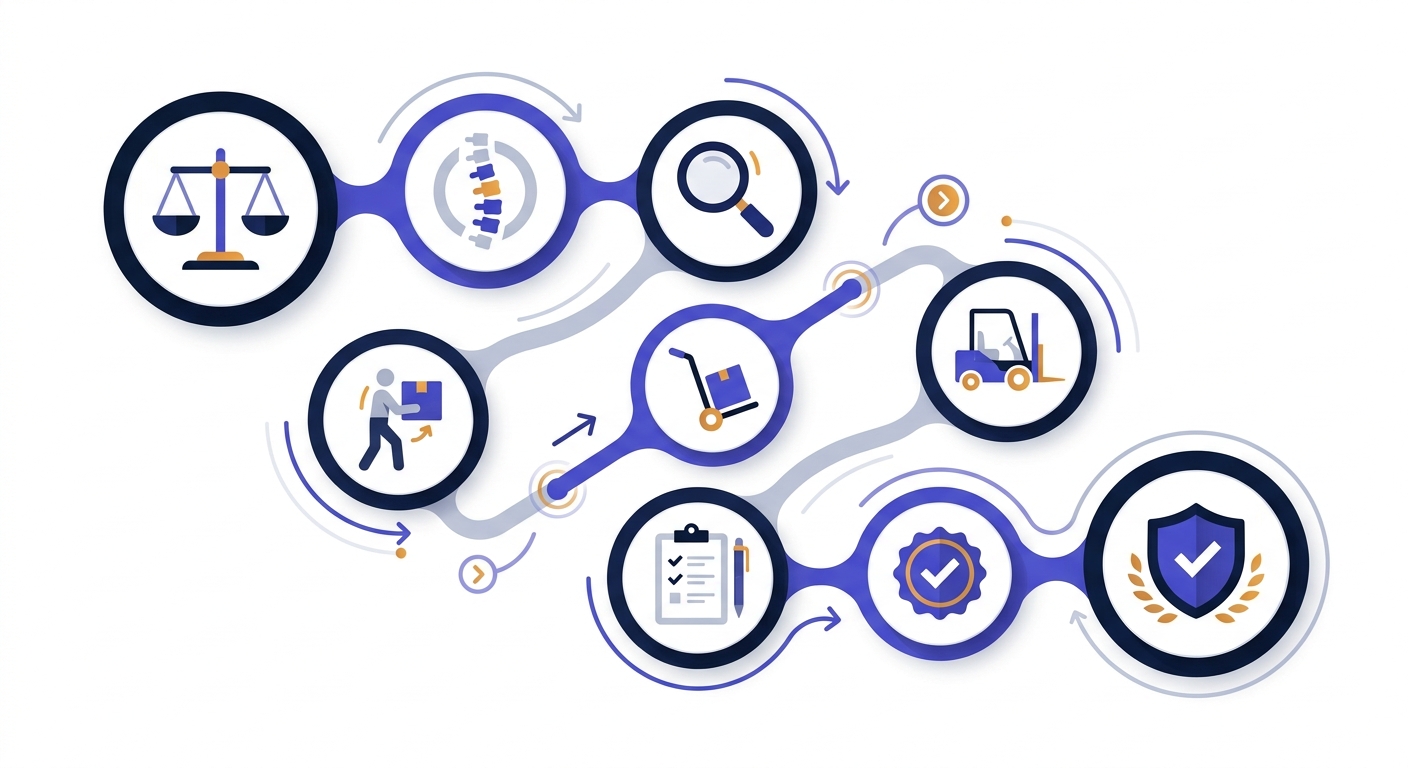
The course is organised into nine sections, designed to be studied in order. Each builds on the last, so by the time you reach the practical technique modules you are not just memorising movements — you are applying principles you genuinely understand.
Section 1 — Why Manual Handling Matters (you are here)
We open by sizing up the problem. Manual-handling injuries remain one of the largest categories of workplace ill-health in the UK, and the costs — human and financial — are staggering. We define manual handling precisely, distinguish acute from cumulative injury, and establish the moral and commercial case for taking this seriously.
Section 2 — The Law and Your Responsibilities
Next we ground everything in UK law. You will meet the Health and Safety at Work etc. Act 1974, the Manual Handling Operations Regulations 1992, and the supporting trio of the Management Regulations, PUWER and LOLER. We translate legal language into plain English and clarify exactly what employers and employees each must do.
Section 3 — The Spine and How Injuries Happen
Now we go inside the body. You will learn a working knowledge of spinal anatomy — vertebrae, discs, ligaments, muscles — enough to understand precisely why a poorly executed lift can rupture a disc, and why repeated small strains can be even more destructive than a single bad incident.
Section 4 — Risk Assessment and TILE
With the science in place, we move to assessment. The TILE framework (Task, Individual, Load, Environment) is the engine of every good risk assessment. You will learn to use it fluently, alongside the HSE weight guideline filters that give you defensible starting points for decisions.
Section 5 — Safe Lifting Technique
This is where theory becomes practice. We break the lift into four phases — plan, position, lift-and-move, lower — and rehearse each one carefully. Team lifting gets its own dedicated lesson because it introduces communication risks that solo lifting does not.
Section 6 — Pushing, Pulling and Carrying
Lifting is not the only way loads move. Pushing and pulling are often safer alternatives, but only when done correctly. We cover trolleys, sack barrows, carrying technique, and the special hazards of slopes, stairs, ramps and kerbs.
Section 7 — Mechanical and Handling Aids
The best lift is often the one you do not do yourself. We survey the full range of manual aids (sliders, trucks, conveyors), powered equipment (pump trucks, forklifts, hoists), and people-moving aids used in care settings, with guidance on selection, inspection and maintenance.
Section 8 — Reducing Risk in Your Workplace
Knowledge becomes habit only through daily reinforcement. This section embeds good handling principles into your workday — posture awareness, early warning signs, reporting culture, and the unglamorous but vital role of housekeeping.
Section 9 — Putting It All Together
Finally, a capstone lesson that integrates everything into a single workflow you can use from tomorrow morning onwards.
Honest scope: what online theory can and cannot do
This course delivers the theoretical and decision-making competence required at Level 2 — the knowledge half of being a safe handler. For most office, warehouse, retail and general workplace roles, that combined with on-the-job familiarisation is sufficient.
However, certain roles — most notably moving and handling people in health and social care, and some specialist industrial handling tasks — additionally require a practical, in-person assessment of your technique by a qualified assessor. No online course, however good, can watch you perform a slide-sheet transfer or observe your hoisting technique and give you immediate feedback. Where this applies, we will signpost it clearly within the relevant lessons. Your employer is responsible for arranging that practical sign-off.
How to get the most out of this course
You have invested significant time and money in this training. A few habits will multiply the return.
Study actively, not passively
Reading and nodding is not learning. Keep a notebook — paper or digital — beside you. After each lesson, write three things: one principle you want to remember, one example from your own workplace where it applies, and one question you still have. This single habit will double your retention.
Pace yourself sensibly
The course contains roughly five hours of content. You could binge it in an afternoon, but you would absorb far less. We recommend two to four lessons per session, with a break to let the material settle. The brain consolidates learning during rest, not during cramming.
Apply as you go
The moment you finish Section 4 on risk assessment, walk through your own workplace and try a TILE assessment on one task. The moment you finish Section 5, watch yourself lift something — really watch, perhaps with a colleague filming on a phone — and compare it against what you have learned. Theory that is never tested against reality fades quickly.
Engage with the exercises and reflection points
Throughout the course you will find practical exercises, scenario discussions and reflection prompts. They are not optional padding. They are where understanding gets forged. Skipping them is like watching someone else lift weights and wondering why you are not getting stronger.
Revisit, do not just complete
The lessons on anatomy and TILE in particular reward a second pass. Once you have finished the whole course and your mental framework is in place, those earlier lessons will reveal layers you missed first time round.
Five study habits that will transform your results
- Keep a dedicated notebook open while studying.
- Limit yourself to 2–4 lessons per session for best retention.
- After every section, walk through your real workplace and apply what you've learned.
- Treat exercises and reflection points as the core of the course, not the optional extras.
- Plan to revisit Sections 3 and 4 once you have completed the whole course.
Most manual-handling injury is preventable. Not minimised — preventable. That fact alone should change how seriously we take the subject.
A word about why this matters
Before we move into the technical material, allow me one moment of plain speaking. The reason this subject matters is not the legislation, and it is not the cost to your employer — important though both are. It is that every year, tens of thousands of people in the UK experience a moment of manual-handling injury that quietly reshapes the rest of their lives. A pulled muscle that never quite heals. A disc injury that turns into chronic sciatica. A shoulder that aches every winter for three decades. A career cut short at fifty-two because the body simply will not do it anymore.
These outcomes are not inevitable. They are not the price of doing physical work. They are, overwhelmingly, the result of preventable risk that was never properly assessed, never properly controlled, or never properly understood by the person doing the task. That is what we are here to change — for you, and for everyone you work alongside.
When you finish the next lesson, you will have a precise definition of manual handling that will sharpen how you see every task in your workplace. Let's begin.
Your destination: avoid, assess, reduce
By the end of this course you will be able to avoid unnecessary manual handling, assess the risk of what remains, and reduce that risk to the lowest reasonably practicable level — using sound technique, appropriate aids, and a clear understanding of the law. That is what competence looks like, and that is what you will leave here with.
Enjoyed this preview? Enrol to unlock all 43 lessons + your certificate.
Training a team? Buy seats for your team →