Welcome, Scope and How to Use This Course
By the end of this module, you'll be able to:
- explain what the mental health continuum is and why mental health belongs to everyone, not just those with a diagnosis.
- distinguish between everyday stress, a mental health problem, and a diagnosed condition using accurate, non-stigmatising language.
- describe how stigma harms individuals and workplaces and identify at least two everyday ways it can be challenged.
Welcome — and thank you for being here
Whatever brought you to this course — a difficult moment with a colleague, a new responsibility at work, a personal experience, or simply the quiet wish to be more useful to the people around you — you are exactly the kind of person UK workplaces need more of. Mental health touches every workplace, every team, every meeting room and every Teams call. Roughly one in four of us will experience a mental health problem this year. That means in any team of twelve, three people are likely to be navigating something — sometimes openly, often privately, and almost always while still trying to do good work.
This course is designed to change what you notice, what you feel confident saying, and what you do next. Across eight carefully structured sections and thirty-four lessons, we'll move from the foundations of what mental health is, through the most common conditions you may encounter, into the workplace context (including the legal duties that sit behind your role), and onwards into the practical skills of recognising signs, holding a supportive conversation, signposting effectively, building a healthier culture, and responding to crisis.
The tone throughout is deliberate. It is compassionate, practical and stigma-free. We will not talk about people with mental health problems as if they were a separate group; we will talk about all of us, because mental health is universal. We will not lecture. We will not catastrophise. And we will not pretend that supporting a colleague is easy — because it isn't always — but we will give you the language, the frameworks and the confidence to do it well.
What this course covers, at a glance
- Section 1 — Understanding Mental Health: the spectrum model, prevalence in the UK, and why stigma harms.
- Section 2 — Common Mental Health Conditions: depression, anxiety, stress, bipolar, PTSD, eating disorders and an awareness of psychosis — recognising, not diagnosing.
- Section 3 — Mental Health in the Workplace: work-related stress, the HSE Management Standards, the business and human case, and your employer's legal duties under the Health and Safety at Work Act and the Equality Act 2010.
- Section 4 — Recognising the Signs: behavioural, physical and emotional cues, and the single most important signal of all — change from someone's normal.
- Section 5 — Starting a Supportive Conversation: when, where and how to ask; the art of active listening; what not to do; and a simple practical framework.
- Section 6 — Supporting and Signposting: internal routes (line managers, HR, EAPs, occupational health, MHFAs) and external routes (GP, NHS talking therapies, Samaritans, SHOUT, Mind, crisis lines), and the all-important question of where your role ends.
- Section 7 — Wellbeing and Positive Culture: protective factors, the Five Ways to Wellbeing, what resilience really is, psychological safety, and the leadership behaviours that make workplaces healthier.
- Section 8 — Crisis, Risk and Urgent Help: recognising a crisis, responding to a panic attack, suicide awareness (including how to ask directly and safely), and looking after yourself afterwards.

Honest scope: what this course is — and isn't
This is an awareness-level course. It will build your understanding, confidence and ability to start a supportive conversation and signpost help. It will not qualify you as a therapist, counsellor, psychologist or Mental Health First Aider — the certificated MHFA England course is a separate, longer, instructor-led qualification, and we'll point you to it where relevant.
Nothing in this course is a substitute for professional medical advice, diagnosis or treatment. If you or someone you know is in immediate danger, call 999. For urgent emotional support at any time of day or night, the Samaritans are on 116 123, or you can text SHOUT to 85258.
How to use this course
The course is structured to be both linear and referenceable. We strongly recommend working through it in order the first time, because each section builds on the last — the conversation skills in Section 5, for example, depend on the recognition skills in Section 4, which depend on the conditions understanding in Section 2. After that first pass, you can return to any individual lesson whenever you need a refresher, before a difficult conversation, or when supporting a specific situation at work.
What you'll find inside each lesson
- Clear teaching — concise written explanations grounded in current UK evidence, guidance and law.
- Realistic workplace scenarios — short vignettes drawn from real UK workplace life: the normally outgoing colleague who has become quiet and short-tempered; the team member who quietly mentions, almost as an afterthought, that they've been feeling overwhelmed; the colleague who has a panic attack at their desk during a busy afternoon. These scenarios are deliberately recognisable.
- "What would you do?" moments — pause points that invite you to think before reading on. Resist the urge to skip these. The reflection is where the learning happens.
- Exercises and self-checks — practical activities to root the ideas in your own working life, from mapping your organisation's support routes to rehearsing the exact phrases you might use.
- Signposting — every lesson, where relevant, points to internal workplace support and the appropriate external services so you always know where to send someone next.
How to get the most out of it
- Give yourself time and quiet. This is content that benefits from a settled mind. Ten focused minutes will serve you better than thirty distracted ones.
- Bring your own context. As you read each section, picture your actual team, your actual workplace, your actual line manager. The course only becomes useful when you translate it into your world.
- Notice what stirs in you. Mental health content can quietly bring up our own experiences — past or present. That is normal and human. Pause when you need to. If anything raised feels heavy, talk to someone — a trusted person, your GP, or one of the support lines we'll signpost throughout.
- Practise the language out loud. Particularly in Section 5. The first time you say "I've noticed you don't seem yourself lately — how are you really doing?" should not be in the moment that matters. Rehearse.
- Don't aim to memorise everything. Aim to know where to find things. A practitioner's skill isn't holding every fact in their head; it's knowing the map.
You don't need to have the right answers. You need to be willing to ask, willing to listen, and willing to point the way to someone who can help.
The single most important idea in this course
If you take only one thing from this opening lesson, take this: you do not need to be an expert to help. You do not need a qualification in psychology, a clinical background, or all the right words. Most of the time, what someone who is struggling needs first is not a solution — it is the experience of being noticed, taken seriously, and treated like a whole person rather than a problem.
Listening and signposting matter most. Almost everything else in this course exists to support those two skills. Hold that in mind as we begin.
A note on language, confidentiality and care
Throughout this course we use person-first, non-stigmatising language: a person experiencing depression rather than a depressive; died by suicide rather than older, more loaded phrases. Language shapes culture, and culture shapes whether people feel safe enough to speak up. We also treat confidentiality as foundational — we'll explore exactly what it means, where its limits lie (particularly around risk to life), and how to honour it in practice.
Finally, a word about you. Supporting others around mental health is meaningful work, and it can also be tiring. This course takes your wellbeing as seriously as anyone else's. Section 7 is devoted to it, and Section 8 closes with how to look after yourself after a difficult conversation or a crisis. You cannot pour from an empty cup, and you are not expected to.
Ready when you are
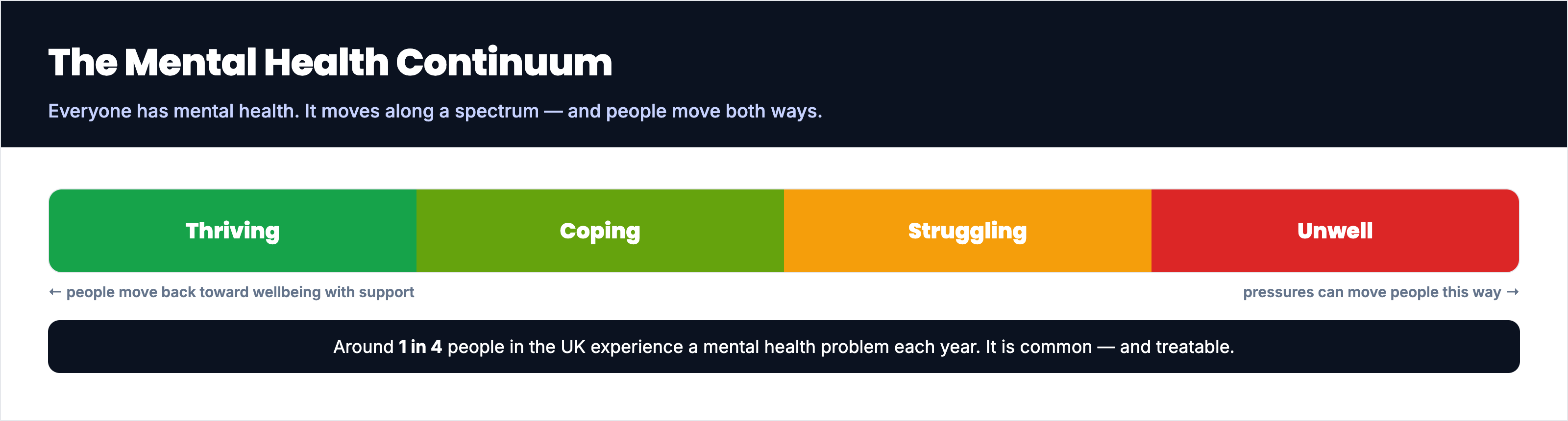
In the next lesson, Mental Health is a Spectrum, we'll dismantle one of the most persistent and damaging myths in this field — the idea that there are "mentally healthy people" and "mentally ill people", and that we belong, fixedly, to one camp or the other. The truth is far more human, far more hopeful, and far more useful as a foundation for everything that follows.
Welcome to the course. Let's begin.
Enjoyed this preview? Enrol to unlock all 44 lessons + your certificate.
Training a team? Buy seats for your team →