The Iron Triangle: Scope, Time, Cost and the Quality Core
The Most Important Triangle You'll Ever Draw
If you remember nothing else from this entire course — which would be a tragedy, but bear with me — remember the iron triangle. It is the single most useful conceptual model in project management, and the one that separates project managers who survive their first major delivery from those who quietly update their LinkedIn profiles six months in.
The iron triangle, sometimes called the triple constraint, captures a truth that every experienced project manager learns, usually painfully: you cannot independently fix scope, time, and cost. These three variables are connected by physics — well, by economics, human capacity, and the immutable nature of how work actually gets done — and pressing on one of them will deform the others. At the centre sits quality, which is not a fourth lever you can pull but rather the thing that quietly bleeds when you pretend the constraints aren't real.
Think of the iron triangle as a rigid metal frame. You can rotate it, you can resize it, but you cannot bend one side without bending the others. When a sponsor strolls into your office and asks you to add three new features, deliver two weeks earlier, and stay within the original budget — and they will, they always will — what they are asking for is geometrically impossible. Your job is not to nod and try harder. Your job is to make the trade-offs visible, articulate them in language a non-PM can understand, and force a real decision.
This lesson will give you both the conceptual model and the political vocabulary to do exactly that.
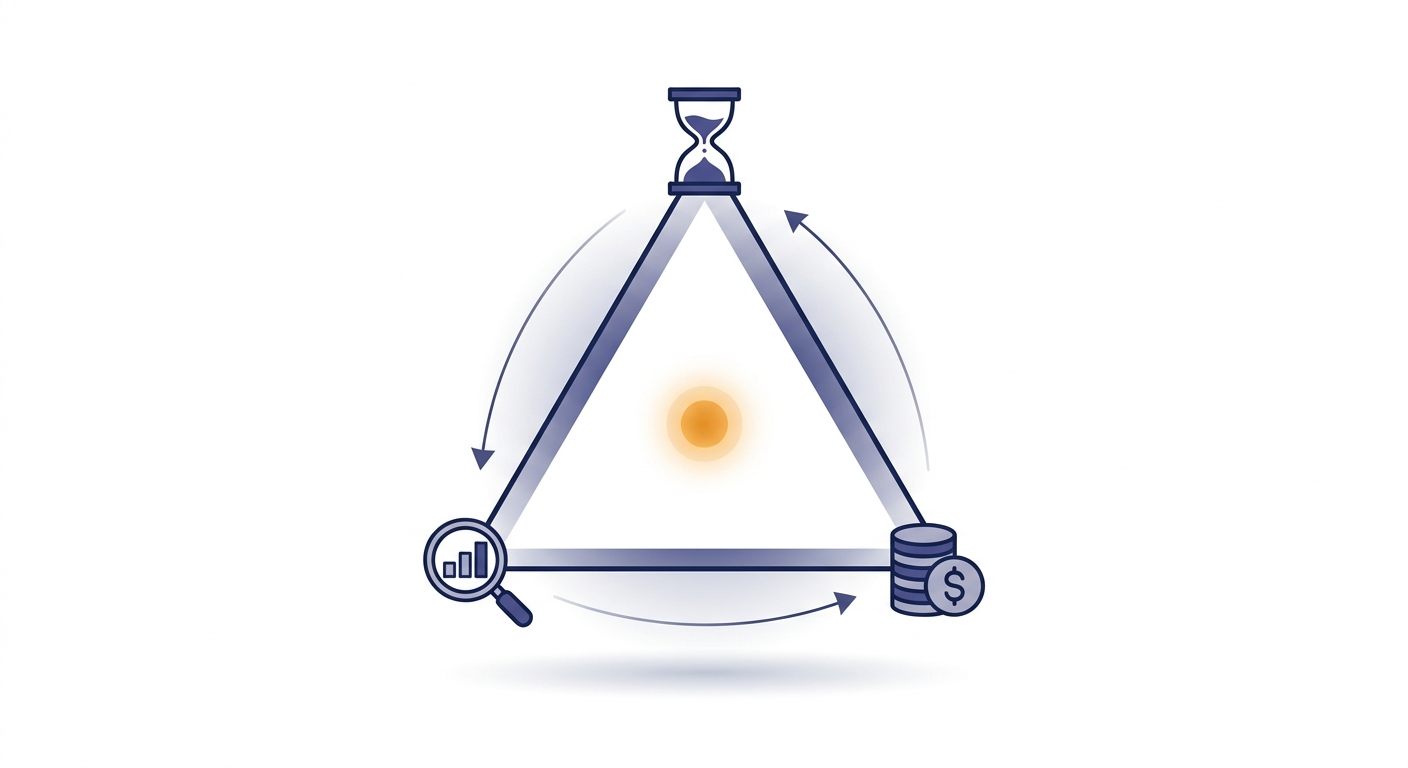
The Three Vertices Defined
Before we manipulate the triangle, let's be precise about what each side actually means — because vague definitions are how project managers end up arguing with stakeholders about whether a request is a clarification or a change.
- Scope is the totality of work to be done and the features, deliverables, or outcomes to be produced. It answers what the project will produce. "Build a customer booking website" is a scope statement at the highest level; "Build a customer booking website with multi-currency support, integrated loyalty points, and SSO via three identity providers" is a much larger one.
- Time is the duration available — the deadline, the schedule, the calendar. It answers when the work will be delivered. Time is the constraint that stakeholders most often try to compress, partly because deadlines feel arbitrary and partly because they often are arbitrary, anchored to a trade show or a fiscal year rather than the actual work required.
- Cost is the total resource expenditure — money, people-hours, equipment, licences, third-party services. It answers how much the project will consume. Cost is often the most carefully governed vertex because it's the easiest to measure, but it is rarely the most carefully understood.
And at the centre, quality: the degree to which the delivered output meets the stated requirements and is fit for purpose. Quality is not a separate budget line. It is the residue of how well you managed the other three. When something has to give and nobody admits it, quality is what gives.
Three Scenarios, Three Distortions
Let's pressure-test the triangle with three realistic scenarios. In each, a stakeholder presses on one vertex. Watch what happens to the others.
Scenario 1: Squeezing time
Your sponsor wants the website live four weeks earlier than planned. The marketing campaign has been booked. The CEO has told the board. The launch date is now, in their words, "non-negotiable."
The triangle does not care about non-negotiable. To pull a delivery date forward while keeping scope fixed, one of two things must happen. Either cost rises — you add developers, pay overtime, bring in a contractor agency at premium rates, parallelise tasks that should have run sequentially — or quality drops, because you cut testing, skip code reviews, defer accessibility work, and ship technical debt that will haunt operations for years. Often both happen at once, and the cost increase doesn't even buy you the time you needed, because of Brooks's Law: adding people to a late project tends to make it later.
Scenario 2: Cutting cost
Finance has reviewed the portfolio and decided your project must absorb a 20% budget cut. Same deadline. Same deliverables. "Find efficiencies," they say, a phrase that should be classified as a controlled substance.
If scope and time are fixed and cost drops, something has to absorb the gap. You may swap senior resources for junior ones (quality falls, rework rises), reduce the testing phase (defects escape into production), cut training (adoption collapses post-launch), or drop "non-essential" risk mitigation (you are now betting the project on luck). The headline budget shrinks; the total cost of ownership balloons. The triangle has been deformed, just not on the page that finance is looking at.
Scenario 3: Expanding scope
Midway through execution, a senior stakeholder discovers a competitor has just launched a feature your product doesn't have. "We need this too. It shouldn't be a big deal — it's just one screen."
It is never just one screen. New scope means new requirements, new design, new development, new testing, new documentation, and new integration. If time and cost are held constant, then either the new feature is delivered as a thin, fragile imitation of what was asked for (quality drops), or other in-scope items are quietly de-prioritised (scope did not actually grow — it was traded, but nobody was told). Both outcomes erode trust. The honest response is to make the trade explicit: more scope means more time, more cost, or less of something else.
You can have it good, fast, or cheap. Pick two — and even then, only if you're honest about which one is really the third.
The "All Three, Faster" Anti-Pattern
Every project manager will, at some point, sit across from a stakeholder who demands more scope, sooner, for less. This is not malice. It is the natural state of organisational ambition meeting incomplete information. Your stakeholder is not lying when they say all three are essential; they simply have not been forced to confront the geometry.
Your job is to force the confrontation — professionally, with data, and without making the stakeholder feel cornered. Here is the script, in three moves:
- Acknowledge the goal. "I understand we need to launch before the trade show and absorb the new compliance requirements. Both matter."
- Make the triangle visible. "Right now we have a fixed scope of forty-two features, a six-month schedule, and a £480,000 budget. Adding the compliance work expands scope by roughly fifteen percent. To hold the date and budget, we'd need to defer four features from the original scope — here they are. Alternatively, we extend by four weeks, or we add two contractors at a cost of around £45,000."
- Hand the decision back. "Which trade-off works best for the business? I can prepare a recommendation, but the call sits with you and the steering group."
Notice what you have not done. You have not said "no." You have not said "impossible." You have not made yourself the obstacle. You have laid the triangle on the table, named the three exits, and made the stakeholder the decision-maker. That is the difference between a project manager who is seen as a delivery partner and one who is seen as a complainer in a hi-vis vest.
Silent Quality Erosion: The Failure Mode Nobody Talks About
The most dangerous failure of the iron triangle is not visible failure — it's silent quality erosion. When scope, time, and cost are all squeezed and no formal trade-off is made, quality absorbs the difference invisibly. Testing gets compressed. Code reviews are skipped. Documentation is deferred "to phase two." Stakeholders see the project hit its date and budget, declare success, and only discover the damage months later when defects, outages, and rework appear in the operations budget — far from your project's closure report.
If you ever feel the triangle being squeezed on all sides and nobody is acknowledging it, raise the flag in writing. A risk logged is a risk shared. A risk hidden is a career hazard.
Using the Triangle as a Planning Tool
So far we have used the triangle as a defensive instrument — something you reach for when stakeholders push. But the triangle is equally powerful at the front of the project, before pressure even arrives.
During initiation and planning, a mature PM asks: which vertex is fixed, which is flexible, and which is the swing variable? Almost every project has one of each, even if nobody has said so out loud.
- A regulatory deliverable — say, GDPR compliance by a deadline set by law — has time as the fixed vertex. Scope is also largely fixed by the regulation itself. Cost is the swing variable. You spend what you need to.
- A fixed-price client engagement has cost as the fixed vertex (your margin depends on it) and usually scope as fixed too (it's in the contract). Time is the variable you protect with buffers and careful sequencing.
- A start-up product launch often has cost as the hard ceiling (runway is finite), time as moderately fixed (market window), and scope as the genuinely flexible vertex. You ship the minimum viable version and iterate.
Identifying this before the work starts, and writing it into the project charter, changes every conversation that follows. When a change request arrives, you don't ask "can we do this?" — you ask "which of our known constraints does this stress, and is the sponsor willing to flex it?"
Exercise: Draft the Pushback Email
Imagine your sponsor has just sent the following email: "Great progress on the dashboard project. The board has decided we also need to include the supplier analytics module in the launch. Same go-live date, same budget — I know you'll make it work."
Before reading on, write a one-paragraph reply (4–6 sentences) that:
- Acknowledges the strategic value of the addition.
- Names the iron triangle trade-off explicitly without using the word "no."
- Offers two or three concrete options (e.g., defer scope, extend time, add cost).
- Hands the decision back to the sponsor with a clear next step.
This is the single most useful piece of writing a project manager can practise. Do this exercise ten times across ten realistic scenarios and you will never again be ambushed by a scope expansion request. Save your best version as a personal template.
The Triangle Is Not the Whole Truth
One honest caveat before we close. The iron triangle is a model, and like all models it simplifies. Modern project management frameworks — PMI's PMBOK Guide in particular — have expanded the picture to include constraints such as resources, risk, and stakeholder satisfaction. Some practitioners draw a hexagon. Others draw a star. The point is not that the triangle is the only constraint geometry; the point is that constraints are interconnected and that pretending otherwise is the root cause of most failed projects.
For the rest of this course, when we discuss schedule compression (Section 3), earned value management (Section 4), or change control (Section 8), you will see the triangle echoing through every technique. Critical path analysis is about understanding which activities directly affect the time vertex. Earned value tells you whether cost and scope are tracking together. Integrated change control exists precisely because every change ripples through the triangle and somebody has to govern those ripples.
Master the triangle now, and the rest of the course becomes a deepening of a model you already understand. Ignore it, and you'll spend forty more lessons learning techniques without ever grasping why they exist.
Key Takeaways
- The iron triangle connects scope, time, and cost, with quality at the centre. The three vertices cannot move independently.
- Pressing one vertex distorts the others. Compress time and either cost rises or quality falls. Cut cost and either scope shrinks or quality falls. Expand scope and either time extends, cost rises, or quality falls.
- Quality is the silent absorber. When no trade-off is named, quality pays the bill — invisibly, and usually after the project closes.
- Use the triangle as a negotiation tool. Acknowledge the goal, make the trade-off visible with concrete numbers, and hand the decision back to the sponsor. You are not the obstacle; geometry is.
- Identify your fixed, flexible, and swing vertices early and write them into the charter. Every later conversation about change becomes easier.
- The triangle is a model, not the whole truth. Resources, risk, and stakeholder satisfaction also constrain projects — but if you can wield the triangle fluently, you have the foundation for everything else this course teaches.
Next lesson, we'll zoom out from the constraint model and look at the lifecycle the triangle operates within — the five process groups that take a project from initiation to closure.
Enjoyed this preview? Enrol to unlock all 54 lessons + your certificate.
Training a team? Buy seats for your team →