What Is a Project? Distinguishing Projects from Business-as-Usual
Welcome to the Masterclass
Before we discuss critical paths, earned value, risk registers, or any of the sophisticated machinery that fills the rest of this course, we need to answer a deceptively simple question: what is a project?
This isn't a pedantic exercise. The vast majority of failed projects don't fail because of bad Gantt charts or poor risk analysis — they fail because the work was never genuinely a project to begin with, or because the people involved couldn't distinguish project work from the operational churn of daily business. They tried to run a marathon using the rules of a treadmill, or treated permanent operational changes as temporary endeavours that would somehow 'finish.'
The discipline of project management exists precisely because a certain class of work behaves differently from everything else an organisation does. It has a different rhythm, a different success criteria, a different relationship with time, and demands a different kind of leadership. Mistake one for the other and you'll either over-engineer the trivial or under-resource the transformational.
By the end of this lesson, you'll be able to look at any piece of work crossing your desk — a request from a sponsor, a vague initiative announced in a town hall, a problem someone has asked you to 'just handle' — and confidently classify it. That single act of classification is the first, and arguably most important, executive decision a project manager makes.
The Formal Definition
Across every major body of knowledge — the PMI's PMBOK, PRINCE2, ISO 21500 — the definition converges on three essential characteristics. A project is:
- Temporary — it has a defined start and a defined end. The end arrives when the objectives have been met, when it becomes clear they cannot be met, when the need for the project no longer exists, or when funding is withdrawn. Crucially, 'temporary' does not mean short. A project can last fifteen years. It just cannot last forever.
- Unique — it produces a product, service, or result that did not exist before in this exact form. Even if you've built fifty similar websites, this website, for this client, with this team, at this moment, has never been produced. Uniqueness is what introduces uncertainty, and uncertainty is what demands planning.
- Outcome-oriented — it exists to deliver a specific, defined result. Not a state of being maintained, but a thing achieved.
Contrast this with business-as-usual (BAU), also called operations. Operations are ongoing and repetitive. They sustain the business. They have no end date because their purpose is continuity. Running payroll every month, answering customer support tickets, manufacturing the same product on a production line, performing routine server maintenance — these are not projects, regardless of how complex or important they are.
The Diagnostic Test
When you're unsure whether something is a project, ask three questions:
- Will this work end? Is there a recognisable point at which we can say 'done' and disband the team?
- Is what we're producing distinguishable from what already exists? Or are we simply maintaining the status quo?
- Could a reasonable person describe the finished result in a sentence? If the answer is 'we're going to keep doing X,' it's operations. If the answer is 'we will have delivered X by Y,' it's a project.
If all three answers point toward a finite, unique, deliverable outcome — you have a project, and you need project management discipline. If they point toward continuity and repetition, you have operations, and you need operational management discipline. These are different crafts.
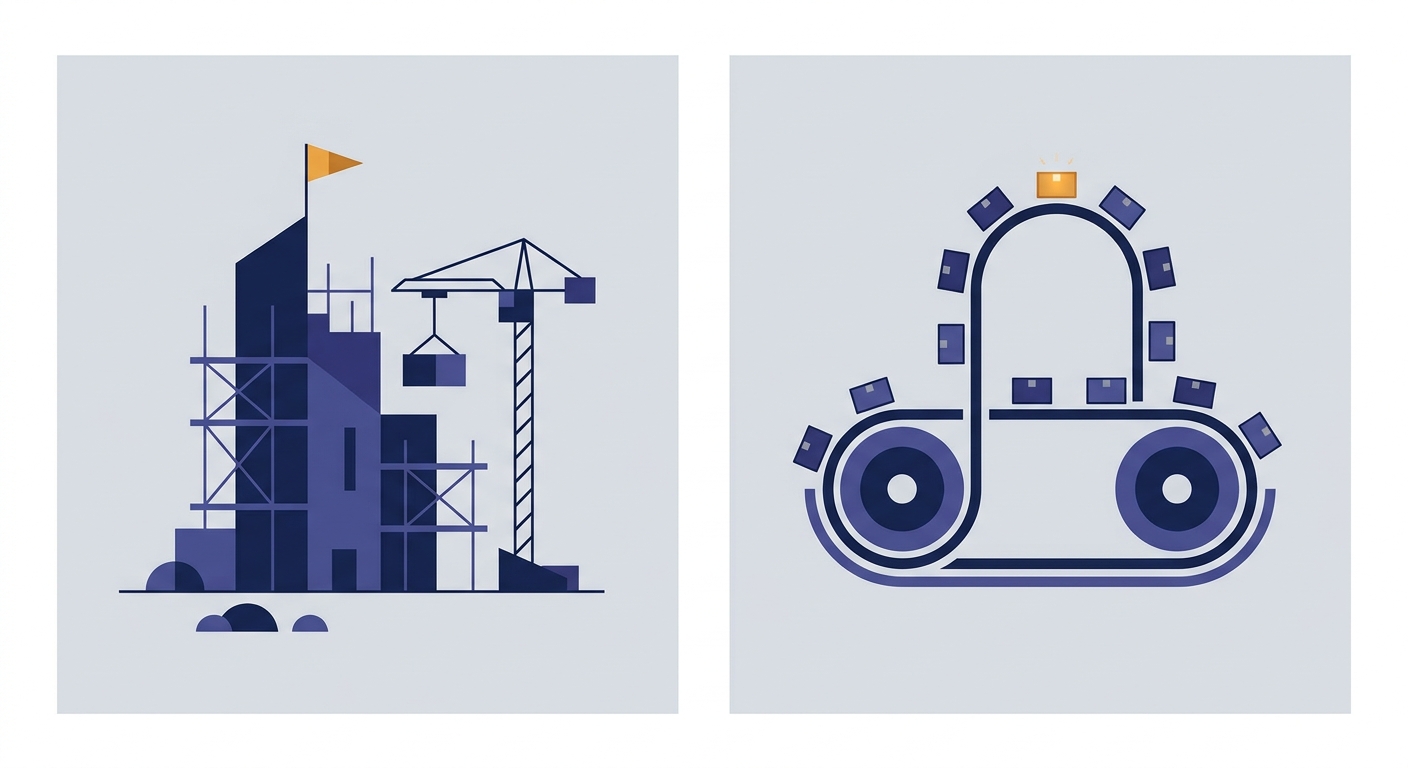
Building a new booking website is a project. Running it day-to-day is operations. The first has a ribbon-cutting; the second never stops.
Why This Distinction Matters in Practice
Misclassifying work is one of the most expensive mistakes an organisation can make, and it happens constantly. Three common failure modes:
1. Treating Projects as Operations
A company decides to 'modernise our customer service.' No charter, no defined end state, no budget envelope — just an ongoing initiative folded into the operations director's remit. Eighteen months later, money has been spent, vendors have been engaged, but nothing has actually been delivered because there was never a definition of delivered. This is the most common form of strategic drift in large organisations.
2. Treating Operations as Projects
The opposite error: an organisation launches a 'project' to handle monthly compliance reporting. They appoint a PM, build a schedule, then are surprised when the work simply… continues, month after month, forever. The PM burns out. The team resents the bureaucracy. What was needed was an operational process owner, not a project manager.
3. Hidden Projects Inside Operations
The most insidious failure. A piece of genuine project work — say, migrating to a new email platform — gets absorbed into the IT operations team's normal workload. Without a dedicated PM, without a charter, without a plan, it limps along for two years, eats vastly more resource than anticipated, and produces a half-finished result that nobody owns. This is where most 'shadow' project failures hide.
As a project manager, part of your job — sometimes the most valuable part — is to name the work correctly. To stand up and say: 'This is a project. It needs a charter, a plan, a sponsor, and a defined end.' Or, equally importantly: 'This is operations. We don't need a project manager. We need a process owner and a service-level agreement.'
The Grey Zone: When Projects and Operations Interact
In the real world, the boundary isn't always crisp, and you need to be comfortable navigating the grey zone.
Projects Produce Operations
Most projects exist to create something that will then be operated. The website launch (project) produces a website that requires daily content updates and uptime monitoring (operations). The new factory (project) produces a facility that runs continuously (operations). A crucial part of project closure — covered in detail in our final modules — is handover: the formal transition from project mode to operational mode. Many projects technically 'succeed' but fail at handover, leaving operations teams to inherit something they don't understand and cannot sustain.
Operations Spawn Projects
Equally, operational pressures regularly trigger projects. A spike in customer complaints (operations) leads to a process redesign project. A regulatory change forces a compliance implementation project. Healthy organisations recognise when an operational pain point has crossed the threshold into requiring project treatment.
Improvement Initiatives
The trickiest cases are improvement initiatives — Lean programmes, continuous improvement efforts, transformation work. These often look like operations (ongoing) but contain dozens of embedded projects (specific, finite changes). The right answer is usually to treat the umbrella as a programme (a topic we'll return to in Lesson 5) and the individual changes within it as projects.
Exercise: Project or BAU?
Classify each of the following as Project or BAU/Operations. Try to justify your answer using the three-question diagnostic before reading the discussion.
- Rolling out a new CRM system across the sales department
- Running monthly payroll for 800 employees
- Renovating the office to add a new collaboration space
- Daily customer support ticket handling
- Organising the annual industry conference
Discussion:
- 1. New CRM rollout — PROJECT. It has a clear end (CRM is live, users trained, old system retired), produces a unique outcome for this organisation, and is finite. Once live, using the CRM becomes operations.
- 2. Monthly payroll — OPERATIONS. Repetitive, ongoing, no defined end. The fact that it happens on a schedule doesn't make it a project; it makes it a recurring operational process.
- 3. Office renovation — PROJECT. Defined start, defined end (ribbon cutting on the new space), unique deliverable. Subsequent maintenance of the space is operations.
- 4. Daily customer support — OPERATIONS. Pure BAU. However, improving the customer support process or implementing a new support tool would be a project.
- 5. Annual conference — PROJECT (each year). This is subtle. Each year's conference is a discrete project with a defined start, end, and unique deliverable (this year's event). The fact that it recurs annually doesn't make it operations — it makes it a series of similar projects. The team may operate as a permanent function, but each conference is project work.
Common Misconceptions Worth Dismantling
Before we move on, let's kill three myths that confuse newcomers and even some experienced managers.
Myth 1: 'If it's big, it's a project.'
Size is irrelevant. Running global operations for a multinational is enormous but not a project. Updating the company logo on every internal document is small but absolutely a project (defined start, defined end, unique deliverable). Project status is about shape, not scale.
Myth 2: 'If it's important, it needs a project manager.'
Operations can be mission-critical without being projects. The team that keeps the trading floor running is doing operations of the highest importance. Importance doesn't change the nature of the work — it changes the level of investment and rigour you apply to it.
Myth 3: 'If it's repeated, it can't be a project.'
As the conference example showed, repetition of similar projects is still project work. The third pharmaceutical clinical trial your company runs is still a project — different drug, different protocol, different participants, different outcome — even if the playbook is reused. What matters is whether this specific instance has a defined start, end, and unique result.
The Project Manager's First Act
Here's the practical takeaway. When you're handed a piece of work — by a sponsor, a boss, a client — your first act as a project manager is classification. Before you build a plan, before you assemble a team, before you ask about budget, you need to satisfy yourself that this is genuinely project work. If it isn't, you'll save everyone enormous pain by saying so early. If it is, you'll need the rest of this course.
The next step, assuming you've confirmed it is a project, is to start building the formal framing — the constraints you'll work within, the lifecycle phases you'll move through, and the document that authorises your existence as a PM. We'll begin that journey in the next lesson by examining the iron triangle: the inescapable tension between scope, time, and cost, with quality at its core. Understanding this tension is what separates project managers who get railroaded by stakeholders from those who shape outcomes deliberately.
Key Takeaways
A project has three defining characteristics:
- Temporary — defined start and end, regardless of duration
- Unique — produces a result that did not exist in this form before
- Outcome-oriented — exists to deliver a specific, defined deliverable
Anything ongoing, repetitive, or focused on maintaining a steady state is operations, not a project — no matter how complex or important it may be.
Your first act as a project manager on any new piece of work is to classify it correctly. Misclassification is the single most common root cause of wasted effort in organisations, and naming work accurately is one of the highest-leverage things a PM ever does.
Enjoyed this preview? Enrol to unlock all 54 lessons + your certificate.
Training a team? Buy seats for your team →