The Modern SERP and SERP Features
The SERP Is No Longer a List — It's a Layout
If you learned SEO any time before about 2018, you were taught to picture a search results page as a clean, vertical list of ten blue links. You optimised a page, you tracked its position, and you celebrated when it moved from #6 to #3. That mental model is now actively dangerous. Not slightly outdated — dangerous, because it causes smart marketers to chase metrics that no longer correspond to traffic, revenue, or visibility.
Open Google today and search for almost any commercially interesting query. What you will see is not a list. It is a layout — a stacked, modular page composed of AI Overviews, featured snippets, People Also Ask accordions, video carousels, image packs, local map results, shopping modules, knowledge panels, sitelinks, and yes, somewhere in there, the traditional organic links. On a mobile screen, the first organic blue link is frequently the fifth or sixth thing a user sees, sitting two or three full scrolls beneath the fold.
This is the single most important shift in modern SEO, and this lesson is dedicated to it. Before you write a brief, target a keyword, or quote a client on rankings, you must learn to read the SERP — to look at what Google has decided to show for a query and reverse-engineer what kind of content, format, and entity it rewards. The SERP is not the scoreboard. The SERP is the answer key.
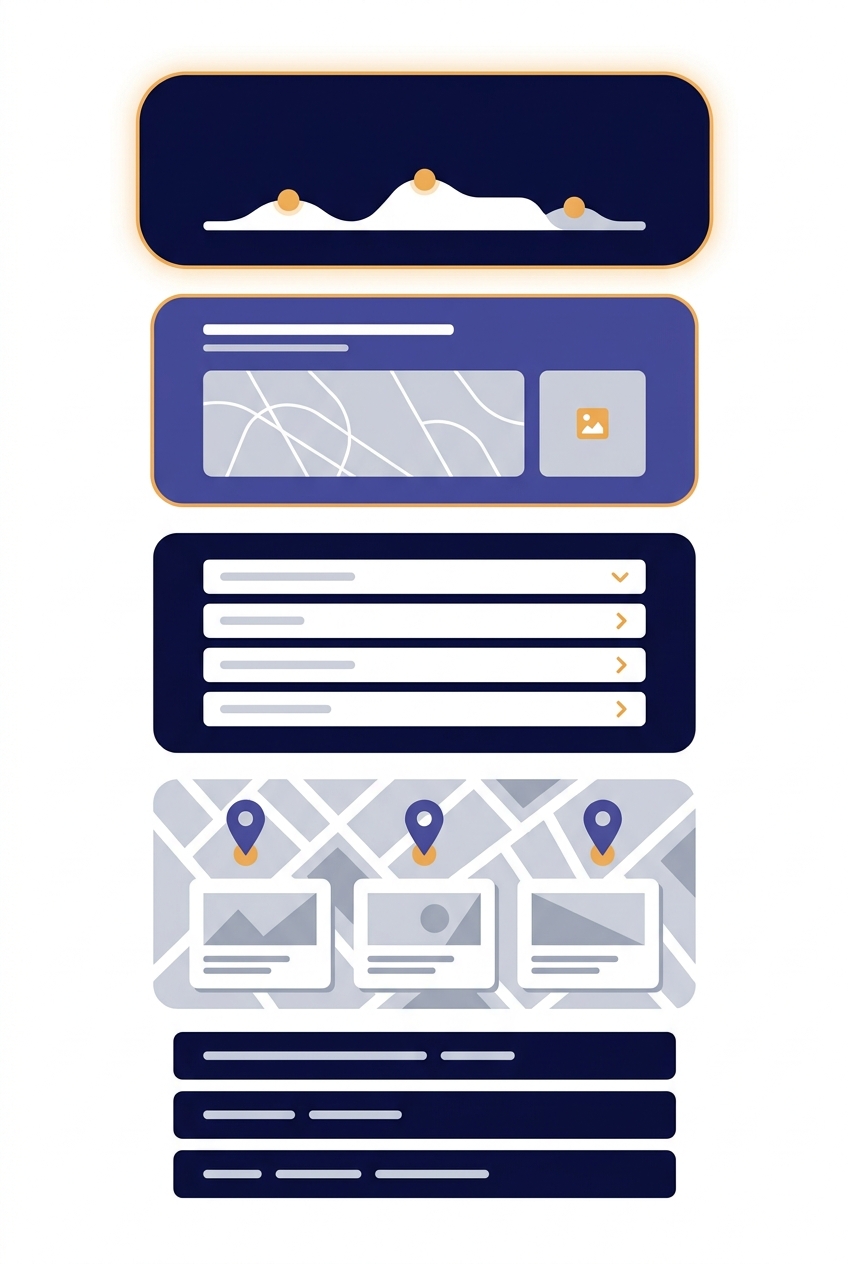
A Field Guide to Modern SERP Features
Each feature on a SERP is triggered by signals Google has learned to associate with specific query types. Understanding the trigger is how you decide whether a keyword is even worth targeting — and if so, how. Let's walk through the major ones.
AI Overviews
The top of the page is increasingly occupied by an AI Overview: a generated summary that synthesises information from multiple sources and links out to a handful of cited pages. AI Overviews trigger most often on informational, exploratory, and how-to queries — especially those with a definable, factual answer. They are the single biggest disruptor to traditional click-through rates in fifteen years. We will dedicate an entire section to them (Section 9), but for now understand this: if a query reliably triggers an AI Overview, your strategic goal shifts from "rank #1" to "be one of the three to five sources cited inside the overview."
Featured Snippets
The featured snippet — sometimes called "position zero" — is a boxed answer pulled directly from a ranking page, displayed above the organic results. It appears for queries phrased as questions, definitions, lists, or comparisons. Snippets come in four formats: paragraph, list, table, and video. Winning a snippet requires concise, well-structured answers (typically 40–60 words for paragraph snippets) placed near a clear heading that mirrors the query.
People Also Ask (PAA)
The PAA box is an expanding accordion of related questions, each revealing a short answer pulled from a ranking page. PAA is gold for two reasons: it tells you the adjacent intents Google associates with your query, and clicking any question reshuffles the box to surface deeper questions — effectively giving you a free, infinite content idea generator.
The Local Pack
For any query with local intent ("plumber near me," "best ramen Soho," "dentist Manchester"), Google displays a map with three pinned business results above the organic links. The local pack is governed by an entirely separate ranking system based on Google Business Profile signals — proximity, relevance, prominence, and reviews. If your query triggers a local pack and you are not in it, classical on-page SEO will not save you. We cover this in depth in Section 7.
Image and Video Packs
Visual carousels appear when Google detects that users want to see something — recipes, products, hairstyles, exercises, tutorials. A video pack on a tutorial query is a strong signal that YouTube is the primary battleground, not your blog post.
Knowledge Panels and Entity Cards
For queries about defined entities — people, companies, places, films, concepts — Google displays a knowledge panel sourced from its Knowledge Graph. You cannot "rank" in a knowledge panel directly, but you can influence what appears there by being a strongly cited, structured source about that entity.
Sitelinks, Shopping Results, and Ads
Brand queries often surface sitelinks — a grid of internal pages beneath the main result. Commercial queries trigger shopping carousels and up to four paid ads at the top, pushing the first organic result even further down. On a competitive product query on mobile, the user may scroll past seven distinct modules before encountering an organic link.
Ranking #1 matters less than owning the real estate a query returns.
Why "Position #1" Became a Vanity Metric
Let's make the quote above concrete. Imagine two scenarios for the query "how long to boil an egg."
Scenario A: You rank #1 organically. But above you sits an AI Overview that fully answers the question, a featured snippet from a competitor with a clean table of times by doneness, a PAA accordion, and a video carousel. Your CTR? Possibly under 3%, because the user's question was already answered three times before they reached you.
Scenario B: You rank #4 organically, but you own the featured snippet at position zero and your YouTube video appears in the video pack. Your effective visibility — and click-through — is dramatically higher than the page "ranking #1."
This is what we mean by owning real estate. The strategic question is no longer "what position am I in?" but "what percentage of the visible SERP do my assets occupy?" Rank tracking tools that report only positional data are, in 2025, reporting a fiction. The serious tools now report SERP feature ownership, pixel depth (how far down the page your result actually sits), and zero-click rate for the query.
The Three Strategic Implications
- Target features, not positions. Before writing a brief, identify which features the SERP shows and design your content to win them. If there's a featured snippet, include a 50-word direct answer near the top under a question-formatted H2. If there's a video pack, plan a companion video. If there's a PAA, build those questions into your H3s.
- Accept that some keywords are no longer worth targeting. If a query triggers an AI Overview that fully resolves the user's question, plus a knowledge panel, plus four ads, plus a shopping carousel — the organic blue links may receive less than 10% of clicks combined. The unit economics simply do not work. Walk away and invest that effort in a keyword where organic still wins meaningful traffic.
- Diversify your surface area. A modern SEO strategy is not just about ranking pages on your domain. It's about being cited in AI Overviews, owning the featured snippet, appearing in the video pack via YouTube, surfacing in the local pack via your Google Business Profile, and being the entity referenced in the knowledge panel. The brands winning right now are present in multiple modules on the same SERP.
Exercise: Map the Real Estate
The SERP Mapping Exercise. Take three of your most important target keywords. Open an incognito or private browsing window (to strip out personalisation), set your location to your target market, and search each one. For every result, document:
- Every SERP feature present, in order from top to bottom
- The pixel depth of the first organic result (estimate in screens — half-screen, one screen, two screens)
- Who owns each feature (your competitors? a publisher? Reddit? YouTube?)
- The format of the content that wins the featured snippet, if present
- Every question in the PAA box, and the next level when you expand each one
Do this for three keywords and you will have generated more strategic insight than a week of keyword research tool reports. This is the single most valuable 30-minute exercise in this entire course — repeat it before every piece of content you commission.
The SERP as Google's Open Book
Here is the mental reframe that separates intermediate SEOs from world-class ones: the SERP is Google telling you, in plain sight, exactly what it believes the user wants. Every feature is a hypothesis Google has tested against billions of queries and clicks. If Google shows a video pack, it is because users who searched this query historically engaged most with video. If Google shows a comparison table snippet, it is because users wanted a structured comparison. If Google shows Reddit threads in the top five, it is because users wanted unfiltered human opinion, not polished brand content.
Your job is not to argue with the SERP. Your job is to match it. If the SERP rewards 800-word how-to articles with embedded video, do not write a 4,000-word listicle. If the SERP rewards Reddit-style discussion, a sterile corporate blog post will never rank, no matter how well-optimised. The SERP is the format brief, the depth brief, and the tone brief — given to you for free, before you write a single word.
This is why every keyword-research workflow in the rest of this course will begin with a SERP audit, not a search-volume number. Volume tells you the prize. The SERP tells you whether the prize is winnable, and what shape your content has to be to win it.
Key Takeaway
The modern SERP is a modular layout, not a list. Position #1 is a partial metric at best and a misleading one at worst. Your strategic objective is to own real estate — the AI Overview citation, the featured snippet, the PAA answers, the video pack, the local pack, the knowledge panel — across as many features as your query triggers.
Before targeting any keyword, read its SERP. Treat it as Google's open-book answer key: it reveals the format, depth, tone, and entity types that will be rewarded. Then build content that matches the page Google has already decided to show.
Enjoyed this preview? Enrol to unlock all 43 lessons + your certificate.
Training a team? Buy seats for your team →