The Distinction Equation and Six Categories of USP
The Maths of Standing Out
In the previous lesson, we established a principle that will run like a steel cable through this entire masterclass: being unique beats being better. Better is subjective, contested, and exhausting to defend. Unique is undeniable. But knowing you need to be unique is not the same as knowing how to be unique. Most founders, when asked what makes them different, produce a list that could be copy-pasted onto a hundred competitor websites. Quality products. Great service. Fast shipping. Passionate team. None of it is wrong. All of it is useless.
This lesson gives you the mechanism — the actual operational tool — to find the edge that nobody else can claim. We are going to use a subtractive framework I call the Distinction Equation, and we are going to combine it with a taxonomy of the only six categories where a genuine USP can live. By the end of this lesson, you will be able to look at any business — yours, a competitor's, a case study — and say with surgical precision: this is their actual differentiator, and this is just noise dressed up as strategy.
The Distinction Equation
Here it is, in its full form:
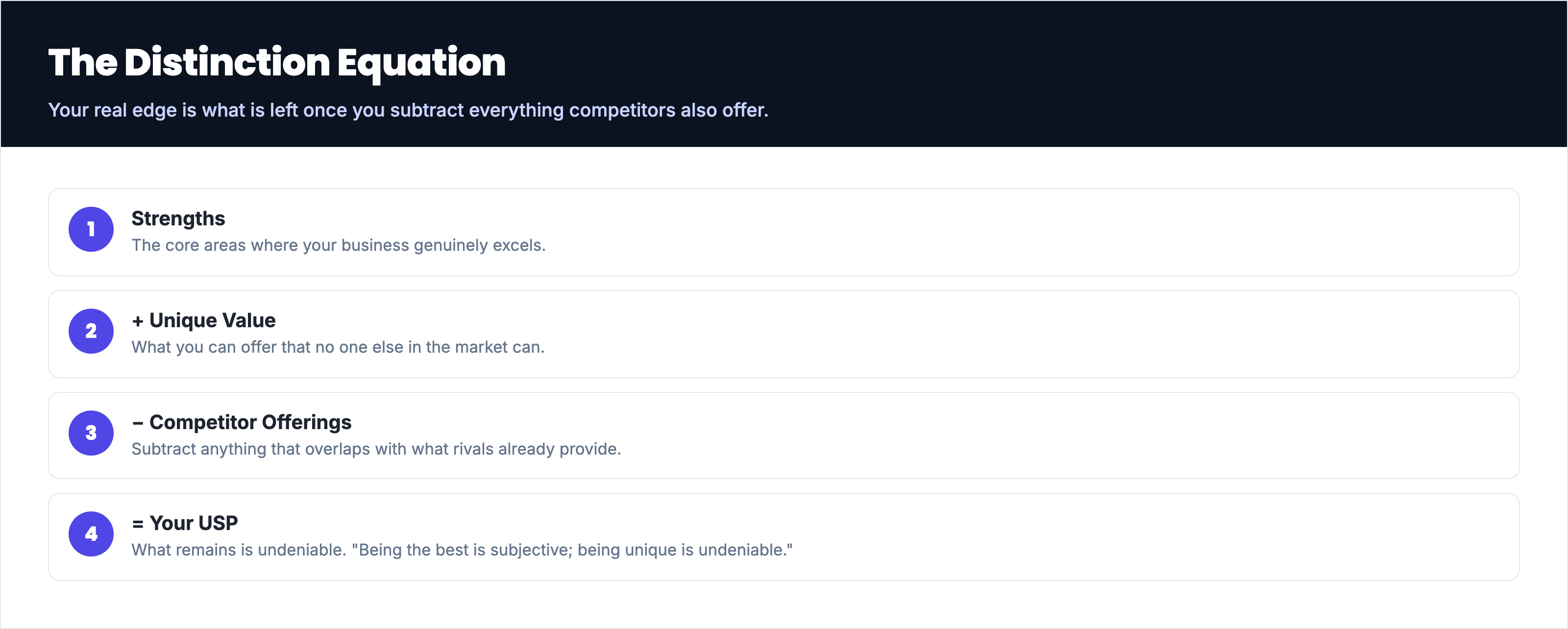
USP = (Strengths + Unique Value) − Competitor Offerings
Read it carefully, because the magic is in the minus sign. Most strategy frameworks are additive — they ask you to list, accumulate, and stack. The Distinction Equation does the opposite. It asks you to subtract. You list what you are good at. You list what you genuinely bring. Then you ruthlessly remove anything that a competitor could plausibly claim with a straight face. What survives that subtraction — that lonely, defensible residue — is your USP.
Let me show you why this matters with a quick example. Imagine a new coffee brand launches and lists its strengths:
- Ethically sourced beans
- Single-origin transparency
- Recyclable packaging
- Friendly customer service
- A bright, welcoming brand
- Free UK shipping over £25
Sounds great, right? Now apply the equation. Run each item past the question: can a competitor make this exact claim without lying? Ethically sourced — every major competitor says this. Single-origin transparency — table stakes in specialty coffee. Recyclable packaging — increasingly standard. Friendly service — everyone claims it. Bright brand — subjective and copyable. Free shipping over £25 — a tactic, not an identity.
Subtract them all. What's left? Nothing. And that's the point. This brand thought it had six differentiators. It had zero. The Distinction Equation didn't take anything away from the business — it just revealed that the business had not yet done the strategic work. That revelation is a gift, because it means the work can begin now, before money is spent on launching something forgettable.

The Subtractive Mindset
Why does subtraction work where addition fails? Because the marketplace is a comparative environment. A customer never evaluates you in isolation — they evaluate you against alternatives, often in the same browser tab. Anything you share with competitors becomes invisible in their decision. It is not that those qualities don't matter; they do. They are the price of entry. But they are not the reason for choice.
Think of it like this: if you and three competitors all stand in a room wearing identical navy suits, the suit is no longer a feature. It's wallpaper. The customer's eye goes to whoever is wearing something the others aren't — the red pocket square, the trainers, the unexpected hat. The Distinction Equation forces you to identify your red pocket square and stop talking about your suit.
This is why the equation is best run as a deliberate exercise on paper, not as a vague mental check. The act of writing your strengths in one column and your competitors' offerings in another — and then physically crossing out the overlaps — produces a kind of strategic clarity that thinking alone cannot. We will do exactly that exercise later in this lesson.
The Six Categories of Effective USP
Once you've subtracted, you need somewhere for your remaining edge to live. After studying hundreds of standout brands — from kitchen-table start-ups to billion-pound exits — a clear pattern emerges. Every genuinely effective USP falls into one (or occasionally two) of six categories. If your claimed differentiator doesn't fit any of these, it almost certainly isn't a USP. It's a feature, a tactic, or a piece of wishful thinking.
1. Unique Products
The most obvious category, and often the hardest to defend long-term, but powerful when genuine. This is when the thing itself is meaningfully different — a formulation no one else has, a design language nobody copies well, a category invention. Dyson built a vacuum without a bag when the industry assumed bags were inevitable. Spanx built a shapewear product women didn't know they were allowed to want. Tony's Chocolonely built a chocolate bar deliberately shaped in unequal chunks to make a point about slavery in the cocoa supply chain. The product itself carries the argument.
The risk in this category is that products can be copied. Patents expire. Manufacturing leaks. So product USPs almost always need to be paired with one of the other five — typically brand story or attitude — to remain defensible after the inevitable imitators arrive.
2. Unique Prices (High or Low)
Note the parenthetical — this is the part most founders miss. Price is a USP at the extremes, not in the middle. Aldi is a USP. Lidl is a USP. They have built brutally efficient operations to deliver a price point competitors cannot match without dismantling themselves. At the other end, Hermès is a USP. Patek Philippe is a USP. Their price is the message — it signals scarcity, craftsmanship, status, and self-selection of customer.
The middle is death. "Reasonably priced" is not a USP. "Affordable luxury" is, ironically, neither affordable nor luxurious enough to mean anything. If you choose price as your differentiator, you must commit to an extreme and build the entire operation to support it. Half-measures here just signal that you haven't decided who you're for.
3. Unique Service
This is where many of the most enduring USPs live, because service is harder to copy than product. Zappos famously built a billion-pound shoe business on a service promise so extreme it became folklore — twelve-hour customer calls, surprise upgrades to overnight shipping, and a culture that hired call-centre staff for personality before competence. Ritz-Carlton empowers every employee to spend up to $2,000 per guest, per incident, with no manager approval, to resolve a problem.
Service-based USPs require organisational design, not just marketing copy. You cannot bolt them on. The reason "great customer service" is so frequently claimed and so rarely true is that delivering it requires hiring differently, training differently, measuring differently, and tolerating short-term cost for long-term loyalty. If you say service is your USP and your support team is outsourced to the cheapest provider, you are lying — to your customers and to yourself.
4. Unique Brand Story
Story is the category that has gained the most ground in the last decade, because as products and prices have converged, narrative has become the last defensible territory. Innocent Drinks built a juice empire on a story of two friends at a music festival asking customers to vote with empty bottles. Brewdog built a beer company on punk rebellion against the duopoly of bland macro-lagers. Method built a cleaning brand on the story of two flatmates who couldn't bear ugly bottles under their sink.
A unique brand story works because human beings are biologically wired to remember and retransmit narrative. We forget features. We forget prices. We tell our friends about stories. The story doesn't have to be dramatic — it has to be specific, true, and emotionally resonant. "We started this because we couldn't find X for Y reason" is a more powerful opening than any feature list.
5. Unique Contribution (The Feel-Good Factor)
This is the category where your business creates value beyond the transaction itself. Patagonia is the masterclass here — Yvon Chouinard's declaration that "We're in business to save our home planet," backed by the 2022 transfer of the entire company's profits to environmental causes, makes every purchase from Patagonia a tiny act of environmental contribution. TOMS pioneered the buy-one-give-one model with shoes. Who Gives A Crap donates 50% of profits to building toilets in developing countries.
Contribution-based USPs are powerful but dangerous if performative. Customers — and journalists — have become sophisticated at spotting "purpose-washing". The rule is simple: the contribution must be material, measurable, and structurally embedded in the business model, not a tagline at the bottom of an email. If you donate 1% and shout about it like you donate 100%, you will eventually be exposed, and the brand damage will exceed any goodwill earned.
6. Unique Attitude
This is the most underrated category and often the most defensible, because attitude is fundamentally inimitable. Two businesses can sell the same product at the same price and still be utterly different because of how they speak, what they refuse to say, and who they are willing to alienate.
Dollar Shave Club did not invent cheap razors. They sold an attitude — irreverent, anti-corporate, hilariously profane — against the bloated incumbents. Michael Dubin's launch video ("Our blades are f***ing great") cost $4,500 and produced a brand that sold to Unilever for $1bn in five years. Liquid Death sells water in a tallboy can with death-metal aesthetics — the product is water, the attitude is everything. Oatly's packaging reads like a wry inner monologue, deliberately picking fights with the dairy industry.
Attitude USPs work because they polarise — and polarisation is a feature, not a bug. The people who hate Liquid Death's branding are not their customers and never would have been. The people who love it become evangelists. A brand that tries to please everyone pleases no one with intensity, and intensity is what drives word-of-mouth.
Your USP is whatever survives the subtraction — the one claim a competitor cannot make with a straight face. It is about challenging the status quo and saying what others won't.
What Is NOT a USP
Free shipping is not a USP. Easy returns are not a USP. A points-based loyalty programme is not a USP.
These are some of the most common items founders list when asked what makes them different — and they are also the items most ruthlessly subtracted by the Distinction Equation. Why? Because every serious competitor either already offers them or could match them within a quarter at minimal cost.
Free shipping is a conversion tactic, not an identity. Easy returns are a category expectation, baked into customer assumptions by Amazon and ASOS. Generic loyalty programmes — earn points, redeem points — have been so widely deployed that they barely move loyalty metrics anymore.
This doesn't mean don't offer them. Offer them if the economics work. But do not mistake them for differentiation. They are the price of entry to the game, not the reason you win it.
The Eight Ways to Stand Out
The six categories tell you where your USP can live. But how do you actually generate the raw material for one? In my experience working with hundreds of founders, genuine differentiation tends to arrive through one of eight specific moves. Think of these as the strategic levers — pull one (or combine several) and you create the conditions for a real USP to emerge.
1. Narrow Your Target Market
The fastest, cheapest, and most underused way to stand out is to deliberately shrink who you serve. Most founders try to be useful to everyone and become essential to no one. The brands that win narrow aggressively — sometimes to the point that observers think they're crazy.
Stitch Fix didn't launch as "clothing for everyone"; it launched as styled boxes for busy professional women who hated shopping. Beardbrand didn't launch as men's grooming; it launched for "urban beardsmen". Lefty's didn't launch as a stationery shop; it launched as a store for left-handed people. Narrowing creates instant relevance and instant authority. It also creates marketing efficiency — when you know exactly who you're for, every word you write lands harder.
2. Deliver Stellar Service
We covered this as a USP category, but it is also a generative move. Even if service isn't your headline USP, choosing one or two service dimensions to obsess over — response time, returns experience, post-purchase follow-up — can become the unexpected detail that customers tell others about. Service is one of the few areas where you can outwork bigger competitors with structural disadvantages, because they have committees and you have decisions.
3. Solve a Real Problem
Many businesses solve problems nobody actually has, or problems that exist but are too small to drive purchase. The strongest USPs solve problems the customer has been silently tolerating — the friction so familiar they've stopped noticing it. Spanx solved "visible underwear lines under white trousers," a problem millions of women had endured for decades without complaint. Graze solved "healthy snacks at my desk that don't make me feel like I'm eating cardboard." Casper solved "buying a mattress is an awful, manipulative experience."
The test: can your target customer recall a specific moment in the last month when they hit this problem? If not, the problem may be too abstract to drive behaviour.
4. Be Creative
Creativity here doesn't mean "art" — it means non-obvious combinations and unexpected formats. Glossier turning skincare into a community-led brand built on Instagram before the product existed. Allbirds making shoes from wool when every athletic brand was racing toward synthetic performance fabrics. Oatly putting essays on the side of cartons. Creativity is what lets a small player out-think a big one with a hundred times the budget.
5. Offer Special Deals (But With Strategic Logic)
Deals on their own are not a USP — they are a discount. But structurally interesting deals can become identity. Costco's membership model. Naked Wines' "Angels" pre-funding model where customers invest in winemakers in exchange for exclusive access. Everlane's radical-transparency pricing where they show you the actual cost breakdown. The deal becomes the story, not just the saving.
6. Demonstrate Expertise
In a market full of generalists, deep expertise — visibly demonstrated — becomes a differentiator in itself. This is why content marketing, when done seriously, works so well. A founder who genuinely knows more than the competition, and who shares that knowledge generously, builds an authority moat that ad spend cannot replicate. We will go much deeper on this in Section 4 ("Killer Content and Becoming a Trusted Media Outlet"), but the principle starts here: expertise, made visible, is a USP.
7. Make It Easy
Friction is everywhere in commerce, and most of it is invisible because everyone has accepted it. The brands that win often win by removing one specific piece of friction the category has tolerated. Warby Parker's home try-on for glasses. Apple's one-click. Trainline's "split ticket" feature that automatically books cheaper segmented journeys. Ease, when achieved through real operational change rather than marketing claim, is exceptionally hard for competitors to copy quickly.
8. Be Authentic
This is the most overused word in modern marketing, which is precisely why genuine authenticity is so disarming when customers encounter it. Authenticity means saying what you actually believe, including the inconvenient parts. It means showing the team, the warehouse, the mistakes. It means writing in the voice of an actual human, not a brand committee. It means refusing to chase trends that don't fit who you are.
Patagonia's "Don't Buy This Jacket" Black Friday advert is the textbook example. They ran a full-page ad in the New York Times, on the biggest shopping day of the year, telling customers not to buy their product unless they truly needed it. Sales went up. Why? Because in a sea of brands shouting "buy more," one brand had the integrity to say "buy less," and that integrity was so rare it became magnetic.
Competition isn't your enemy; sameness is.
Case Study Deep-Dives: The Equation in the Wild
Dollar Shave Club: Attitude + Narrow Market
Let's run the Distinction Equation on Dollar Shave Club at launch, in 2012. Strengths and unique value: a direct-to-consumer subscription, decent (not exceptional) razors, a founder with comedy-writing experience, and a willingness to mock the incumbents. Competitor offerings: Gillette and Wilkinson Sword owned roughly 90% of the market with vastly superior R&D, distribution, and ad budgets.
Subtract everything Gillette could also claim: blade quality (they had better), brand recognition (they had infinitely more), retail presence (they had it; DSC had none). What remained after subtraction? Two things: attitude (irreverent, anti-corporate, profane) and delivery model (subscription direct to door, bypassing the locked razor cabinet in the supermarket). The $4,500 launch video did not sell razors. It sold rebellion against the perceived absurdity of paying £20 for four blades behind anti-theft glass. One million subscribers in two years. $1bn exit to Unilever in 2016. The product was ordinary. The USP — attitude plus model — was extraordinary.
Patagonia: Contribution + Attitude
Patagonia's strengths include genuinely durable technical outerwear, strong supply-chain ethics, and a founder with deep environmental conviction. But many outdoor brands now claim sustainability — The North Face, Columbia, Arc'teryx all have impressive ESG reports. Subtract the overlap. What's left?
What's left is structural contribution — the 2022 transfer of the entire company into a trust where all profits fund climate action — and attitudinal courage: the willingness to tell customers not to buy, to sue the US government over public lands, to close on election day so staff can vote. No competitor will copy these because copying them requires giving up control of the company. The USP is, almost literally, uncopyable.
Innocent Drinks: Brand Story + Attitude
Innocent's juice was good but not technically unique — pressed fruit smoothies could be made by anyone. Their pricing was premium but not extreme. Subtract product and price overlap with competitors. What remained was the story (three friends, a music festival, a sign reading "Should we give up our jobs to make smoothies?" with bins for Yes and No votes) and the tone of voice — bottle labels written like notes from a slightly distracted friend. That story and tone became the entire brand, and the brand was, in time, acquired outright by Coca-Cola in a deal valuing it in the hundreds of millions.
The Counter-Example: A Generic D2C Skincare Brand
Now consider the hundreds of D2C skincare brands launched between 2018 and 2023. Most listed near-identical strengths: clean ingredients, sustainable packaging, pastel branding, female founder, Instagram-led launch. Run the equation: every item subtracts to zero against the others. The result was a graveyard of brands that raised capital, spent it on Meta ads, hit a ceiling around £2-5m revenue, and quietly wound down. Not because the products were bad. Because there was no surviving residue after subtraction. The Distinction Equation, applied honestly at the start, would have surfaced this in an afternoon.
Exercise: Run Your Business Through the Distinction Equation
Take 45 minutes with a blank sheet of paper and a pen. Not a laptop. The friction of writing by hand forces precision.
Step 1 — Strengths (10 minutes). Write down every genuine strength of your business. Products, people, processes, partnerships, founder background, location, supplier relationships — anything real. Aim for 15-20 items. Do not edit yet.
Step 2 — Competitors (10 minutes). List your top 5 competitors. For each, write the top 3-5 things they would claim as their strengths if you asked them. Be generous to them — assume they are smart and well-resourced.
Step 3 — Subtract (15 minutes). Go through your strengths list one by one. For each item, ask: could any of those competitors plausibly claim this with a straight face? If yes, cross it out. Be brutal. "High quality" — crossed out. "Great team" — crossed out. "Passionate about customers" — crossed out. Survive only what is genuinely defensible.
Step 4 — Categorise (10 minutes). Take the survivors and ask which of the six USP categories each one fits into: product, price, service, story, contribution, attitude. If nothing survives, or what survives doesn't fit a category, you have a strategic problem — and identifying it now is worth more than any tactical work you could do this quarter.
Step 5 — Articulate. Write a single sentence: "We are the only [category] business that [surviving differentiator], because [reason it's defensible]." If you can't fill in the blanks with conviction, return to step 1.
Common Failure Modes (and How to Avoid Them)
Having walked dozens of founders through this exercise, I see the same traps repeatedly. Knowing them in advance will save you weeks.
Failure mode 1: Confusing features with differentiators. A feature is a thing your product does. A differentiator is a thing only you can credibly claim. Most strengths lists are 90% features. Features matter — they sell — but they are not strategy.
Failure mode 2: The aspirational USP. Founders sometimes list things they want to be true rather than things that are. "Best-in-class service" when the team is two people and tickets take three days. "Industry-leading sustainability" when the supply chain has not been audited. The Distinction Equation only works on truth. Aspiration belongs in the roadmap, not in the USP.
Failure mode 3: The unsustainable USP. Sometimes the surviving differentiator is real but not defensible at scale. A founder personally hand-writing every thank-you note is charming at 50 orders a week and impossible at 5,000. Test your USP against your year-three volume. If it breaks, you need to either redesign the operation to preserve it or pick a different differentiator.
Failure mode 4: Hiding behind multiple USPs. When founders survive subtraction with three or four differentiators, the temptation is to claim all of them. Resist. Customers can hold one idea about your brand in their head. Choose the strongest, lead with it relentlessly, and let the others be supporting evidence rather than headline claims. Apple is "think different". Not "think different and well-designed and intuitive and premium". The other things are true; they are not the headline.
Failure mode 5: Static thinking. A USP that is real today may be commoditised in two years. Warby Parker's home try-on was unique in 2010; it's standard now. The equation is not a one-time exercise. Run it annually, minimum. We will return to this idea in Section 2 with the "iterate or die" principle, and again in the final section with the laws of timing.
From Distinction to Decision
Once you have a real USP — something that survives subtraction and fits a category — it becomes a decision-making instrument, not just a marketing line. Every subsequent question in this course becomes easier to answer because you know what you are protecting and what you are not.
Should you offer free shipping? Depends on whether shipping has anything to do with your USP. Should you expand into a new product category? Depends on whether that category lets your USP travel. Should you hire this person? Depends on whether they amplify your USP or dilute it. Should you accept this PR opportunity, run this discount, redesign this packaging, partner with this influencer? Every one of these becomes faster to decide when you have done the work of this lesson honestly.
This is why we open the masterclass with strategy before tactics. Everything in the lessons that follow — platforms, payments, SEO, social, fulfilment, retention — only generates returns when it is in service of a clear, defensible distinction. Tactics applied to an undifferentiated business produce a faster, slicker, undifferentiated business. Tactics applied to a genuinely distinct business produce a category leader.
Looking Ahead
In the next lesson, we turn from defining your edge to measuring and listening for it — KPIs, KLPIs (the Key Life Performance Indicators that separate sustainable founders from burnt-out ones), and the four channels of disciplined listening that keep your USP sharp as the market evolves around it. The Distinction Equation is the diagnostic; measurement and listening are the maintenance regimen. Together, they are the strategic foundation on which everything else stands.
Key Takeaways
- The Distinction Equation: USP = (Strengths + Unique Value) − Competitor Offerings. Subtract anything competitors can plausibly claim. What survives is your real edge.
- Six USP categories: unique products, unique prices (high or low — never the middle), unique service, unique brand story, unique contribution, unique attitude. If your claimed differentiator doesn't fit one of these, it's probably not a USP.
- Not USPs: free shipping, easy returns, generic loyalty programmes, "quality," "passion," "great team." These are table stakes or tactics, not identity.
- Eight ways to stand out: narrow your market, deliver stellar service, solve a real problem, be creative, offer structurally interesting deals, demonstrate expertise, remove friction, be genuinely authentic.
- The price extremes rule: price as a USP works at the top or bottom of the market, never in the middle. The middle is where undifferentiated businesses die.
- Polarisation is a feature: the strongest attitude-based USPs alienate as many people as they attract. That is by design.
- Run the equation annually: USPs commoditise. What's unique in 2024 may be standard by 2026. Make subtraction a recurring practice, not a one-off exercise.
- Strategy enables tactics: every later decision in this course — platform, payments, marketing channels, fulfilment — gets easier and more profitable when made in service of a clear, defensible USP.
Enjoyed this preview? Enrol to unlock all 71 lessons + your certificate.
Training a team? Buy seats for your team →