Why Uniqueness Beats 'Better'
The Most Expensive Word in Business is ‘Better’
Every founder, at some point, falls into the same trap. They look at the market, study the leaders, and decide they'll win by doing what those leaders do — just better. Better quality. Better price. Better service. Better packaging. Better website. Better everything.
It feels logical. It feels safe. It feels like the responsible adult thing to do.
And it almost never works.
The graveyard of e-commerce is filled with brands that were genuinely better than the incumbent. Better-engineered headphones than Beats. Better-sourced coffee than Starbucks. Better-tasting cola than Coca-Cola. Better razors than Gillette. They had the spreadsheets to prove it. They had the focus-group data. They had the awards. And they still failed — or limped along as forgettable footnotes — because they made the same fatal mistake: they tried to win an argument the customer was never having.
Customers don't sit at home running comparison tables. They don't audit specifications in their spare time. They don't reward marginal superiority with their loyalty. What they reward is something far more primitive, far more emotional, and far more enduring: distinctiveness. The feeling of having found something that doesn't just serve them — it represents them.
This is the foundational principle of the entire Everywhere Commerce philosophy, and it's the reason this masterclass begins not with logos, not with platforms, not with funnels, but with strategy. Because if you get this one decision wrong — if you choose to compete on ‘better’ rather than build on ‘unique’ — every subsequent decision in this course will be working against you, no matter how skilfully you execute it.
Why ‘Better’ is a Subjective Trap
Let's interrogate the word itself. ‘Better’ is a comparative. It only exists in relation to something else. The moment you claim to be better, you've done three things, all of them dangerous:
- You've made the competitor the reference point. Every conversation about you now starts with them. You are, by your own admission, a variant of an existing thing.
- You've entered a subjective argument. Better according to whom? On what axis? Measured how? The customer has to do work to evaluate your claim — and customers, overwhelmed and time-poor, almost never do that work.
- You've signed up for a treadmill. If your edge is being marginally better, you must remain marginally better. Forever. Against competitors with deeper pockets, larger teams, and longer runways.
‘Unique’, by contrast, is a different category of claim. It doesn't ask the customer to adjudicate. It doesn't invite comparison. It simply is. A square is not a ‘better circle’. It's a square. The mind processes it instantly, files it in its own drawer, and remembers it.
This is the truth that the most enduring brands of the last fifty years all discovered, often by accident, sometimes by genius, but always to the same effect: clarity wins over volume, and distinctiveness wins over superiority.
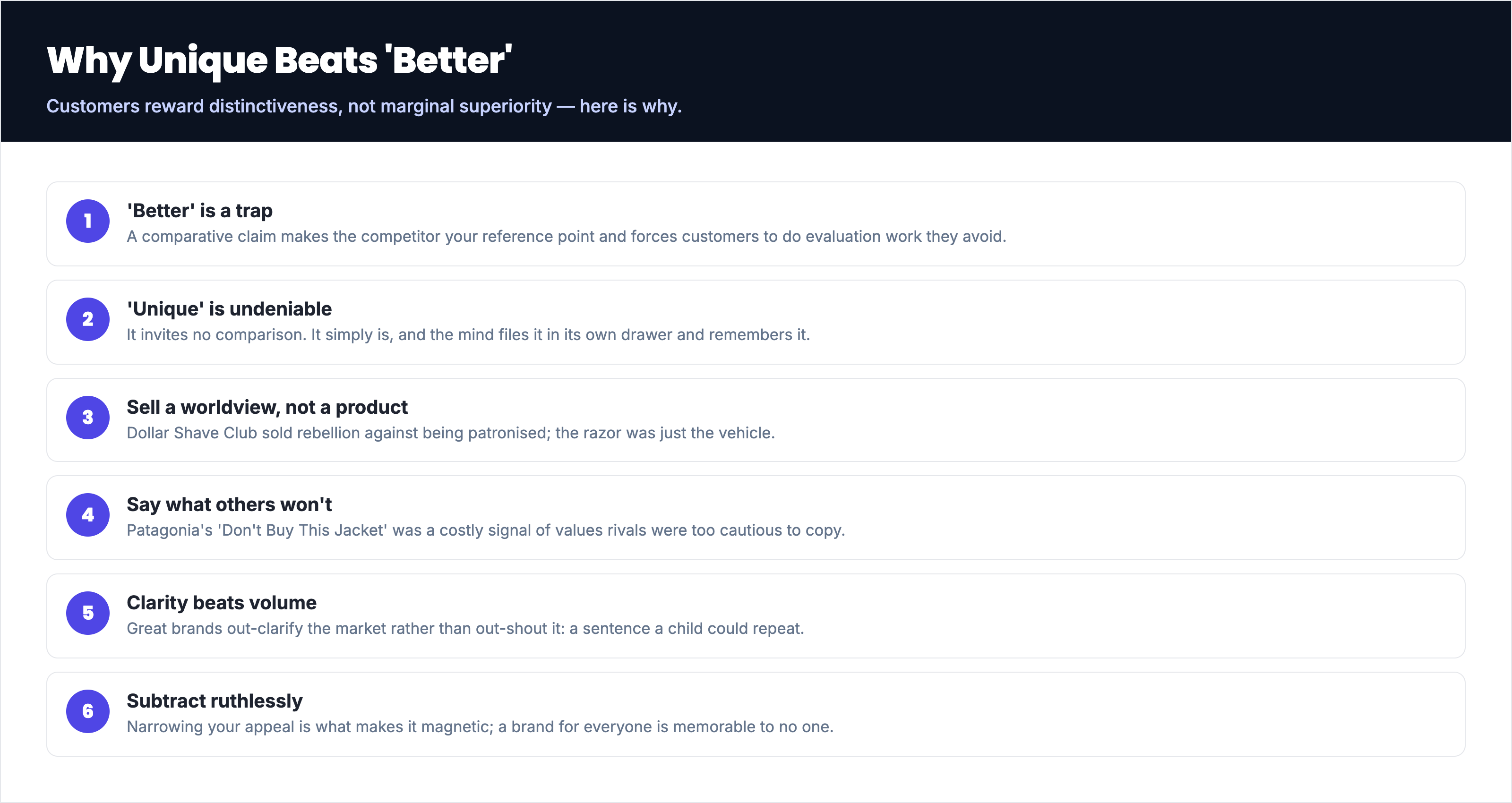
Being the best is subjective; being unique is undeniable.
Case Study One: How Dollar Shave Club Sold Rebellion (Not Razors)
In March 2012, a former improv comedian named Michael Dubin posted a 90-second video on YouTube. He stood in a warehouse, walked through aisles of cardboard boxes, swore mildly, made a joke about a forklift, and looked directly into the camera to tell viewers that their razors were too expensive and that the executives selling them were ripping them off.
The video cost roughly $4,500 to produce. Within 48 hours, it had crashed the company's servers and generated 12,000 orders. Within two years, Dollar Shave Club had a million subscribers. In 2016, Unilever acquired the business for one billion dollars in cash.
Now — and this is the part most people miss — let's be brutally honest about the product. Dollar Shave Club's razors were not better than Gillette's. They weren't worse, either; they were perfectly adequate, manufactured by Dorco in South Korea, the same factory that supplied much of the industry. On any objective performance metric — closeness of shave, blade longevity, ergonomics — Gillette would have won the comparison. Gillette had spent literal billions on R&D, lubrication strips, pivoting heads, vibration motors, and patent moats.
So how did a company with a comedy video and an adequate razor take a billion dollars off the table?
Dubin Didn't Sell Razors. He Sold a Worldview.
Read the script of that original video carefully and you'll notice something remarkable. Dubin barely talks about the razor. He talks about you. He talks about how stupid it is that you've been paying $20 for a cartridge. He talks about the absurdity of vibrating handles and flashlights on razors. He talks about how the big incumbent is treating you like an idiot — and how he, Michael Dubin, standing in this warehouse with this cheerful chaos around him, is on your side against them.
The product was a razor. The offer was rebellion against being patronised.
That distinction — product versus offer — is the heart of why uniqueness beats ‘better’. Gillette could (and did) respond by lowering prices, launching a subscription service, and even acquiring competitor Harry's. None of it mattered, because none of it addressed the emotional contract Dollar Shave Club had with its customers. You couldn't out-Gillette Dollar Shave Club, because Dollar Shave Club wasn't selling shaving. It was selling the feeling of having figured out the game.
The Strategic Anatomy of the Disruption
Let's break down what Dubin actually did, because the principles transfer to any category — from coffee to skincare to enterprise software:
- He identified an industry pretending to be more complex than it was. Razor blades are not rocket science. The incumbent had spent decades convincing customers otherwise.
- He named the villain. Not Gillette by name (initially), but ‘the system’: bloated marketing budgets, celebrity endorsements, ridiculous handle designs, all baked into the customer's price. A clear enemy is a gift to a story.
- He spoke like a human. The video used the word ‘f***ing’. It had a baby waving a machete. It treated the customer as a friend, not a market segment.
- He removed friction the incumbent couldn't. Subscription delivery solved a problem (running out, forgetting to buy, the awkward locked-cabinet drugstore experience) that Gillette's retail-dependent model literally could not solve without cannibalising its own distribution.
- He let the brand be the product. The razor was a vehicle for a feeling. Every touchpoint — the box, the email confirmation, the customer service tone — reinforced it.
If Dubin had launched with the message “our razors are 17% sharper and last 23% longer,” he would be running a small DTC brand today, if he was running anything at all. Because better would have put him in the ring with Gillette on Gillette's terms. Unique put him in a ring of his own.
Case Study Two: Patagonia and the Audacity of Saying What Others Won't
On Black Friday 2011 — the most aggressively commercial day in the Western retail calendar — Patagonia took out a full-page advertisement in The New York Times. The headline read: “Don't Buy This Jacket.”
Beneath it was a photograph of the company's bestselling R2 fleece. The copy explained, in detail, the environmental cost of producing that fleece: the litres of water consumed, the carbon emitted, the waste generated. The advertisement asked customers to consider whether they really needed it before purchasing. It even encouraged them to repair their existing jacket rather than buy a new one.
By every conventional rule of advertising — rules drilled into MBA students and refined over a century of consumer marketing — this was lunacy. You don't tell people not to buy your product. You don't draw attention to your supply chain's environmental footprint on the busiest shopping day of the year. You don't undermine your own commercial moment.
And yet, in the years that followed, Patagonia's revenue grew significantly. The company became one of the most trusted brands in any category, anywhere. When Yvon Chouinard transferred ownership of the company to a trust in 2022 to fight climate change, the business was valued at approximately $3 billion. The “Don't Buy This Jacket” campaign didn't damage Patagonia. It defined Patagonia.
The Counterintuitive Logic of Refusing to Sell
Why did it work? Because Chouinard understood something profound about the relationship between a brand and its tribe: people don't follow companies that want to sell to them; they follow companies that appear to stand for something larger than the sale.
When Patagonia said “don't buy this jacket,” it wasn't really telling customers not to buy the jacket. It was performing an act of values-based theatre — demonstrating, irrefutably and at financial risk to itself, that its mission (“we're in business to save our home planet”) was not a marketing slogan but an operating principle. The advertisement was, in effect, a costly signal. Anyone can put “sustainable” in their About page. Only a brand that genuinely meant it would tell you not to shop on Black Friday.
And costly signals are the most powerful trust-builders known to human psychology. They cut through the noise of advertising claims because they cannot be faked cheaply. Every customer who read that ad walked away with a thought no Gillette-style campaign could ever produce: this company is different. I want to be on their side.
The Uniqueness Wasn't the Jacket. It Was the Stance.
Patagonia makes excellent outdoor apparel. So does Arc'teryx. So does The North Face. So do dozens of well-funded competitors with comparable technical performance. If you laid all their flagship jackets on a table and removed the labels, most consumers couldn't tell them apart in a blind test.
And yet Patagonia has a moat none of them possess. Because Patagonia doesn't sell jackets — it sells membership in a worldview. Buying a Patagonia jacket isn't a purchase; it's a declaration. It says: I care about the planet. I value durability over disposability. I am the kind of person who would rather repair than replace. The jacket is a wearable signal of identity.
This is what every great brand eventually becomes: a uniform for a tribe. And tribes do not form around ‘better’. Tribes form around shared belief. Around a stance. Around the willingness to say something the rest of the industry won't.
The Question Every Founder Must Answer
What is your industry afraid to say? What truth is everyone in your category quietly avoiding because it's commercially inconvenient? What lie has the customer learned to expect, and what would happen if you simply told them the truth?
The fastest-growing brands of the last decade have almost all been built on the answer to that question. Allbirds said: shoes don't have to be plastic and polluting. Oatly said: dairy isn't the default. Liquid Death said: water doesn't have to be sold like wellness. Who Gives A Crap said: we'll talk about toilet paper, openly, and donate half the profits. Each of them found something the category wouldn't say, and they said it, loudly, and built a tribe around the saying.
That's the lesson buried in Patagonia's audacious advertisement. Sometimes the greatest unique selling proposition isn't a feature, a price, or a service guarantee. It's a willingness to challenge the status quo — and to say, out loud, what your competitors are too cautious, too compromised, or too cowardly to say themselves.
Sometimes a great USP is about challenging the status quo and saying what others won't.
The Emotional Logic of Choice
To understand why uniqueness beats ‘better’, we have to understand how human beings actually make purchasing decisions — not the polite economist's version, but the messy, evolutionary truth.
For roughly two hundred thousand years, our species made decisions in environments of scarcity and immediacy. We didn't compare twelve variants of berry. We learned, quickly, which berry to recognise and which to avoid — and then we ran a pattern-matching algorithm for the rest of our lives. The neural architecture that powers modern consumer choice is still that ancient pattern-matcher. It runs on shortcuts, emotional tags, and tribal cues, not on spreadsheets.
When a customer encounters your brand in a feed, on a shelf, or in a search result, they are not consciously evaluating it. They are unconsciously asking three lightning-fast questions:
- What is this? (Category recognition.)
- How does it make me feel? (Emotional tag.)
- Is it for someone like me? (Tribal identification.)
Notice what's missing from that list: is it better? That question, when it comes at all, comes later — usually as a post-hoc rationalisation of a decision that's already been made emotionally. The customer chooses with their gut, then justifies with their head.
This is why uniqueness wins. A unique brand answers all three questions at a glance. A ‘better’ brand answers none of them — it just invites comparison, which is cognitive work, which the brain avoids.
Clarity Beats Volume, Every Time
There is a common misconception that standing out requires being loud. Louder ads. Bigger campaigns. More noise, more channels, more frequency. This is the marketing equivalent of shouting in a crowded room — eventually, everyone is shouting, and no one is heard.
The brands that genuinely break through don't out-shout the market. They out-clarify it. They reduce themselves to a sentence so sharp it lodges in the customer's mind on first contact. Dollar Shave Club: a great shave for a few bucks a month. Patagonia: we're in business to save our home planet. Liquid Death: murder your thirst. Each of these is a complete brand strategy compressed into a phrase a child could repeat.
Clarity is not the absence of sophistication. It is the result of sophistication — the end product of a thousand strategic decisions about what you are, who you serve, and what you refuse to be. Most brands are murky not because their products are complex, but because the founders never did the hard work of subtraction.
The Three Disruptive Effects of True Uniqueness
When a brand achieves genuine distinction, three things happen in the market — almost mechanically:
- Word-of-mouth becomes free. Unique brands give people something to talk about. ‘Better’ brands give people nothing to say. (“You should try this razor — it's 17% sharper” is not a conversation anyone has ever had. “You should watch this Dollar Shave Club video” was viewed over 26 million times.)
- Price sensitivity collapses. When customers identify emotionally with a brand, the question stops being “is this the cheapest option?” and becomes “is this my option?” This is why Patagonia can charge $300 for a fleece that costs a fraction of that to manufacture, and why customers thank them for the privilege.
- Competitor responses become irrelevant. When Gillette responded to Dollar Shave Club by launching its own subscription service, the response failed — not because the product was worse, but because Gillette was structurally incapable of being the underdog rebel. The unique brand had captured a position the incumbent couldn't occupy without contradicting itself.
Workshop Exercise: The Refusal Sentence
The exercise: Take a clean sheet of paper. At the top, write the name of your brand (or the brand you intend to build). Beneath it, write a single sentence that completes this prompt:
“We exist because we refuse to accept that ___________.”
That blank is your stance. It's what you stand against, not just for. Dollar Shave Club refused to accept that men should be ripped off for shaving. Patagonia refuses to accept that business and the planet are in opposition. Oatly refuses to accept that dairy is the default. Liquid Death refuses to accept that water has to be sold like a wellness product.
Write the sentence. Read it aloud. If it sounds like something your competitor could also say without flinching, it's not sharp enough — rewrite it. Keep rewriting until the sentence is one your competitor would never dare to put on their homepage. That's when you've found your edge.
Why This Matters for Everything That Follows
This is the very first lesson, and we have spent thirty-five minutes on a single principle. That is deliberate. Because every subsequent lesson in this masterclass — logo design, platform selection, payment infrastructure, paid social, SEO, retention, logistics, the lot — is downstream of this one decision.
If your brand is built on uniqueness, the rest of the course becomes a series of expressions of that uniqueness. Your logo will be easier to design, because you know what it must communicate. Your copy will write itself, because you know what you stand for. Your paid social will convert better, because your message will cut through. Your retention will be higher, because customers will feel part of something. Your team will be easier to hire, because attitude-fit becomes obvious. Every decision compounds in your favour.
If, on the other hand, you skip this work — if you launch on the assumption that you'll figure out your positioning later, or that being ‘better’ will somehow be enough — then every later decision will require more spend, more effort, and more compensation for the strategic vacuum at the centre. You will be the brand that has to outspend its way to attention because it has nothing inherent to attract it.
This is what we mean by “strategy before everything.” Not strategy as a slide deck. Strategy as the deliberate, often painful act of deciding what you are — and, more importantly, what you are not.
The Discipline of Subtraction
One of the hardest things you will do as a founder is decide what your brand will not do, will not sell, will not say, will not stand for. The instinct is always to add. To broaden. To include. To leave the door open. To avoid alienating any potential customer.
But the brands that win are the ones that subtract ruthlessly. Patagonia subtracted “customers who don't care about the environment.” Dollar Shave Club subtracted “men who want premium-feeling razors with vibrating handles.” Each subtraction is a sacrifice — a deliberate forgoing of a slice of the market in exchange for a deeper, more emotionally committed relationship with the slice that remains.
This is the paradox that makes founders nervous: narrowing your appeal is what makes your appeal magnetic. A brand that tries to be for everyone ends up being memorable to no one. A brand that is unapologetically for someone — specifically, deliberately, even exclusionarily — becomes a touchstone for that someone, and gets discovered by everyone adjacent through the only marketing channel that genuinely scales: word-of-mouth from people who feel seen.
Setting Up the Next Step
In our next lesson, we'll move from the principle of uniqueness to the architecture of it. You'll learn the Distinction Equation — a formula for systematically identifying what makes your brand genuinely different from every competitor in your space — and the Six Categories of USP that the most enduring brands have used to anchor their distinction.
You'll also learn which kinds of claims aren't USPs at all, no matter how often founders mistake them for one. (Spoiler: if your big differentiator is free shipping, easy returns, or a loyalty program, you do not yet have a USP. You have a hygiene factor. We'll fix that.)
But before we get there, sit with this lesson. Don't move on until you've written your refusal sentence. Don't move on until you've identified what your industry is too cautious to say. Don't move on until you understand, in your bones, that the goal is not to be a better version of what already exists — the goal is to be a clearer, sharper, more unmistakable version of something that doesn't yet exist in quite the form you're going to give it.
Because the market doesn't reward effort. It doesn't reward intelligence. It doesn't even reward quality, most of the time. The market rewards recognition. And recognition only happens when you've made yourself impossible to confuse with anyone else.
Key Takeaway
Competition isn't your enemy. Sameness is.
Your competitors are not the threat. They are, in a strange way, your allies — they define the territory you must not occupy if you want to be seen. The real enemy is the gravitational pull of category convention: the temptation to look, sound, and behave like everyone else in your space, because that's what feels safe and that's what the playbooks recommend.
The brands that win refuse that gravity. They look at the convention and ask: what if we did the opposite? What if we told customers not to buy our jacket? What if we made a viral video swearing at our own industry? What if we sold water like an energy drink, books like a streaming service, mattresses in a box delivered overnight?
Wherever you are in your journey — pre-launch, scaling, or pivoting — ask yourself the same question every quarter: where am I being ‘better’, and where am I being unique? Wherever you find ‘better’, you've found a place where you're competing on the incumbent's terms. Wherever you find ‘unique’, you've found a place where you're winning on yours.
Enjoyed this preview? Enrol to unlock all 71 lessons + your certificate.
Training a team? Buy seats for your team →